[00:00:00] Speaker A: The truth can breakthrough
[00:00:05] Speaker B: housing. It's not just about a first time home buyer or about apartments or new construction.
For many families, the most stressful time comes is when someone can no longer safely live in their home.
And figuring out what to do and how to do that, and that moment comes fast and can be really surprising. It's the fallout from a hospital stay or a fall or memory loss or caregiver burnout.
Suddenly a family is in a position where they have to find a solution and they have to do it urgently.
And sometimes they don't have the finances to do that with.
[00:00:48] Speaker C: No, everything is expensive now.
[00:00:51] Speaker A: Right.
[00:00:52] Speaker C: But I'm, I'm excited about this conversation today because it's another one of our buckets that we talked about way back in the beginning on talking about seniors and people with disabilities and legislative and finance and all of our good buckets that we have.
We're going to talk about seniors today and. But the conversation is going to obviously touch on more than one bucket because again, we don't sit just in one, one bucket cleanly.
And when we're talking about the housing conversation for seniors as well, that affects other folks who, if we have seniors that are aging in place in say their old family home and none of the kids are at home and they're still sitting in that house when maybe they could downsize or they could go to an independent living or, you know, another situation that would be better for their current circumstances.
[00:01:40] Speaker A: Right.
[00:01:40] Speaker C: And will help the larger housing market in a given area as well.
So I'm really interested in hearing about all of that. There's healthcare considerations, obviously you mentioned finances are a huge consideration.
[00:01:55] Speaker B: There's also that personal responsibility of their children.
[00:01:58] Speaker A: Right.
[00:01:59] Speaker B: And that sandwich generation.
[00:02:01] Speaker C: Yeah, yeah, we know that. Well, in my household and mine.
[00:02:04] Speaker B: Yeah.
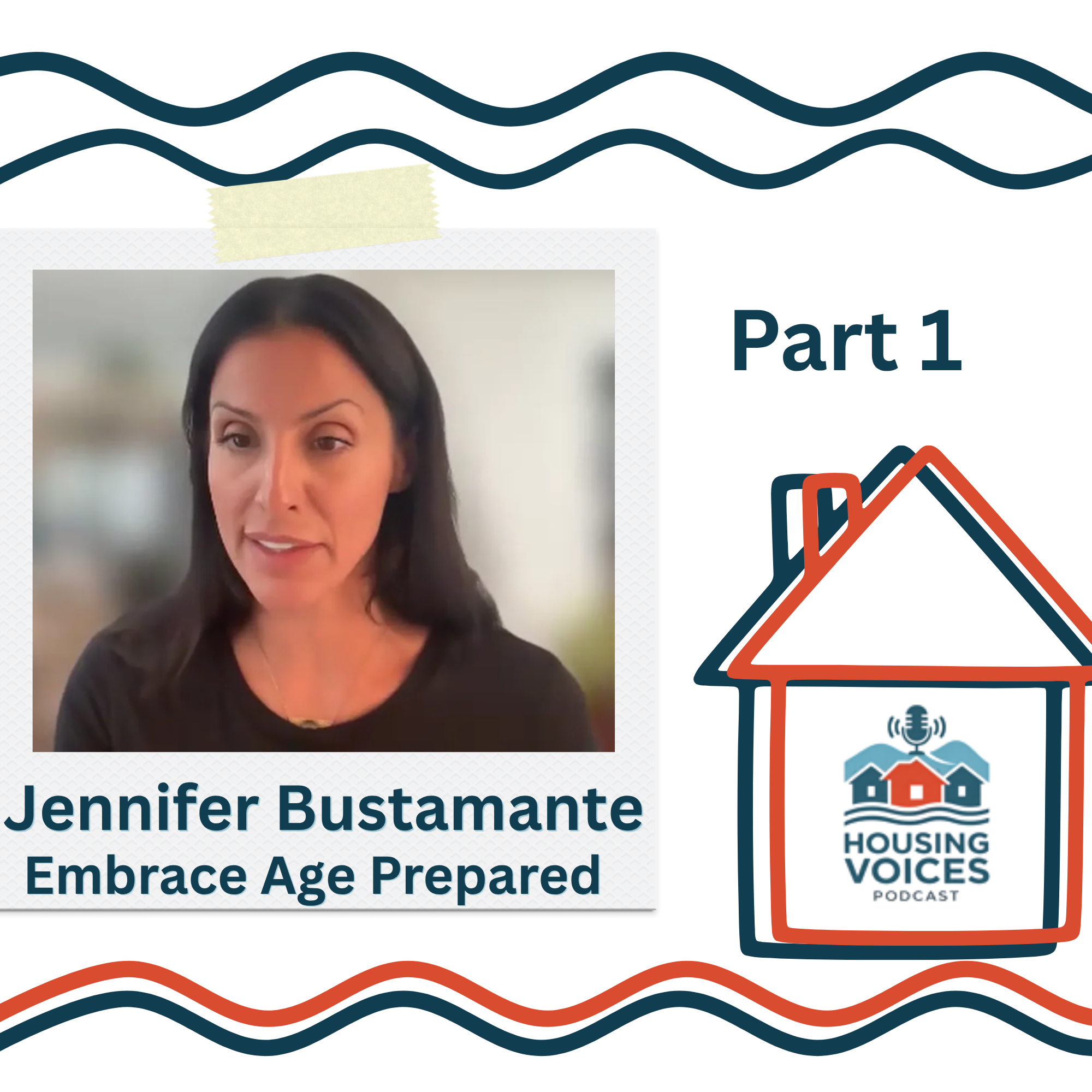
[00:02:05] Speaker C: So I'm very excited to talk today with Jennifer Bustamante or Jen.
She is a CEO of Embrace Age Prepared, which is helping seniors navigate that situation of, you know, I need to find different housing or helping with their situations. And I'm, I'm interested to see exactly what that means.
[00:02:26] Speaker A: Really.
[00:02:27] Speaker B: I'm interested in seeing how she ties those resources together in order to help solve these complex emotional and tends to be very sudden changes that must happen because I don't think that everybody plans for the of us.
[00:02:43] Speaker C: No, absolutely not.
[00:02:45] Speaker A: But let's get into it. All right?
[00:02:47] Speaker B: This is Housing Voices.
[00:02:48] Speaker A: Let's unlock housing from the porches and shelters, streets and the room.
[00:02:57] Speaker C: If the house have voices, the truth could break through.
[00:03:06] Speaker B: Well, welcome to the podcast to Housing Voices. Jen, we're so happy to have you.
[00:03:11] Speaker A: Thank you, thank you for the invitation and I'm excited to be here.
[00:03:16] Speaker B: Share with us a little bit about what you do in your story.
[00:03:21] Speaker A: Yeah. Well, I'll start off with my name. My name is Jennifer Bustamante and I'm the founder and CEO of Embrace Age Prepared.
For more than three decades I have worked in the aging industry supporting seniors, their family, healthc care professionals, care providers and I have helped navigate all the treacherous waters when it becomes aging related.
Out of 17 of those 33 years, I scaled multiple adult foster care homes in Oregon and have had the privilege of fully helping families navigate the aging and aging complexities. That's a key word, aging and aging complexities, dementia, disease processes, long term care, housing discharges, rehabs, and just really prepping theirselves for the Medicaid conversation. Because most people are not going to live a capitalist life with cash. And I say that a lot. So there is preparation in that and there is a, a, there is a rhyme and a reason to that preparation. We can talk more about that if it's necessary.
But today I am the CEO of Embrace Age Repaired and that is my current company. I no longer have the adult foster cares. So we are a full service advocacy, transitional liaison and placement support and we take care of anybody and everybody. Whether easy or super complex. There's probably not a person that we cannot support.
Some of our services are free and that's the placement and all the guidance that comes with that. But for advocacy and transitional support that does come at a cost and everybody's situation is super different and unique. So it depends on what it is that you're needing and the amount of time that you need us. But we do work with families for about anywhere from 30, 60 to 90 day stretch, so.
[00:05:27] Speaker B: And how many people are working at the company with you or for you?
[00:05:32] Speaker A: Yeah, so we have nine senior advisors, we have three transitional support liaisons and we have two advocates in our team. So we cover all of Oregon, Washington and we're working our way into Arizona.
[00:05:52] Speaker C: Nice.
That's amazing.
[00:05:55] Speaker B: That is.
[00:05:55] Speaker C: And how, how did you come to realize that this was something that was needed?
[00:06:03] Speaker A: You know, having the 33 years of experience. I started at 15 and I'm 47.
And so being able to evolve into the long term care industry and see all the pitfalls that are happening and especially on this side where I tell this to everybod, for as long as you have breath in your lungs, you're going to be aging and you need to Have a plan.
And I say that plan starts when you think about it. And hopefully you think about it real soon before the 911 in at the ER.
So I have seen in my ownership of 17 years in the adult foster care home world, which is quite amazing. I learned a ton working with families. And what I saw was on that side of things, most of the time is families are not prepared. It's a 91 1.
Mom or dad has fallen, mom or dad is in the rehab or the hospital, Somebody's had a, somebody had a stroke. Nobody planned for it.
We don't plan for those complexities in our aging journey.
And so on the side of ownership, I was helping people put the pieces together and connect to senior real estate specialists, connect to elder law attorneys, connect to movers and downsizers and estate planners. You name was, I would say, very hard to navigate at that point. When you're emotionally involved and you're completely inundated, don't know who you know like and trust, where do we go? This information is really not even out there for the world to understand. And you don't really know that you need it until you need it, and that's when it becomes a problem. So I saw the gaps in the aging industry, especially in this, in this area.
And you guys, I've had a lot of experience with senior advisors, and it's a lot of the times, kind of like a lead generator, they're not really guiding families. Families need more than placement. We need a whole life service.
We need to look at every area, finances, assets, Medicaid, potentially. You know, where do what. What happens if I run out of money? That's a big one. What happens if I run out of. Where do I go?
Did I choose the right place?
Who's my executor? Who makes decisions on my behalf if I can't make them?
[00:08:43] Speaker C: So many questions.
[00:08:45] Speaker A: Huge. Yeah, huge.
[00:08:48] Speaker B: Yeah. You know, personally, we're dealing with this in our family. Right. And it, it does raise a lot of questions. It also raises a lot of emotions within families.
And yeah, it's a process. Right. Because sometimes you have people like my mom who are 91 and super independent and, you know, want to live alone forever and ever, right?
[00:09:12] Speaker A: Yes, yes.
[00:09:14] Speaker B: Cognitively, they're, you know, really doing great. And then an incident happens and people refuse to, to move from their home. Right. Because they never think that they're going to be that person that needs it. Because you live on the side of hope. Right.
And we all want to live on the side of hope. Where Things are going to be okay, right? That's not going to happen to me. That's somebody else's problem.
[00:09:40] Speaker A: Exactly. I hear that a lot. And, you know, I can just use my dad as the example is he said it just happened overnight. He was old.
My dad did not see himself as old until it happened.
And, you know, one day came which was, you know, dad started falling out of nowhere, his gate was off, and that started the decline.
But it happened overnight. So, you know, nobody views themselves as old. And I don't. I personally do not talk to my. My elders, my son smarter than me, friends as old, you know, and I feel like it's. No, we're all, we're all living life and we all have choices and I think choices are very gorgeous. It's an amazing, amazing right to have is choices and that's what we provide. And I think it's scary to people because when you get older, the number one reason why people feel so, I would say, restrained in wanting to ask for help is the fact that their choice is going to go away and that it's shameful to age and have trouble.
Yesterday you could go check the mail like my dad, and then the next day he's falling and he can't really check the mail anymore. Overnight.
Hard.
Yeah. It's removing that barrier. It's okay to have conversation. It's okay. You're aging and you need some power partners. I always tell them, you don't really need a, you know, physical full support. You just need a power partner. We'll navigate this together.
[00:11:32] Speaker C: I like that. That's cool. It's a lot of times and one of my first jobs was as a home care aide in an assisted living facility.
Memory care.
They specialized in memory care.
And it was so hard to see families come in and having to navigate the process, right. They come in and there is a huge stack of papers that is thrown on, on the desk in front of you and. Okay, let's figure it out. How much money does your family member have? What, what assets do you have? Going through it in a very.
Is kind of cold, honestly, because like those people that do that as a, as a job for these nursing home and assisted livings, like, no knock to them. It's their job and they're doing what they need to do for their, you know, their stuff. But it's a very vulnerable time for families. You know, everything is changing. Their whole world is essentially flipped upside down and now their life is being turned into this kind of itemized asset list where what do you have? Because it was not cheap. It was astronomically expensive compared to what I had expected as somebody who was working in it.
I had no idea how truly expensive it was for those people who were living there and their families to foot the bill as well, too.
[00:12:56] Speaker A: Absolutely. Yeah. No, you're so correct. You hit the nail on the head.
It is. And that at that point, it does feel very cold, and it is very scary, and it's very confusing. What am I signing? What are we doing? I don't know if I don't. I don't have all those answers. I'm not sure. Mom and dad didn't have these conversations with us because we don't talk about finances. That's very it.
And so that's still going on. But those.
Those are the baby boomers. That's our tsunami that's coming. And actually it's really here today, and we'll go over all of that. But, you know, we don't have these conversations. So when something changes, and I say something acutely changes or emergently changes, kids are coming in to help mom and dad or dad or mom, whoever it is, grandma, grandpa, and making all these decisions, and that feels very embarrassing. And you want to put the brakes on really fast and rightfully so, to a point. Right.
But I get it. It's having these conversations ahead of time, which I do sit with a lot of families in preparation, which I'm like, God bless you guys. This is amazing that we're having this talk, and then most of the time it's a 91 1.
[00:14:16] Speaker C: How do people know to reach out to you? Because I, like, I used to work in the industry, and I had no idea that, you know, you've been in this business for. For decades. And I had never even heard of this outside of maybe like a case manager role. Right.
And so how does a family know, oh, I can call Jen. Or if there are other folks in your industry who do similar, if they're in different parts of the. The nation or something. Like, how do you know? Like, oh, okay, I need to call somebody to help me through this. When you don't even know what you're facing.
[00:14:51] Speaker A: Yeah. And I think every. It's. It's case by case. I. Every situation is so different. So I kind of rule of thumb is, you know, if you're at 65, and that sounds young.
It is young, 65. But I tell people, you want to start having this conversation and you want to start planning for your aging journey because you want to have choice where you Go and, and, and how things happen and who's in charge if this happens.
My mom personally had a stroke at 68. We didn't plan for that, and mom and dad wasn't ready for that. Even though we had lots of conversations, it's still, like you said, that's not going to happen to me. I'm young and I don't need help. We're independent and we keep our life private.
So how people find me or know that they need us is as you're aging and complexities start happening, you start, you know, maybe minor things, forgetting. You see, you're viewing mom, you're. I'm. So let me go back up real quick.
My target market of people that I'm really speaking to about 95 to 98% of the time are kids of parents or grandparents. I'm talking to the 35 and 70 year old.
Those are the people I'm talking to.
And I, we are sharing the message. As you see your family aging, you want to start having these conversations about where everything is, what they have, how to plan if the just in case. And I think that is really the key is we're just planning for the just in case, hoping that nothing happens. And you age out beautifully to 95, you know, or 90, if that's what you want. I have a lot of people that have an, an age in mind. I want to hit 90 or I want to hit 100. You know, I, I hear that a lot. But it's planning, you know, as you age, we need to know where everything is because typically nobody knows anything and we're cleaning up the mess as we go. I mean, I have a, a few clients that I'm working with that are very complex and we're working in reverse so we can flip it around and move forward, which beautifully. It's happening very well.
And I'm just really thankful and honored to be there to support them.
But we are marketing as much as we can.
[00:17:24] Speaker B: You guys, can you go through and explain the process if people were to come in, in your ideal Magic wand world, what does that look like?
And. And then on the other side, when it goes in reverse.
[00:17:40] Speaker A: Yeah, yeah.
[00:17:41] Speaker B: With the Magic wand, you know, what would that ideally look like for you?
[00:17:45] Speaker A: Magic wand, which is 2 percenter, which I had the honor of helping a client recently. She's wonderful. She's coming from another state, wanting to relocate into Oregon, and she is 72.
She called me because she found my blog about Bend and thought, man, I would love to relocate to Bend. So she Gave me a call and she says, hey, I'm really not old, but I want to start planning. And it sounds like I need to have a plan in place. And I said, absolutely. So we began the conversation and I gather the story. That's what we all do. Your story matters for so many reasons.
And she told me her story.
She and I love to. I want a perfect world. I want to know what are all the things that you need, want, love, can't live without. Those are the non negotiables. We need to know those things.
And then I need to know the area where you want to be. I want to know how far out can we bust that boundary if. If we didn't find the perfect place in the area that you want.
And then from there we talk about finances, we actually talk about liquidation.
And I pair people up with the right power partner, that's what we call them, power partners on your team. Because it's not just us. There are a multitude of people that play a piece in this because we don't touch everything, but we have experts that will cover everything.
So it was, you know, needing to downsize, move and relocate, sell a home, find a new location here in Oregon. And from there, you know, she has, I would say a cap on her cash and it's $300,000. That's the cap. So then we need to plan and put a plan in place for that Medicaid spend down. Medicaid spend down. And you'll hear that a lot if you work with us and hear from us. Medicaid spend down. Nobody understands it, nor do they know it, but you need to know it. And this is a big one, that if you do not have endless bank accounts, we have to talk about that Medicaid spend down and making sure that we get you into the right place now potentially. So that way we have time to spend down because most communities are requiring nowadays.
Here's a keynote.
Two to three years of cash before you can go on to Medicaid and continue your living situation with them.
[00:20:23] Speaker C: And that's give me. I know there is a lot of variation in the costs associated, but can you give me an idea of what that looks like?
[00:20:36] Speaker A: Yeah, I can give you an average. So right now in independent living, you're looking at a base. And this is independent, no care, no nothing. It is a condo style, apartment style home, but you have the access to emergency personnel, you have access to oversight if needed. If something happens, you get meals that are involved, you get activities, socialization, and you get a wonderful Home to stay in that on average right now is $4800. Starting.
Starting depending on where you live. And then from there you're going into assisted living.
Assisted living, on average, depending on the level of care that you need, which most places are using a point system, so they add up quickly. Yeah, you're looking at an average.
You walk in the door, your condo or your apartment costs about 6,500.
[00:21:37] Speaker C: Oh my God.
[00:21:37] Speaker A: And then you work your way up. And I'll just as an example, my last two placements, my two clients, one came in at 10:5 in an assisted living and the other one was 9300.
[00:21:54] Speaker C: Holy cannoli.
[00:21:56] Speaker A: Yeah.
[00:21:56] Speaker C: So that will burn through some cash very quickly.
[00:22:01] Speaker A: Yes.
So here's an example. And this is why I say if you have 300 or less thousand dollars, we need to have a conversation. Regardless of your physical needs today, we need to have a conversation because a plan needs to be put in place.
So I had a client that had 282,000 and he was like, oh, I'm great, I'm good. I'm five, I'm still riding my bike. I'm great. I'm going to spend my money down at home, live here as long as possible to keep my independence so that way I can enjoy my life and then get onto Medicaid and no whole can of worms for a conversation. And I said, you know, I'll just use the name Joe. You know, Joe, we need to have a conversation. And I'll tell you why.
You have 282 left and you're living, you know, every day you're gonna, your, your, this goes towards your everyday life and your, and your apartment that he lives in because that's all he had. He had no other assets.
So there wasn't a cell coming. There's no money market accounts, there's no purse or pension.
So. Wow. Oh my gosh.
[00:23:17] Speaker C: So would you say, would you say then you need to go into an assisted living situation or however independent living earlier than you feel that you need to, because you need to have that money to put on the table for that facility to say, this is what I have, let me in. Essentially.
[00:23:38] Speaker A: Yeah, it's true. And here's the thing. And I, I, I share with families and encourage your independent living.
Condo. I love to use a condo because it feels, for lack of a better word, feels sexier. I mean, to be honest, it feels greater. You know, it's not an apartment and it's not another mortgage. Even though it feels like another mortgage.
But it's security.
And I tell people if you're spending the money down, you have 282 left. If you're spending that down to Medicaid, it's okay.
Don't worry. Because you're going to save your place where you're at. You're just securing the location that you want to be at. This is a place that you chose and that you could go to sleep at night feeling good about your decision when you have a zero dollars. And this is the crisis right now across America, especially in the east coast. But here on the west coast, you guys, it's amazing how disconnected we are and how strenuous. Like how strained I'll say else how strained our Medicaid program is.
It doesn't keep the lights on. It doesn't pay the facilities well.
No, because still operating under them, those old rules back in 1977.
And our, our Americans are not, not getting the benefit. And that's the truth. We're not getting the benefit. You actually are left with no choice and you will actually be left zero choice. It took me eight months to find a place for my mother.
Eight months.
[00:25:19] Speaker B: Incredible.
[00:25:19] Speaker C: And as somebody who worked in Medicaid mostly facilities for some of the training that I did for the caregiving, they are not a lot of times nice places. And I don't want to be pejorative for the folks that work there that are doing their best and are working hard under really just tough situations like myself. When I was a caregiver, I had sometimes 35 people to take care of in a single shift that were, that could not take care of themselves. Right. For, for whatever their needs. They needed full time assistance for all of the activities of daily living. And in a lot of the Medicaid places that I did a lot of my trainings and the clinicals that I needed to do, it was far less than what people deserved in terms of staff, in terms of patients. The whole situation, it's not good. And a lot of these places, people do not last as live as long as they that they want to because of the conditions in those facilities.
And that's when I start really getting worried when we talk about okay then we're going to rely on Medicaid after you spend through all of your money.
[00:26:36] Speaker A: Yeah.
[00:26:36] Speaker C: That is not the safety net that you think it is.
[00:26:39] Speaker A: Correct. But doesn't that sound right? Of course I want to keep my independence and of course I want to stay. Of course. Of course it sounds right. Yeah. Yeah. But it's not safe because you will be left with no choice. And that is the fact I face. I see this every single day of the week. I'm talking to people. And what makes this conversation so personal for me is that I study these issues.
I am a part of them every single day. I get lots of phone calls for Medicaid and I put them on a list and as soon as I get a Medicaid direct, it's a Medicaid placement. A direct Medicaid placement. Excuse me, phone call.
I am calling these people back because I'm doing my best to help people land in a okay place. And that's not me talking bad about some of these places, but it's just a reality. It is. If you had money in your pocket, you wouldn't choose that. That's the truth.
So. Yeah.
[00:27:44] Speaker C: Oh, I'm sorry. I've been totally hogging this. I'm so sorry.
[00:27:47] Speaker B: It's okay, honey.
But now you just took me off my question. That was so funny. No, so it's interesting. I was talking the other day with some clients, right. And they were determining whether or not to sell and move into an assisted living place or sell and buy something that was more, you know, aging in place. Right. And we were kind of going over the options, right. And the location and what is close and where are their children and all of these things. But the interesting thing that, you know, we discussed was the fact that the facilities that they were talking to actually required five to six years worth of money in the bank.
[00:28:30] Speaker A: Wow.
Ooh. Was this a continued care community?
[00:28:36] Speaker B: Yes.
[00:28:37] Speaker A: Yeah. And that, those are, those are going to be a thing of the past. I think pretty soon. I think they'll be working themselves out over the next five years.
It's a very competitive world right now. We they that that model just doesn't work anymore. People are steering away from that.
A lot of these communities are asking for a million dollar buy in. Sometimes.
Buy in.
[00:29:08] Speaker B: You know, they were, they were just talking to me about one here locally where it's a five hundred thousand dollar buy in plus monthly expenses in the first month. You know, the condo.
[00:29:19] Speaker A: Hi.
[00:29:20] Speaker C: Oh my gosh.
[00:29:21] Speaker B: Just starting at five grand a month plus food. I mean it was, I was just blow me over with the feather.
[00:29:28] Speaker C: Who even has, like this is my concern here. As a young, like as a younger person, I just turned 30.
There is a lot, there's, there is a lot of assumptions that I think people are making sometimes that oh, there is going to be an inheritance, right. Or you know, there's going to be Money left over. And as, as we are having these conversations, I don't think that money is coming. They're going to burn through all of the money for the care that they need, right? And it's, and I'm not saying that, you know, I feel that that is owed to me or somebody else feels like, oh, that money is mine. No, the parents can use it for what they need, obviously. But in terms of a generational wealth transfer, I'm not very hopeful for it. I think a lot of the money is going to be eaten up in, into the care industry, which like it needs. But When I hear $500,000 to get in, $1 million, I don't know anybody outside of boomer generation that has that money at all.
[00:30:33] Speaker A: It's burning. Yeah, go ahead.
[00:30:36] Speaker B: Because I can remember and this was 20, 30 years ago, right? My aunt who, they had the funds, right? But they used Medicaid to get into a place and to pay for it and all of this and the properties that they had transferred nicely to their children, right? And that generational wealth stayed within that side of the family, right? And I'm sitting here thinking, oh, so they use the system, right, the older boomers and, and before in order to support every, every part of their life. Whereas now, now we, we don't have those kinds of fallbacks.
[00:31:15] Speaker A: We don't. And today, you guys may or may not know this Medicaid does a five year look back.
Something very important that people need to know in the world is Medicaid is a federal program.
They have the right to do a five year look back.
So, you know, like my parents, my dad was an executor of his mother and father's estate. He moved money around, he had money cross through his fingers. He is from a generation that we pulled cash out to pay for gas, pulled cash for coffee, cash for food, cash for yard maintenance, whatever it was, didn't use a debit card very often. He wrote checks far and few between, but that would be the form of payment, would be a check. So when we did a, we had to do a five year look back for mom to get onto Medicaid.
A lot of money slipped through my debt, their accounts we could not prove about $18,000 of that money.
So we had to come up with that money to satisfy the bill so my mom could get into Medicaid.
So I tell fans this is why 65 at the very least, making sure that you have an irrevocable trust, a will is a wish, even the way your trust is Set up. Got to be careful. Your trust needs to be updated every, I say, every two years. It was every three to five, but it is every two years or sooner as you're aging. It should be a yearly thing. People don't realize that you have to make sure that all of your finances if you want to do that wealth transfer. You're right. I hear this a lot.
Talking to somebody yesterday, she said, I wanted to give my kids money. And I wanted to, I wanted to will some homes over. And I said, so is this set up in an irrevocable trust? She says, no, I have a will. I have it all written out, but it's written out really well. I said, when's the last time that you had written that out with a lawyer looking at it? She goes, oh, honey, it's, it's been about 20, 30, maybe even 30 years ago. And I said, oh, oh, okay. Super heart. I mean, you know, and it's, it's such a hard, hard truth to chew on. And I, I get you want to go on to Medicaid, but you can't. You don't qualify, first of all. Secondly, you have homes to sell. You have to sell the homes. Then you need to use this money unless somebody is living in it. You just, you start freeing things up. So there's a, there's a pathway to that that's long and drawn out. But we need to use up what's in your account. Then you need to use up, use up your assets. We need to set something for sale so it can go towards your care. You have to spend all your money down to $2800.
You cannot have any more than that in your account.
[00:34:13] Speaker C: 2800 is peanuts nowadays.
[00:34:17] Speaker A: Yeah. For you to qualify so that five year look back is a shock to everybody I talk to. I think it's never not a shock. It always is. What do you mean by that? So are they going to look at all of my accounts? Every one of them with your name on it? Are they going to be able to see all my assets? Anything with your name and your Social Security number on it?
Yes.
[00:34:38] Speaker B: So how does the irrevocable truck trust help?
[00:34:43] Speaker A: It helps. You know, you set up executors, you set up representatives within the, the trust. And so I'll just preface this with, I'm not a lawyer. I've only worked with law teams and people that have gone through it. But you can set it up in a way where you appoint your assets and your money in the direction that you want it to go. And you're allowed in Oregon to gift up to a million dollars.
So if everything is set up appropriately and you want to transfer that generational wealth, you really can. With an irrevocable trust, you can.
So I always teach on a will is a wish. Let's not get a will. It's not helpful.
And you want to make sure all your paperwork, you know, such as your Oregon, you know, your advanced directives, your last will and testament, because that supersedes your death. So somebody can stand in proctor of you so that it doesn't have to go to probate. Probate is such a nasty word. It takes forever. It's long and drawn out, and sometimes people lose because things were not written. It isn't written. It didn't happen.
Yeah.
[00:35:58] Speaker C: And we talked a little bit about some of, some of the things. But in your career, what are some of the changes in terms of aging in the beginning of your career kind of 30 years ago versus now?
What are the big differences? Because I know we've talked about a couple, but it doesn't seem like, as somebody who has worked in it and a younger person, it doesn't seem like this is a sustainable model for folks aging in this country. And I feel like it can't have always have been this way.
[00:36:32] Speaker A: Yeah, I, I would say, you know, the generation that I cared for before, this boomer generation. Right. We've got the. What's called the Silver Tsunami. It's here.
It's here now. And I will say by 2030, and this is anecdote, anecdotally speaking, I mean, you can look up the numbers.
Every baby boomer in America will be 65 plus.
And that's. That is.
That is a lot of people.
[00:37:04] Speaker C: That's a lot of 65 plus.
[00:37:06] Speaker A: There is between the years of 1946 and 1964, a lot of people are coming. And so by 2030, that will be 71 million Americans over the age of 65 and over 20% of the population.
That's a lot of people.
[00:37:29] Speaker C: And that spells trouble for a lot
[00:37:31] Speaker A: of our programs on every level. So then it's not just a housing problem. Correct. It's a health care problem. It's a workforce problem. It's a Medicaid problem. It's a family, you guys. It's a. It's a huge problem that's coming. I don't feel like Oregon again, even though we're the leaders in healthcare, I don't feel like Oregon is still put together. But I do think that we are one of A handful of states that have a decent pulse, but we're still not ready.
So you asked the question what are the differences? Right. Or what are the changes?
I would say that first and foremost your statement about that wealth transfer that used to happen and that wealth did go and, and, and get handed down to the younger generations and that was the, that was the American dream. Right.
We work our butts off, we work really hard, we save every penny, we are very frugal and then we want to give something away to our kids.
That's not happening as much now.
That's a huge change. And why? Because people didn't. Most people do not have long term care insurance, which that's a great offset.
Not everybody has tons of assets or businesses or pers or pension.
So they're living off of their one home. Their home. Sell like one of my clients. Currently they are going to sell their home and that's what they have. And we're gauging about 600,000 which that's not bad numbers.
But this person isn't that they're not, they're in their 70s. Right.
[00:39:20] Speaker C: Well and then if they have any children.
Right.
[00:39:24] Speaker A: The.
[00:39:25] Speaker C: As we've talked about on this podcast before, a home purchase is one of, if not the biggest transaction of a person's life. And that is the main way our economy is really predicated on generational wealth and how much money that we can make. And if you have one big transaction in your life which is your home and that is now being sucked up wholly and completely by your end of life care and your, and your aging care, then who's, then what's left for your family? Where we're having an extremely compressed housing market in some parts of the nation and housing costs are through the roof.
That then sets, you know, the ripple effect, it just cascades down that not just. It's a terrible situation for the people that are aging themselves, but everybody else and all of the people in those industries in the periphery.
[00:40:23] Speaker A: Yeah, no, correct.
And you know, the other thing I'm just thinking too that the difference between, you know, I would say in the span of my 33 years, people are more sick at younger ages now. So.
[00:40:36] Speaker B: Really?
[00:40:37] Speaker C: That's interesting. Yeah.
[00:40:38] Speaker A: They are. Oh yeah.
[00:40:40] Speaker B: Putting all the contaminants in our food and the poisons and our crops.
[00:40:44] Speaker A: Thank you.
[00:40:45] Speaker B: Fillers and everything. Right. So that we're poisoning our bodies. Right. Everything from microplastics and yeah. Pesticides and oh my goodness, those in our parents generation. Right. That's why, you know, they're 91, you
[00:41:00] Speaker A: know, not, not as much. And I will say there's a difference between my city folks to my country folk.
My country folks who are aging out are aging much more better and they're aging into their 90s and they're passing away and it sounds maybe a little bit morbid but they're passing away more beautifully versus my city folks who are much more sick, who are living on a smaller budget. They don't have the land and the houses and the businesses to sell off to age comfortably. They have less and they lived less.
And so they're, they're aging harder and they are more sick.
So I would say the, the biggest difference is the increase in all types of dementias. More now today than ever.
More so strokes, more heart failure. Oh my goodness, heart failure is huge.
We have really, really, really sick people. Als, Parkinson's is huge.
That is what I see a lot of. And stroke. So als, Parkinson's and strokes are prevalent
[00:42:14] Speaker C: and it's, it's, that is really disheartening to hear especially as somebody who has a lot of aging to do that' that I'm looking forward to that. Yahoo.
[00:42:27] Speaker A: Please.
[00:42:28] Speaker B: We just hope the alternative housing solutions. Let's try to, you know, turn this a little bit.
[00:42:35] Speaker C: Let's not be so doomer.
[00:42:37] Speaker A: Yeah, exactly. So you know, I, I look at this alternative housing. So we've got our independent, we've got our community style which that serves the purpose for a certain amount of time in life and for certain people. It's not for everybody and, and not every place is the same.
But the alternative housing is adult foster homes. And I will tell you guys, in the last three years we've had a huge increase of many people flooding from the east coast over to Oregon and Washington and California to open up these long term care homes because A, in Oregon it is easier to open up a home and you need one year, two year, three years of experience in the industry and you have to have a certain amount of money in your pocket. You have to have, you just have to go through class time and you can open a home.
They don't vet them as well as they should but it is a great alternative housing option and I would say they span cost wise between 7,000 to 16,000 on average depending on your level of care.
It's still expensive and sometimes seems to
[00:43:55] Speaker B: me our earlier numbers were just for independent living was 4800 base and for assisted living was 6500. But you're saying foster, it's more expensive.
[00:44:09] Speaker A: Yeah, yeah.
[00:44:11] Speaker C: Solutions Meet A special thanks to our partners Marty Bulford.com and Signet.net for supporting thoughtful dialogue around housing in our communities.
Music for Housing Voices is provided by Karen DeWolfe and Adrienne Kriz. Thank you for helping us set the tone.
You can find
[email protected] and connect with us under Housing Voices on Instagram, Facebook, LinkedIn, Bluesky, TikTok, and our YouTube channel.
If you found value in today's conversation, share this episode, follow the show and help us expand the dialogue.
Until next time, this is Bri. Let's keep listening, keep learning, and keep building practical housing solutions together.