[00:00:00] Speaker A: The truth can break through.
[00:00:06] Speaker B: Housing. It isn't just a headline. It's pressured complexity. It is the most critical human issue underneath many of our problems today.
Schools, employers, seniors, mental health, workforce.
[00:00:21] Speaker A: Yeah, a lot of folks. And today's topic covers a couple of our buckets, but most notably is our disability bucket. We're going to talk talk with a couple individuals who support and advocate for people with intellectual and developmental disabilities, or idd.
And really they work with folks to do so many different things. But obviously I'm really excited to talk with them about the complexity that is housing folks with intellectual and developmental disabilities and the roadblocks. And also I think the uniqueness and the unique perspective that they bring to this issue.
[00:01:01] Speaker B: It's going to be cool to see how they case manage differently than housing case management happens for people without intellectual disabilities.
[00:01:12] Speaker A: Yeah. And I also think that this is a really good opportunity to talk about all of the different layers in the housing conversation that even I had no idea about before talking to even you.
[00:01:27] Speaker C: Yeah, yeah.
[00:01:27] Speaker A: Truly. I mean, this is such a multifaceted issue and I'm going to elbow you for that there.
[00:01:34] Speaker B: You're welcome.
[00:01:35] Speaker A: Yeah, I'm really excited to talk to these folks and and hear about this.
[00:01:39] Speaker B: This is Housing Voices from the poes
[00:01:43] Speaker A: and shelters, streets and the room.
If the house have voices, the truth could break through.
Hi. So we are back at Housing Voices.
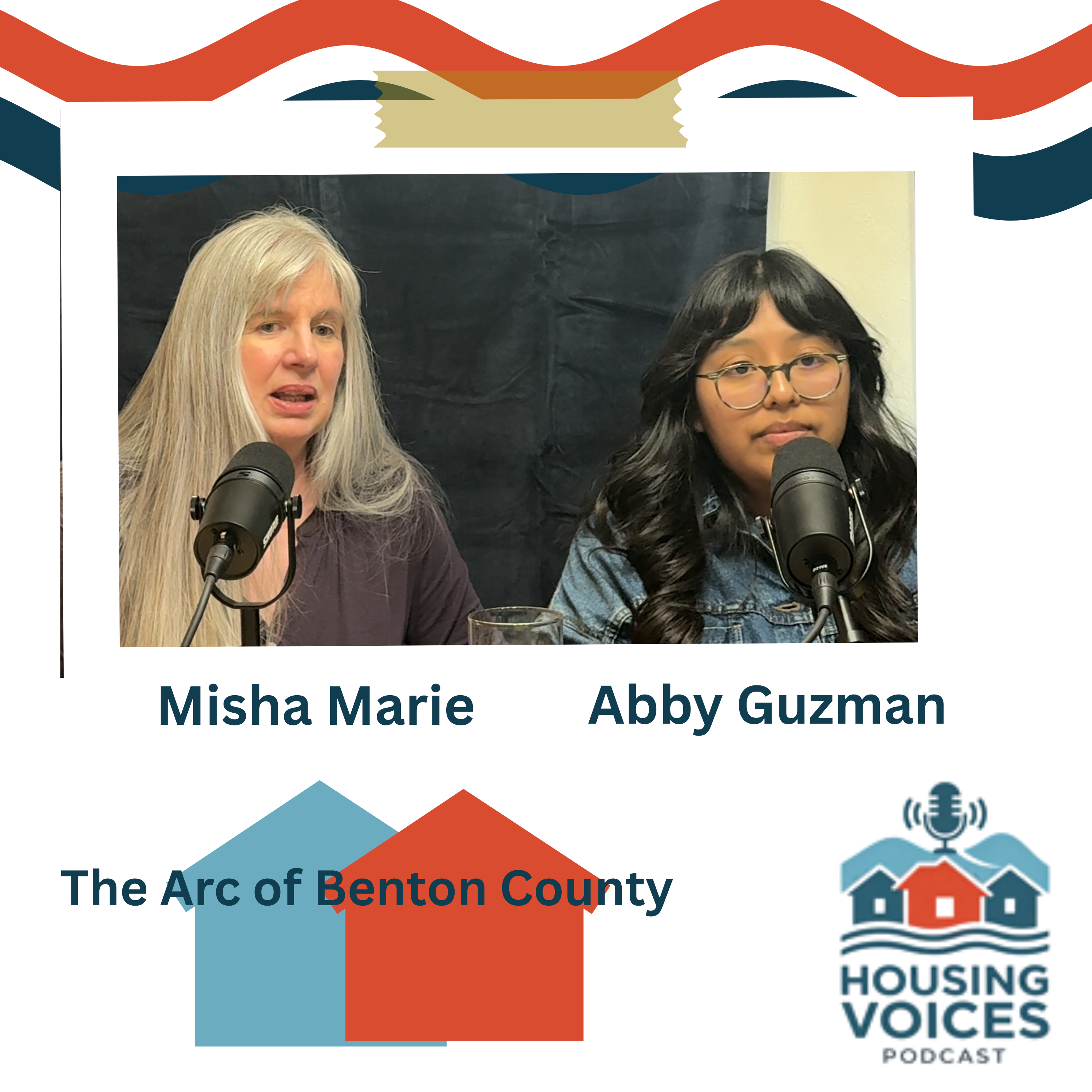
I am here. Or not just I. We are here with Misha Marie and Abby Guzman, who are director and assistant Director of programs at the ARC of Benton County. Thank you for joining us.
[00:02:17] Speaker D: It's great to be here.
[00:02:18] Speaker E: Thanks for having us.
[00:02:19] Speaker D: Thanks for having us.
[00:02:20] Speaker A: So can you first off talk a little bit about what it is, the work. What is the work that you do here in Benton County?
[00:02:28] Speaker D: Sure. Shall I get started? You want to go for it? Okay.
So the ARC of Benton county serves people with intellectual and developmental disabilities in many different ways.
Access to the community. We have classes and courses and opportunities for people. We also do advocacy and support and we provide sort of behind the scenes support for families of people as well, family and friends of people with developmental disabilities. So it's a pretty broad range of things we do. And Ambie and I are in it together.
[00:03:07] Speaker B: Yeah.
[00:03:08] Speaker A: Incredible.
[00:03:09] Speaker E: So along with all the programs and advocacy we do, we also are the people that when families don't know what to do or they don't know how to access something, they come to us. So even if we don't offer that service or program, we support them in getting those services.
[00:03:30] Speaker A: Very cool. So kind of like a.
[00:03:32] Speaker B: We want to hear everything you have to say. And the production crew's telling us you need to lean in a little bit more to the.
[00:03:38] Speaker D: Absolutely. I can get closer because you guys are the important ones here.
[00:03:42] Speaker B: We can get closer. Anybody can hear Bree and I anytime.
[00:03:45] Speaker E: Yeah.
[00:03:46] Speaker B: Because our voices echo.
[00:03:47] Speaker D: Just as Abby was saying, we tried to be that if people come to us looking for anything related to services, we try to point people in the right direction or connect them, do a warm handoff. And so that's. We're often the place. People just show up at our doorstep, give us a call, reach out via our website. And we do a lot of handoffs to help people find resources in the community.
[00:04:14] Speaker A: Kind of like case management, essentially.
[00:04:17] Speaker D: We don't call it case management. It's really just helping people navigate to find the resources. Yeah. Okay.
[00:04:24] Speaker A: Needs navigation.
[00:04:25] Speaker B: Abby, can I ask you a question?
Can you define what it means to be intellectually or developmentally disabled?
[00:04:33] Speaker E: Yeah.
So there is.
You. You might hear it called IDD or dd. So it's either intellectual developmental disability or just developmental disability.
Some people believe that all intellectual disabilities are developmental disabilities. And so we drop the I and just the DD encompasses it all.
And so a developmental disability is legally categorized as having a
[00:05:09] Speaker D: pause impairment.
[00:05:12] Speaker B: Yeah, words can be hard.
[00:05:14] Speaker E: It's legally categorized as having an impairment before the age of 22.
And it's arbitrary because you can get a developmental disability at any point in your life.
[00:05:30] Speaker A: That's what I was going to ask,
[00:05:31] Speaker E: and I like to say non disabled instead of able bodied, because if there's one thing that might occur to anyone here is that we might become.
Probably will become disabled at some point in our lives.
[00:05:48] Speaker A: That's something we talked about here on, actually on the podcast when we were meeting in advance of all of this and trying to figure out how we were going to essentially attack the problem of housing, that it has so many different variables that are feeding into the housing problem. Right. Like different types of housing, and also supportive housing for families, people with disabilities, or for seniors. Right. And. And also. And disability comes up a lot because as people age, it is, I think, a matter of time and luck in a lot of ways of if and when you are going to become disabled. And we really. That's why we wanted to talk with. With you two as well, to. To bring that into the conversation, that there are more things that need to be brought into the housing discussion, to really have a conversation of how are we going to address housing for. All Right.
[00:06:38] Speaker B: How many people in Benton county, would you say that you serve the Ark
[00:06:44] Speaker D: of Bend county has an official ish list of somewhere around 100, I would say plus or minus 15, depending on where we're at and who all you're lumping into?
The folks that we connect with. But an interesting thing is Abby was describing the legal definition of someone with a developmental disability.
It's estimated from pediatric studies, school surveys and the CDC that about one in six people have a developmental disability.
That's 17 to 18% of the population has a developmental disability.
The number of people with a developmental disability who qualify, who reach the level of eligibility for services through our state services is a tiny fraction of that.
That's 1 or 2%, unsurprisingly.
Right.
So in Benton county, people receiving services are a small fraction of the number who probably needs some support related to a developmental disability.
[00:08:00] Speaker B: So in your roles with the arc, what exactly do you do?
As a navigator, Not a case management.
[00:08:08] Speaker D: Yeah. So as a navigator, one of the things that's important to us is that although we do accept and provide services to people who reach that level of eligibility with the county to receive Medicaid funded services, and that's our classes, our programs, life skills programs, we also accept people who don't rise to that level of higher eligibility but still see themselves as someone with a developmental disability. They can participate in our programs and come to us either just to help navigate resources or to join our programs on a private pay basis if it's not funded through Medicaid. We really want to acknowledge that a lot of people need supports that aren't going to be receiving supports through Medicaid.
So that's. It's a broad group and the ARC wants to be as inclusive as possible and supporting people.
[00:09:08] Speaker A: Excellent. And since this is a housing podcast and we're talking specifically about housing, I would love to hear from you too. In your experience helping folks navigate what are some of the housing challenges that folks face?
[00:09:26] Speaker D: Let me start.
[00:09:27] Speaker E: I can. I can go, Go.
[00:09:29] Speaker B: Okay.
[00:09:31] Speaker E: So people really.
So people really have only a few options for housing here.
If they have a family home and they can live there, then they can live in their family home.
They have group homes or foster homes as well as several folks are in like units at the Julian or.
[00:10:03] Speaker D: Yeah.
[00:10:03] Speaker E: Or in other apartments and receive services that wasn't very good.
[00:10:07] Speaker A: Go ahead.
[00:10:09] Speaker B: Could you paint a picture of what each of those would ideally look like? What does it look like if you live in a family home? What does it look like if you live in this or this or that. Does that make sense?
[00:10:20] Speaker D: Let me take a stab and see if this covers that. Okay, go for it. I think in my head, I'm also remembering what Bree was articulating, and I may still be off in left field, but this is what's in my head at the moment. So for people with developmental disabilities, if they rise to the level of qualifying for DD services, then they can access some of the things that Abby was speaking about, if they're interested.
A group home, perhaps a foster home, supported living, which is supports in any home that they would have in the community.
The challenge is that that's a tiny number of folks with developmental disabilities.
That's only the folks who have support in how to navigate first getting that eligibility. There's a lot of people we run into that come to us that certainly would qualify, but their parents didn't understand or their schools didn't direct them, so they've never managed to get that eligibility. So they can't access those housing services.
There's also a group of folks they really don't want to be seen as different.
They don't want to be seen as lesser than. And there's still that stigma and that stereotype out there. So even people who might be able to qualify for those services may not choose to go for that eligibility.
And then where do they go? So, as Abby was saying, we know of a lot of parents that are able and willing to have their folks live with them who have challenges and barriers, and they either just have their bedroom or their parents have created an apartment or something like that for them, but they're not connected in any larger sense to the community. And that can be a pretty fragile situation.
We've seen what happens when the parents pass away and then what? Or there's a crisis, and the parents are no longer able to really be the support and the person who could provide the care. And so even though that feels like a great option, it can often be an unexpectedly fragile option for someone with a developmental disability.
I mean, some families have bigger networks and bigger supports and more resources, so it's less fragile. But we see a lot of cases where that's quite fragile.
And as you can imagine, a fair number of people, the whole reason that they're needing support, they have a developmental disability, they have challenges that can create friction, trauma within the family.
And we see every week folks we work with who are homeless, who drop in, we direct them to places that we know in the community can help them.
Jackson street is great until they're age 24. As long as they can follow the rules.
Rule following can be challenging for a lot of folks with developmental disabilities.
[00:13:35] Speaker B: And for me, for a lot of us. All of us.
[00:13:38] Speaker D: All of us. I don't. Yeah, all of us.
[00:13:40] Speaker B: Yeah, I know.
[00:13:42] Speaker D: So it's just a point of where it can be really not easy for someone to access or maintain their housing situation if they were ever able to.
[00:13:57] Speaker A: Well, a lot of this paperwork is daunting for.
On its own.
[00:14:02] Speaker D: Right. For anyone.
[00:14:04] Speaker A: Yeah. And then for folks who are dealing with challenges, just so much going on in their personal lives, and then. Okay, now they have to face recertifying that they still have a disability when they have the threat of homelessness breathing down their neck, or maybe they already are.
How do you dig yourself back out of that hole? Sometimes it is really hard.
[00:14:28] Speaker D: Without support advocates, most people cannot navigate that process. I'll just be blunt. Most people can't. I mean, a lot of what happens, the folks that we work with are challenges in executive function, literacy, time management. The idea of there being a deadline, a hard deadline and submitting these forms and maintaining this documentation, it's all often well beyond what someone is able to navigate on their own. So we help them when we can or we try and point them in the direction of some folks.
[00:15:07] Speaker A: Yeah. And it's, it's also, additionally, there's a lot of costs. Right. It is very expensive to live here in Benton county, but also statewide and nationwide, it is, it is an expensive market for housing. And these folks also have limitations if they are receiving benefits from the federal government, they have limitations on how much money that they can have. Right. It's something like $2,000 maximum for their assets as well.
And so when rent is nearly $2,000 a month, how do you manage that?
[00:15:45] Speaker E: Right.
[00:15:45] Speaker A: Truly.
[00:15:46] Speaker D: And most of the folks that we support, the vast majority are receiving SSI, which is in the neighborhood of $1,000 a month for.
[00:15:57] Speaker E: Yeah.
[00:15:57] Speaker A: What's that going to do?
[00:15:58] Speaker D: Which is something that if they don't have access to a non standard form of housing, it's not something they're going to be able to afford.
So. Yeah, it's a big challenge. Yeah.
[00:16:12] Speaker B: Can we go take a step back for a sec?
[00:16:14] Speaker A: Yeah, yeah, of course.
[00:16:16] Speaker B: What is involved in recertification? How does that happen? What's required?
Can you talk about that? Why is that necessary if you've been diagnosed at one point?
[00:16:27] Speaker D: That's a really good question.
[00:16:29] Speaker B: Yay.
[00:16:30] Speaker D: That's a really, really good question. And one that I have, I have never been able to give a satisfactory answer to parents who bring me a pile of papers, increasingly scary looking documents from Social Security.
They're about to run out. They haven't met the deadlines. What are we going to do? Why do we have to do this? This person was born this way. They're never going to not be this way. Why do we have to go through this process?
Because the federal government says so is really the only answer.
[00:17:06] Speaker B: How often does so it's changing.
[00:17:09] Speaker A: Oh, good. No, I mean, I say that sarcastically, not good.
[00:17:14] Speaker D: So it used to be.
So when we're talking about recertification, right now we're talking about just the folks who can meet the eligibility for Medicaid services. So that's what we're talking about is that level of eligibility and their Social Security being able to receive their ssi.
So it used to be every many years, it wasn't always predictable because some people would just not get their letters and they just sort of be swimming along that never sees this letter show up and then all of a sudden it'll show up. And it wasn't following a very close schedule, if you will, of recertification or redocumentation.
What we're facing now is that it's going to be happening much more often even for people with developmental disabilities. Not as often, thank goodness, as for people without developmental disabilities. But it's still going to be every few years.
And it is silly. I would say it's silly because if someone has a developmental disability, the very definition of which is that it's going to be a lifelong condition that impairs them to a certain degree, that's been established by definition. There is no expectation of that changing.
There's no curing that or treating it so that it's no longer the case that someone has these barriers. So there is something very incongruous, just contradictory seeming about having to do this recertification or re. Eligibility.
[00:19:01] Speaker A: Yeah. And this, that recertification, then if they do not recertify in time, they don't get their benefits and then they can't access care and then it feels like then it's a compounding problem where things then can quickly pile up for them. Right. If they don't get their money, they then can lose their housing and then they.
[00:19:25] Speaker D: Are we asking a question or are we telling us no?
[00:19:28] Speaker A: She does this to me a lot.
[00:19:31] Speaker D: I can't tell you. Tell me if there's a question in there somewhere.
[00:19:36] Speaker A: My mistake. But this, the loss of your certification, we'll call it that for, for lack of a better term, Then starts a cascade of problems. Is that correct?
[00:19:46] Speaker D: It can. It can.
Folks who have support through the county, some backstop of help because they're already in that system. So they're more protected, if you will, from just being at a loss for services.
The folks that it's particularly problematic for.
I mean, it's problematic for anyone, but are. For those who aren't connected to that level of services.
That makes sense.
[00:20:23] Speaker B: So what are the level of services that you provide?
[00:20:27] Speaker D: That we provide. So the. The. We are a Medicaid provider. We're certified to provide the supports that people can access through funding from the county. Ultimately, it's the county saying that.
And we. We do that with day support activities. We do that with our attendant care, supported living.
We have our social gatherings.
We also provide all of that. Even if you don't have Medicaid funding, those services are also available to you. Plus we offer support to people to find whatever they would need, even if they don't either don't want to go through the eligibility process for DD services, or I don't think they would rise to that level of eligibility based on their needs.
So we try to be really open in terms of supporting people, so even if they don't qualify for county services, they can access our services.
[00:21:42] Speaker B: Abby, what do you think people in the public are getting wrong or don't understand?
[00:21:49] Speaker E: I think people might think that they're receiving benefits, they're receiving services, so they should be thriving, but they're not.
Some people are not also just going back to the conversation of some of the people we support being homeless.
They're like, okay, well, there's many services that they can get in Benton County.
Why are they still homeless?
And again, it's just that there's just not enough resources, organizations, funding.
I think we all know of a very big organization that supported homeless individuals. They got their funding cut and, you know, they were trying to survive that time. So I think that's one of the things that people get wrong a lot.
[00:22:46] Speaker B: So my understanding correctly, that the biggest constraint that I'm hearing from you is financial.
[00:22:53] Speaker E: That is some.
[00:22:54] Speaker B: I think that's what are some of the other constraints.
[00:22:57] Speaker D: I would say another one is openness to creative solutions, because I think there are solutions that could meet needs if we could think beyond just the idea that the housing models that are currently established are sufficient and doing all the work that's needed to be done for people.
So, yes, funding, but just funding more of what we have, I don't think solves the problem.
I Think thinking beyond the boxes of group homes, foster homes and family homes and in scattered individual apartments is really an important next step for people with, for people.
Because I think creative housing could really serve lots of groups of folks, but definitely including the folks that we support with developmental disabilities. I think co housing models, shared commons, these kinds of things. Even more support in terms of functional roommate or housemate situations can be really amazing for people to just create something that really suits who they are. We've worked with folks who receive all the services, could choose a group home or a foster home, but that's not the living situation they want. They don't see themselves as somebody who's going to live in a foster home or group home.
What can they do? What are the options available to them?
And right now there aren't a lot unless you have parents who have a lot of resources. So.
[00:24:49] Speaker A: Yeah, well, because some of the limitations when you're getting services or getting benefits. Right. That there are also a lot of rules that surround housing for people with disabilities, intellectual and physical, and pretty much everybody, if you have a disability and you're receiving benefits, the federal government puts a lot of, of rules on you on how, how to make it work. And I really appreciate that you brought up really kind of unique housing situations and I would love to hear some stories and, and maybe some information on how those unique models have worked for folks. And is it, is, is that really, is there a reward there for relaxing our housing rules? Essentially,
[00:25:45] Speaker E: Go for it.
[00:25:45] Speaker D: Okay, so one of the housing rules that the federal level that comes into play that can limit options that depend on any kind of federal stamp of approval or funds is this idea of congregate housing and that people with disabilities, developmental disabilities, can't live together because that's representative institutions and we've done away with our institutions.
But this is also saying that people no longer have the choice if they want to live in community with each other. It's saying that, well, good for you, but we're not going to support that, we're not going to help that, we're not going to endorse that. And so what has happened is that private groups, parent groups or other organizations that provide services have come together to fund themselves.
Co housing, shared neighborhood kind of scenarios that can look a lot of different ways. In some urban settings, these are apartment blocks and more urban, less urban, more suburban, rural. They can be townhouses or condos or even individual small houses for people.
So it can look a lot of different ways depending on where you are, number of resources. But it's been so well received by the people who can access them. And of all the ones that we've researched and checked into across the United States, there are waiting lists. I mean, this is something that clearly is of interest to people. It's of interest to individuals because it feels like it's their own. It's their own home. Here I am, I am just like everybody else, living in my home.
An apartment, a townhouse, a condo. And yes, I have supports nearby because I'm someone who needs support, but it's all integrated into my space in a way that I have choice and I'm a part of creating.
And I tell you, it makes parents and guardians just feel so happy and relieved that their loved one is now in a situation that helps them thrive, regardless of the family's circumstances. Whether, you know, a parent is no longer physically able to or financially able to do the support, their loved one is now in a situation where they have a home and they have the supports and they have a community of people that they feel resonant with. And that is what we all want. Right? That's what we want. We all want that our neighborhoods. Right. We choose where we live. We choose our communities. And this, this kind of choice has been very limited for people with developmental disabilities.
[00:28:57] Speaker A: And that's. Again, I'm sorry to cut you off, just to reiterate, that option and the flexibility in housing and what you just talked about is really for private pay. Right. It's not really supported by benefits that people receive from either the state or the federal government. And I know the rules changed a little bit depending on the state. Right, too, yeah.
[00:29:17] Speaker D: The way that can be worked around is through if, if it can be a low income housing offering, if you can thread that needle.
And if the.
So, yes, private pay, but a lot of the. Not all, some of these are very expensive that I'm talking about, even. Yeah, yeah. These are from people with substantial resources. But others have been designed so that the buy in or rent for these is maintained at a very reasonable level.
So, yes, private pay in most cases, but some have been really thoughtfully designed. So it doesn't exclude people with low incomes. They're intentionally created so that they support people with low incomes. Because the vast, vast majority, vast majority of people with developmental disabilities have very low incomes.
[00:30:20] Speaker A: And all of those have waiting lists.
[00:30:22] Speaker D: Right.
[00:30:23] Speaker A: No matter if they're very expensive or very affordable.
[00:30:26] Speaker D: Yes. I mean, they're in demand.
[00:30:29] Speaker B: So what would you say is your greatest source of resistance for these creative housing solutions to support people With IDD or dd.
[00:30:40] Speaker A: Oh boy, are we opening a can of worms.
[00:30:46] Speaker D: Gosh, I just want to look at other people in the room who really know a lot about this, figuring out.
So you get a group of parents, they're interested, they want to make this happen. They see it's happened here, there, the other place. But what are the steps? How do we form an llc? How do we form a group? How do we buy land? How do we meet zoning rules?
How do we set this up in perpetuity so it doesn't all fall apart just when we're gone? So I would say it's knowing how. And then the how is going to vary so much depending on where because every location will have its own set of rules. And so I think, I mean, this is what we're discovering with a local parents group who's very, very interested in, in exploring a co housing kind of model. And they, it's like, where do we start? How do we put this together? What kind of an entity do we create? What are the rules around this? How do we.
[00:31:50] Speaker B: Do you have any professional resources, you know, attorneys and all of those people who are willing to pro bono work in order to help or support.
[00:32:02] Speaker D: We're looking for them.
[00:32:03] Speaker B: Okay.
[00:32:04] Speaker D: We're looking for all the folks who would be willing to do that here locally for this group.
And we're trying to learn as much as we can from other groups who have succeeded. But it really does, having this kind of legal expertise, accountants, real estate people.
I'll help. You gotta. Yeah.
Who can, who can just put their knowledge into the pot and help a group navigate this? Because it's really, for a couple of years now, there's been a group here that wants something, knows it would make a huge positive difference for their loved ones.
Where do we start? Where's the first thread to pull?
What path do we need to go down to start putting this together?
[00:32:51] Speaker A: Because there's no.
And I guess this is kind of exposing my ignorance here on the issue or the topic, excuse me, is there's no one that say, I have a family member that has a developmental disability and okay, we need to figure out their housing.
There's no like state agency that I can call up and say, okay, what do I do? Right. That's why people call the arc. Right, right. And so how do you then, as the ARC and navigators for folks, do you then reach out to the state and do they say, hey, oh, you can do this, or XYZ or.
[00:33:32] Speaker D: Well, we're lucky enough that we've Been doing this that we usually know or can help them figure out where they might go first.
So if they're interested in and think they may be eligible for developmental disability services that will open up some housing options to them that are the best financially for them. They may not be the design they want, but we definitely can point people and explain a little bit about how to go through an eligibility process for that which is separate than like the Social Security eligibility. This is very specifically like county DD services. We've also done a lot of phone calls for people to the homeless services as Abdi was talking about. We call up with them to the local places around here, trying to help them find just a bed to sleep in the shelter. We've supported people to access Jackson street services if they're within that age group.
Then we talk with families about.
Some families have put a little ADU in the backyard or a separate apartment in a basement or something, and they're wondering, okay, this is what we've got now.
Can someone also get some support in these situations if they rise to the level of either DD services?
For some people, their door to services may be through mental health or behavioral services, or it may be people are old enough that they qualify for senior services. So we try to point them into one of these directions.
Right now I've been sharing with more and more people that I encounter in the community. I don't know a week goes by that I don't encounter this housing question with people. I was just at a meeting yesterday in the community and it came up.
And now I'm promoting connecting with this family group, this interest group of co housing so that people know that they might be able to create an independent option.
[00:35:50] Speaker B: Abby, you've been keeping quiet on me.
[00:35:53] Speaker D: Yeah. We're going to get you to pull
[00:35:55] Speaker A: you out a little bit, put you on the spot.
[00:35:57] Speaker B: No, we won't. I'm saying pull her out a little bit. Yeah, or put you on the spot.
Would you share with me your favorite story that shows a success of how you brought somebody through this process? Somebody in their family or whatever their story looks like, and unfortunately, one where they couldn't successfully go through the process.
So that we can learn from both sides? I'd love to hear from your heart what speaks most to you, if you would.
[00:36:30] Speaker E: Let's see.
I'm thinking of, I guess, a couple of different ones. I know a family member had a sibling who lived in California, and I believe the sibling that was caring for them passed away.
Now the surviving sibling that lived here in Benton county had to make this big move to essentially take their brother out of their comfortable space in California and bring him here closer to her so that she can support him.
And it was just kind of like, what do I do?
[00:37:12] Speaker D: It's a lot.
[00:37:13] Speaker E: Yeah.
[00:37:13] Speaker D: Yeah.
[00:37:14] Speaker E: That's a lot to navigate.
Yeah. And that's a lot to navigate when
[00:37:19] Speaker B: you don't have a disability.
[00:37:21] Speaker E: Yes.
Yeah. So it was. It was really big. And we were there. Misha was there to support her through that.
And I believe they were able to find housing for their brother in Salem, but that still wasn't close enough. You know, you want to be closer to your family and especially this individual moving here and not, you know, having a developmental disability and not knowing anyone, being in a new space.
But they were successfully able to move him to a closer group home nearby. And now he is in a lot of our programs. I get to see him weekly at our games.
[00:38:04] Speaker A: Excellent.
[00:38:05] Speaker E: I saw him yesterday. He was really happy. He was thriving. He was playing blackjack.
[00:38:10] Speaker D: Awesome.
[00:38:11] Speaker E: He gets to do what he enjoys.
And so that's one story that I can think of.
There's also another individual who is currently still homeless.
This individual we've been supporting a lot and meeting with.
And he was at that point where, you know, he's drowning, but he's finally being able to come up for some air.
And then a tragedy happened in his life, and it kind of brought him back down.
And, you know, it was. He had. He was really positive and had, like, leads on housing and was like, this is what's gonna happen with me and my friend, and, you know, we're doing better. And then the tragedy hit. And so dealing with mental health, the tragedy being unhoused already, the last thing, you know, he was gonna. On his mind, you know, or that he could deal with even was housing.
[00:39:15] Speaker D: Yeah.
[00:39:16] Speaker E: And so he is currently still unhoused.
[00:39:21] Speaker B: Yeah.
[00:39:22] Speaker A: I.
I volunteer twice a week in Corvallis on street outreach and. And encounter a lot of amazing, incredible, and some of the most resilient people I've ever met in my whole life, truly.
And we have to do better and help those people, regardless of if they have a disability or not. Right.
[00:39:42] Speaker D: They.
[00:39:42] Speaker A: Everybody deserves ownership and self determination in their housing and accessibility. And as I'm sitting here, my background is in legislation and policy, and I keep thinking about what we can do to address this problem from a legislative point of view, how can we make this better? And that's, I think, another can of worms in and of itself. But I also think that that's probably one of the barriers as well that you face. Right?
[00:40:13] Speaker D: Yeah. Yeah. And I think, you know, a roadmap for creating these alternatives. When I think about how much we have a co housing coho village here in.
[00:40:28] Speaker B: Yeah, I love it.
[00:40:29] Speaker D: It's so cool.
And it took that group so long to put that together.
[00:40:37] Speaker B: And there are no openings.
[00:40:39] Speaker D: No, no, no. And. And this is. This is, you know, very.
People who are very capable had a plan. They, you know, putting resources together. And it took years and years and years to get that going.
And then you think about the different obstacles that. That we're talking about for a co housing situation for people with developmental disabilities. And it's just more complicated, more complex.
And I feel that if one of the legislative things that could really help would be to take away this restriction on what they call congregation congregate housing, this idea that.
I understand the idea, yes, we don't want to take steps backwards to institutions, but can we think of taking steps forward to creating choice and letting people decide where they want to live and who they want to live with and what they want it to look like instead of just deciding they can't know for themselves, you know, what's good for them? It feels like a very paternalistic kind of approach. It doesn't seem like an empowering thing to tell people you can't have that. If that's what you want, if that's what you feel would serve your needs best and your life goals best to be told that, no, that's not good for you or, you know, we don't see that as.
It just feels like we're a step backwards instead of a step forwards.
[00:42:27] Speaker B: So, Abby, I'm working on you.
[00:42:30] Speaker D: Okay.
[00:42:33] Speaker B: I can take a challenge.
If you had full authority and you could make the big changes or grab the magic wand, what would you like to do to help solve this crisis for people with developmental disabilities in the housing realm?
[00:42:51] Speaker E: Yeah. So there's this really popular and true saying in the DD community is nothing about us without us. And it's even moving towards nothing without me.
So it's really including the voices of the people.
Right. So, you know, and, you know, from my stance as someone who's currently non disabled, I would work more from like a social justice allyship in supporting them and getting to where they want to be.
So, you know, and it's. I think it's something that we're going to try to do is maybe it's like a focus group kind of thing, but it's hearing from the people.
[00:43:34] Speaker A: Right.
[00:43:35] Speaker B: And how do you define the people,
[00:43:37] Speaker E: the people with developmental disabilities and the people with dd, who it affects? We've heard from the parents, and parents know their children really well.
And in some cases, not that it applies to the situation at all, but sometimes we've seen parents just taking the lead on certain things and maybe their child not having as much choice.
And maybe that's why a child may end up in a group home.
And so, you know, including the people who it will affect, which is people with developmental disabilities.
[00:44:21] Speaker A: And I also. The people are going to be the folks with the developmental disabilities themselves.
But are you going to share any of this information with say, like legislators. Right. And local leaders? I'm sorry, I always go back to.
[00:44:36] Speaker B: And it's great because you're trying to make a difference in the world.
[00:44:40] Speaker A: And I just.
For when I'm putting myself in the shoes of when I was a staffer and when I was writing legislation and advocating for things, it was so vitally important to have a story to point to that said we need to do blank because this person in this city or this family was facing X, Y and Z.
And then would you take those stories, obviously, with permission, of course, to legislators or bring the legislators to the group? Is that something you've talked about?
[00:45:14] Speaker E: It's something.
So we've done in the past some stuff we've done in the past through some of the ARC national conventions, talking to leaders.
And even here locally in Oregon, there's the ARC of like, yeah, the national convention is actually coming up here. There's a self advocacy convention.
So those are the avenues that I see easiest for us and our self advocates to get into.
We are planning on our self advocates doing a, like a session at one of the conventions. And you know, this could definitely be one of the topics that's talked about.
[00:46:00] Speaker B: What would you like for leaders to understand differently than what they currently do, both local, state and national levels?
[00:46:11] Speaker A: Easy question.
[00:46:12] Speaker D: Yes, I would like them to understand that people deserve choice, people deserve options, people deserve a safe home and an affordable home that suits their needs.
And they are the ones who know their needs the best.
And so I would just like to open up the minds of folks who think in more narrow ways about what's suitable for people with developmental disabilities. Let's check in with people with developmental disabilities and their advocates and their parents and the people that help them articulate their needs and really find out what will make your life the best and secure for you and help you thrive. What does that look like for you? And that can Change over. Like, our housing needs change over the course of our lives, how we wanted to live when we were in college. College may not be how we want to live when, you know, 20 years out of college and so that you may move into a group home out of high school, and that might feel just right for the first five, ten years, but is that where you want to be for the rest of your life? Maybe not. And so just to really open up and not think that we're done with this situation.
As Abby was saying, I don't think people know that it hasn't all been sorted, it hasn't all been fixed.
That people shouldn't be surprised when they learn, yeah, someone has a serious disability and they can't find housing. Well, yeah, there's structural things in place that make that really, really hard for them to find housing. And so.
[00:48:14] Speaker B: And with the magic wand, in the current environment, how would you change that? Oh, what do you mean by the current environment?
[00:48:21] Speaker D: Okay.
[00:48:23] Speaker B: With the current resources that are in place, the current policies that are in place, how can. How can a citizen. How can I go out there and make a difference? That's not going to only help
[00:48:36] Speaker D: Bree,
[00:48:37] Speaker B: but it's also going to help others, some with developmental disabilities, some with physical disabilities. You know, the whole enchilada. Right?
[00:48:45] Speaker D: Yeah.
Wow.
[00:48:48] Speaker A: Another easy question.
[00:48:50] Speaker D: No, but these are the good ones. These are the good questions. This is where we have to get.
And I think what you were asking before, you know, find other people that are working on this.
One of the great things that has started happening at our meetings around housing is just cooling people's talents.
And I think no matter who you are, you've got a skill somewhere, somehow, to contribute to this effort. So in our housing group, you know, if you're someone who is comfortable making a phone call or taking the minutes of the meeting, or if you're a real estate professional and you know some things, or you're a lawyer or your uncle is an accountant and could weigh in. I feel like there's.
Everybody has something that they could contribute to this work. Maybe you're someone who has worked with someone with a developmental disability at some time in your life, and you're like, oh, yeah, let me reach out to them. Let me bring them to this meeting. Let's get their voices in this. Or everybody, I think everybody needs housing, has lived with or without it or in different situations. I don't think that it's hard to talk to anyone about housing and how important it is. Nobody wants to. Well, I don't think many people want to imagine I have no place to go tonight, or the place I have to go tonight does not suit me at all. I would rather never go back to that place because that is not where I want to live.
And so I think it's a conversation and a topic that. That isn't hard to resonate with people. Like when you say, don't you enjoy having a choice about where you live?
[00:50:45] Speaker B: And yeah, that was really profound to me in how you said that we as citizens.
[00:50:52] Speaker D: Right.
[00:50:53] Speaker B: Don't really understand and haven't accepted that those with developmental disabilities also change their needs, their wants, their desires, and how they want to live.
[00:51:04] Speaker D: Right.
[00:51:04] Speaker B: That wasn't something that. And I'm involved in this community that I had really thought of. I'm like, oh, great, they're in a place. It's good working.
[00:51:13] Speaker A: Our work is done. Right. That's it.
[00:51:15] Speaker B: No, but that was really enlightening and helpful, and I think that other people will find that piece of education helpful. Right. And that's what we were trying to do here, is we're trying to educate people and for people to understand the complexities of the issue and that it's not singular and sometimes that revolves. It revolves. Or. And when I say revolves, I mean involves, you know, the self reflection and the how am I contributing to the problem?
Not through any lack of kindness or love or want, but from the point of not knowing and not taking the time to know. And so I appreciate you sharing and educating me with that, so thank you.
[00:51:54] Speaker D: Fantastic.
[00:51:55] Speaker A: And I also. Part of this podcast as well is after we've talked about the issue, and for a lot of folks, I think maybe this is kind of maybe their first time. Oh, yeah, I never thought of that, actually.
If people are feeling called to action.
[00:52:15] Speaker E: Right.
[00:52:15] Speaker A: Like, what can I do?
How do you think that would be best directed?
[00:52:25] Speaker D: Any of the organizations in the community that address housing need your support.
Any and all of them.
And if you're particularly interested in supporting questions around housing for people with dd, you can certainly reach out to Abby or I at the Ark of Benton county, and we can put you in touch with the housing group that's being created now.
[00:52:49] Speaker A: And there are different organizations. There are different arcs in each county. Right.
[00:52:56] Speaker D: So there's a handful of arcs throughout the state of Oregon.
[00:52:59] Speaker B: Okay.
[00:52:59] Speaker D: Not every county is lucky enough to have an arc.
We're lucky enough to have one here.
But it'd be the ARC of Benton county where this group is, where you and Abby are.
[00:53:12] Speaker A: Yeah. But if they're listening to this somewhere else in the state.
There is potentially or maybe not another arc, but there is hopefully another organization that is supporting people in that. Okay.
[00:53:25] Speaker D: Yeah.
[00:53:25] Speaker A: Yeah.
[00:53:26] Speaker B: Cool.
[00:53:26] Speaker D: There will be supports in every county around people with disabilities, developmental disabilities.
[00:53:30] Speaker A: And I also. Would it be too much to also say that even in regular conversations around housing. Well, that we need to also always be bringing up people with disabilities, whether it's physical or developmental?
[00:53:43] Speaker E: Absolutely. Yeah.
It's, you know, we have a choice if we want roommates who our roommates are a lot of people with developmental disabilities, don't they, you know, are essentially, they maybe get to choose which home they want to live in and then we expect them to have these built in friends in their roommates. But that's not the case.
And it can create social isolation, which is a whole other topic for people with developmental disabilities. But yeah.
[00:54:16] Speaker D: Wow.
[00:54:16] Speaker B: We'll have to reserve that maybe for next time.
[00:54:18] Speaker A: Next Next episode.
[00:54:20] Speaker B: Abby and Misha, we really want to thank you for coming and sharing and being a part of Housing Voices, but more importantly, for really helping those in our community that need the love, the care and the support that you obviously give them.
[00:54:33] Speaker A: You both are heroes.
[00:54:35] Speaker D: Thank you for having us to be able to share this story with folks.
[00:54:40] Speaker B: Housing Voices, where people, policy and practical solutions meet.
[00:54:46] Speaker C: Practical solutions meet.
A special thanks to our partners MartyBulford.com and Cyanette.net for supporting thoughtful dialogue around
[00:54:55] Speaker A: housing in our communities.
[00:54:57] Speaker C: Music for Housing Voices is provided by Karen DeWolf and Adrienne Kriz. Thank you for helping us set the tone.
You can find
[email protected] and connect with us under Housing Voices on Instagram, Facebook, LinkedIn, Blue Sky, TikTok and our YouTube channel.
If you found value in today's conversation, share this episode, follow the show and help us expand the dialogue.
Until next time, this is Breen. Let's keep listening, keep learning, and keep building practical housing solutions together.