[00:00:00] Speaker A: The truth can Breakthrough.
[00:00:06] Speaker B: Housing isn't just a headline. It's pressured, it's complex. And it is the underpinning of most things in society.
It relates to our workforce, our children in schools, our seniors, those who are disabled.
[00:00:21] Speaker C: Yeah, exactly. And nice, nice segue there. Our topic today covers disability. One of our big buckets, one of our major buckets. But I mean, I think all of them are major. All eight of them are important. Yes, exactly. And I was doing some research in the lead up for this episode and according to the national league of cities, 26% of people in the US have a disability and only around 6% of our housing nationwide is accessible. And we'll get into what does that actually technically mean? And that doesn't seem like it's super. That's enough housing for me. Just.
[00:01:02] Speaker B: It doesn't. Yeah, that's a numbers issue.
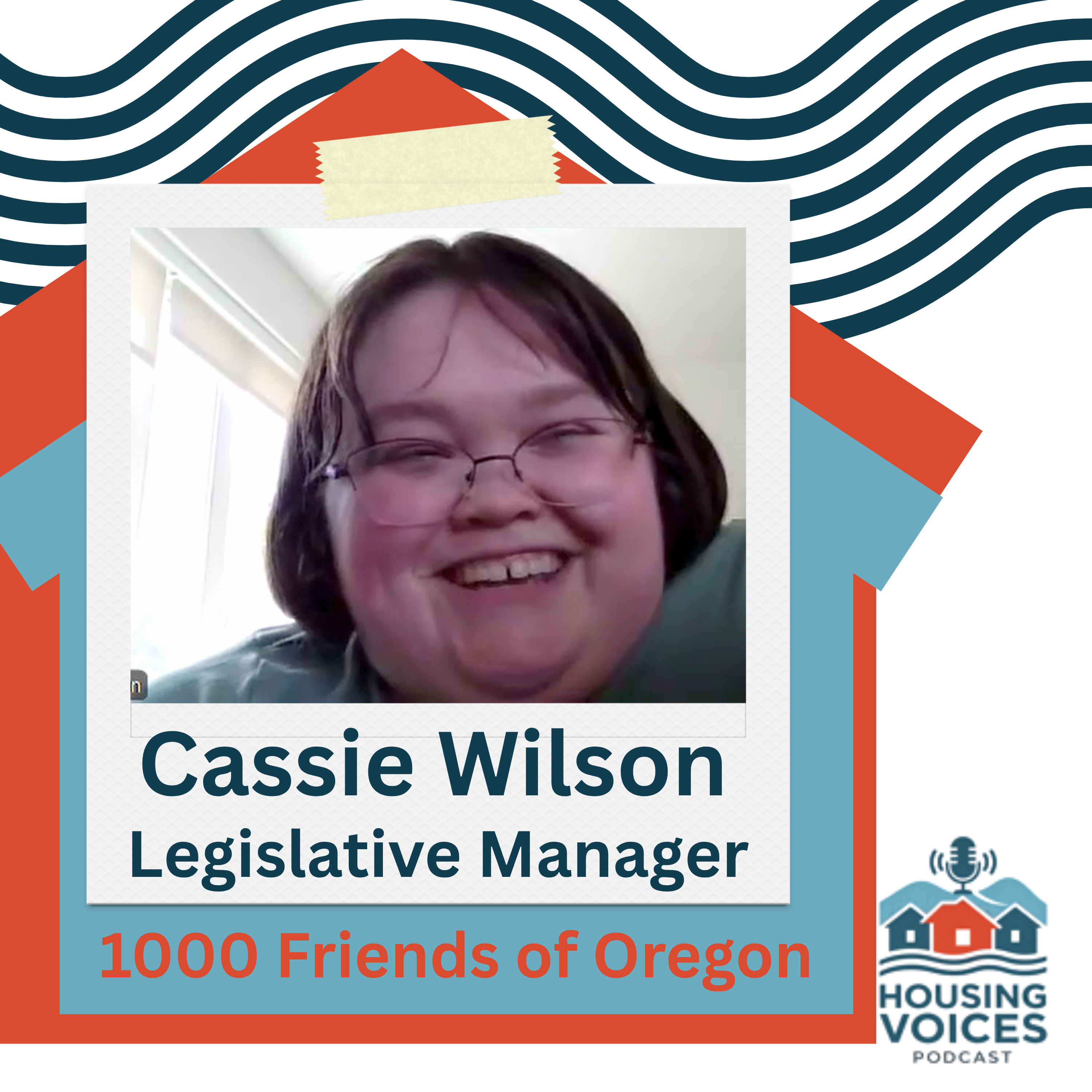
[00:01:05] Speaker C: Yeah, exactly. And our guest today recently did a video actually with thousand friends. It's really cool. Yeah, she's incredible. Cassie Wilson. And she actually walked through some of the accessibility barriers within her own apartment. And it was really enlightening for me.
[00:01:20] Speaker B: It was enlightening for me as well. And I'm excited to meet her virtually and to hear more of what she has to say.
[00:01:27] Speaker C: Yeah, absolutely.
I'm Bri.
[00:01:31] Speaker B: And I'm Marty. And this is housing voices from the
[00:01:35] Speaker A: porches and shelters, streets and the room.
[00:01:41] Speaker C: If the house had voices, the truth could break through.
Hi, welcome back.
I'm Bri.
[00:01:55] Speaker B: And I'm Marty. And today we have the honor and privilege of speaking, speaking with Cassie Wilson.
[00:02:00] Speaker C: Hi Cassie.
[00:02:03] Speaker A: Thanks for having me.
[00:02:04] Speaker B: Thanks for being here.
[00:02:06] Speaker A: Yeah.
[00:02:06] Speaker C: And Cassie, you do a lot of work around the state on accessibility and accessible design. And you. And we talked about this in our cold open that you recorded this really eye opening video for me at least going through your own barriers in your apartment and your accessibility barriers. And it was really, really enlightening and really propelled a conversation that we had about when we were talking about this podcast and housing and all of the layered complexity in housing that we need to consider when we're talking about housing in the state and nationally.
And I would love to hear from you about that video for folks that haven't seen it. And we will also link it in the description for this as well. But I'd love to hear from you about that video and how that came to be.
[00:03:01] Speaker A: Yeah. So during the 2025 legislative session, Senator Patterson ran a bill to increase the number of accessible units in new multifamily buildings. And that was kind of my first time even hearing or thinking about accessible housing policy because it, you know, it came at a time that was about a year after me living in my first apartment and having a lot of accessibility issues.
And so also, I hope you can't hear my cat, plastic in the background.
[00:03:37] Speaker C: We were just having our own cat audio additions, let's call them. Yeah,
[00:03:45] Speaker B: your cat, we saw in the video, and he's adorable. So he's more than welcome to join in the party and the fun.
[00:03:51] Speaker A: Right? Yes, he. I'm sure he will at some point.
[00:03:57] Speaker B: What's his name? Just so we can call him by name.
[00:04:00] Speaker A: Oh, Toast.
[00:04:03] Speaker C: Excellent. Love that. Yeah.
[00:04:05] Speaker B: Okay. I'm sorry. Please go ahead.
[00:04:09] Speaker A: So in starting to learn more about accessible housing and, like, what is possible and what an accessible unit may actually look like, I found that it was really hard to convey to legislators what that actually looks like and means, because it's one of those things where, I mean, I personally, before I actually just moved last weekend into an accessible unit and. Excellent. Before I toured this unit, I had never seen an accessible unit in real life. Wow. Maybe, you know, seen things on reality TV with other disabled people, but it's always their own home that they own that they renovate, which is just very different from seeing, like, what is required by law in rental units.
And so going into the 2026 session, because we didn't get that bill all the way through in 2025, I really felt compelled to show people for themselves, show legislators what the problems are that I'm experiencing and that so many other disabled people are experiencing.
And I think it definitely helped because when you see that my laundry is stacked and that I can't reach my dryer and that, you know, my kitchen is completely inaccessible and my, you know, I couldn't reach my windows, things like that, let alone my blinds.
And so, I mean, that is what a lot of disabled renters are facing around the state. And part of it's a lack of education on both the property management side of, like, when I went to look at apartments for the first time, they didn't even know which ones were accessible.
And then.
But then on the tenant side, like, I had no idea what to look for because I had never heard about what an accessible apartment would look like. And so in terms of the difference between my old apartment and this one.
Yeah, my old apartment. Yeah. Like I said, all the appliances and stuff were really inaccessible. Too tall.
But it's funny because when I started sending my friends pictures, when I decided to move into this apartment, which is an accessible apartment.
Really the only thing that most of them noticed in the pictures was just that my laundry side by side. But like, I think that actually speaks really positively to how accessibility, like isn't even noticed necessarily by people who don't need it. Like, it's not something that's in their way.
You know, people. It took people a while to even notice that. It's like half my kitchen counters are lower and my fridge and freezer are side by side and all of my windows and blinds I can reach.
And you know, there's not even a built in microwave here. They're ordering me a countertop one because I'm guessing that no disabled person has I guess lived in this unit before me already have one. But yeah, so it was just like one of those things that was interesting because it was also like I feel like using my lived experience to counter what we hear for the talking points against building more accessible housing. And yeah, it's just been a very interesting thing to learn about policy through my lived experience, which I love as
[00:07:47] Speaker C: somebody who used to work for a legislator.
The lived experience and creating policy through lived experience I think is actually integral to successfully legislating and advocating for your constituents. And that's all I'm going to say about that. And I could go down a rabbit hole on that, but I'm going to not.
[00:08:05] Speaker B: She can't.
[00:08:06] Speaker C: She does.
[00:08:07] Speaker B: Yeah.
[00:08:08] Speaker C: And I would love. You brought this up recent. Oh, you have?
[00:08:12] Speaker B: Well, I do. I wanted to take a step back for Cass for a second. Cassie, would you just tell us a little bit about yourself?
Kind of give us an introduction and your just your background would be really fantastic.
[00:08:25] Speaker C: That's a good idea.
[00:08:26] Speaker B: Thank you.
[00:08:27] Speaker A: Yeah. So I was born and raised in Oregon. I currently work as the legislative manager at 1000 Friends of Oregon. So we're a land use advocacy nonprofit that was created to be a watchdog for the state's land use planning program just a little over 50 years ago now.
And yeah, I mean being born with a disability, I, you know, accessibility advocacy has just been an inherent part of my life.
You know, it started out as advocating for accessibility and the schools that I grew up in. And then, and then when I started to pre2020, I was really into going to concerts and like was really interested in working in the music industry, but realized that Toast is being. Sorry. He's literally trying to open the drawer that his food bag is in.
[00:09:26] Speaker B: He's smart and it is.
[00:09:28] Speaker A: I'm like, I would put him somewhere but there's nowhere to put him squirrel.
[00:09:35] Speaker B: Yeah, go with it. No worries.
[00:09:40] Speaker A: Where was I going?
[00:09:41] Speaker B: Oh.
[00:09:43] Speaker A: So when I started getting interested in live music and being more part of that world, realizing that most especially smaller concert venues are not fully accessible, then I started to do accessibility advocacy in that space.
And then during the 2020. And here's toast.
Hi, toast.
During the 2020 wildfires, I. That was my first time being in an evacuation zone. I was still living at my parents house in Boring and oh yeah, I had always kind of been aware of climate change and stuff, but I was like, yeah, the effects are like down the road. And then.
Thank you, Toast.
[00:10:32] Speaker B: I love that.
[00:10:35] Speaker A: I'm like, censor that.
Sorry. He's so distracting.
[00:10:43] Speaker C: I feel the pain.
[00:10:44] Speaker A: Yes. So I.
The 2020 wildfires really made me start thinking more about climate and then specifically my experience as a disabled person in an evacuation zone and feeling like there was just really no, no like demographic specific guidance for navigating that situation and navigating natural disasters. And I just had become very aware of the statistics of disabled people left behind in natural disasters and so started getting more involved in climate advocacy. And then that specifically led to me getting more involved in transportation and land use advocacy because transportation is one of our biggest sources or is our biggest source of greenhouse gas emissions. And I had never really thought about my experience with the transportation system as a disabled person. And especially growing up in a rural area, like I didn't have any option but to drive or be driven everywhere.
And so starting to think more about that and what was possible.
And then transportation and land use intersect with basically everything.
And so it's been, yeah, it's been fun that like, as I am quite literally navigating and learning life stuff like getting my first apartment, I am like simultaneously learning the policy side of it, which I mean, I love bringing like real time experience to legislators.
And literally being like this literally just happened like right now.
And I think it just, I feel like it makes it so much more real because I think, I think something that's maybe a little bit different about me and some of my colleagues is that it's like, I feel like traditionally lobbyists are kind of seen as being like really far removed from the problem. You're just there to get paid and speak on behalf of other people. And it's like a lot of me and my colleagues are like living the things that we are fighting.
And so I think it, it makes it a lot harder for a legislator to be like, actually no to your own lived experience because there's, there's really nothing to argue because stories sell.
[00:13:16] Speaker B: Right. People need to see what the story is to make it real and impactful and to elicit change.
Yeah.
[00:13:26] Speaker C: So you talked a little bit about the 2020 succession here in Oregon, and we're facing, obviously this podcast is focused on housing and we're. Can you talk a little bit of what kind of the state of play is right now in terms of housing here in Oregon for people with disabilities? And you mentioned some work that you've done for accessible apartments versus adaptable apartments. And if you could just walk us through that a little bit.
[00:13:55] Speaker A: Yeah. So Senator Patterson brought back her bill from the 2025 session on Accessible housing and specifically increasing the number of fully accessible, or also known as type A accessible units.
Because right now only 2% of units in buildings with 20 or more units. So basically large apartment buildings, which are disproportionately in larger cities, are the only place that type A fully accessible units are required to be built.
And even then it's, yeah, only 2% of units. And so on the smaller end that can maybe look like minimum one unit in a whole building.
And then even when you scale up from there, it's just not enough. And so as a result, less than half of 1% of all housing in Oregon is accessible because there's not accessibility requirements on single family homes, which even though in the last, you know, decade we've done a better job at diversifying the type of housing we're building, still a majority of our housing stock was either built before the federal housing like, accessibility standards were put into place or, or just, you know, our single family homes. And so, so now it's kind of playing catch up on building the accessible housing we need, especially as our population is aging.
I think that something I hear occasionally from legislators is like, adaptable housing is fine.
You can just adapt it then as you age to meet your needs.
But when I think about the reality of what a lot of older adults are facing, I'm like, I don't know that I would be dropping a bunch of money on renovating my apartment while I'm living on a fixed income in my retirement. Like, that makes it hard.
It's so much more expensive to do it later than to just do it from the beginning.
Especially when, like I said, most of the things that make a space accessible are not things that are a barrier for non disabled people to use.
[00:16:18] Speaker B: I. Can I ask another question? Please?
Let's talk. So, so many times I'm in the housing industry, right? You know, we Hear about, is this handicap accessible? Right. Is there a difference? How do you determine, you know, what's the type one?
Can you touch on that? Right. Just so that it creates a broader understanding for more people like me.
[00:16:42] Speaker A: Yeah. So what's. Well, and so what's interesting too is like the language that even just like disabled renters use is often different than what the actual law is.
Because ADA gets used as a synonym for being fully accessible, but the ADA only touches on the public parts of housing. And so that's like the leasing office parking lot, like mostly those things.
And then the Fair Housing act accessibility standards are really where most of the market rate accessibility requirements live. That's where the 2% of units must be type A accessible. That's where that lives.
And then to make it more complicated, because why could things ever just be simple?
Anything that's federally funded, then also must comply with accessibility standards in the 504.
[00:17:46] Speaker B: So.
[00:17:48] Speaker A: So it can really depend the building. And my understanding is the 504 standards are the strongest.
But even I'm still learning, like that's how complicated this is. That it's like I as a disabled renter needed to learn building codes just to like know what to look for when I'm renting. Like, it's lovely.
[00:18:09] Speaker B: It's.
[00:18:10] Speaker A: It's made way more complicated than it needs to be.
[00:18:14] Speaker C: Like, that's how we do things.
[00:18:16] Speaker B: It is kind of how we do things. Right. So what would you like to hear as to what would you like people to know what's actually happening in the simplest terms?
[00:18:29] Speaker A: I mean, myself and many other disabled renters are being forced to live in housing that doesn't actually meet our needs.
We are paying the price just to be able to get inside, but then not able to fully utilize that space.
And often even just getting inside, like I said, because our housing stock is older, you're tending to end up in a newer building just to have an accessible entrance and wider doorways, which all of the adaptable units have. And most people probably don't even necessarily notice.
But so it's like, you know, I'm paying like central city prices just to get inside, whereas like, you know, my neighbors that had identical units to me but weren't disabled could fully utilize their space, but I could not do the same. In mind,
[00:19:31] Speaker B: would you say that the cost of disabled housing on a square foot basis. Right. Is higher than the cost of non disabled housing?
[00:19:40] Speaker C: Because we've heard that complaints from some developers and builders that it's too expensive or it just increases the Cost per square foot, and it doesn't pencil out.
[00:19:53] Speaker A: Mm, yeah. So when it comes to the actual numbers, the main difference that makes the cost of an accessible unit more is just that it requires more space because they. There needs to be enough space to have turning radius radii and, like, clearance in.
In every space. And so that's the main thing. But even then, like, the city of Portland is working on some model code stuff that they're finding that, on average, an accessible unit is maybe only two and a half percent more in cost than.
Than a regular unit. And then.
And then I've talked to some developers from California that they only do fully, like, above and beyond accessible housing. And they're like, it doesn't even need to cost more if you're good at your job.
And so I thought that was really interesting, too, because there's definitely some examples around the country and locally of fully accessible housing developments.
And it's like, well, somehow they found a way to make it pencils. So I think, too, sometimes I wonder. I'm like, if we were doing it more, if it had been required from the start, like, would we still be hearing these things? Because the other thing that I learned way too late into, like, my advocacy on this is that the 2% requirement rate was set when disabled people were still institutionalized.
[00:21:27] Speaker C: Yeah, that's what I mean.
[00:21:28] Speaker A: It's like, we weren't living in community, and so it's like, of course, like, at the time, it maybe seemed like an appropriate amount to build, but it's like, it's not now. And now we're massively behind as a result.
[00:21:42] Speaker B: How behind do you think we are?
[00:21:46] Speaker A: All right, can you say that again?
[00:21:47] Speaker B: How behind do you think we are as far as need.
[00:21:55] Speaker A: Great question.
I did. You don't have the statistics super memorized, but I mean, like, we. I mean, both nationally and locally, about a quarter of the population is considered disabled, obviously. Only that then divides up into, like, mobility disability, sensory, like, the whole spectrum of needs which can look different in a housing situation. And I think most of the time when we're talking about costs and, like, the feasibility of building it, it's usually more to do with mobility accessibility needs.
But, I mean, right now there's only. I believe it's like, there's one accessible unit for every, like, 66 Oregonians who need one.
That's horrific. And there's some. Some other data out there on just, like, you know, folks who live in.
I'm so sorry. I need to toast. He opened a drawer, pulled his Food bag out. And now he's trying to eat through the food bag. So orange.
[00:23:08] Speaker C: Yeah.
Orange cat activities.
[00:23:15] Speaker B: Is that a normal orange cat thing?
[00:23:16] Speaker A: Yeah.
[00:23:17] Speaker B: Okay.
[00:23:17] Speaker C: I think there's, there's. They say that orange cats all share the same brain cell.
[00:23:23] Speaker B: Oh my gosh. I've never heard that.
[00:23:30] Speaker C: I know. Sorry. To the orange cat loving community. I love them too, but they get into things and are troublemakers.
[00:23:39] Speaker B: Well, it's, it seems smart to me. Right. She's distracted. She's doing something else. And the cat's like, oh, and now's my time.
[00:23:48] Speaker C: Now is toast like a child.
[00:23:49] Speaker A: He learned how to do that at midnight last night. Oh, good.
[00:23:53] Speaker C: Perfect time. Yeah.
[00:23:55] Speaker B: Do like child latches. Do they have cat latches?
[00:23:58] Speaker A: Well, those are. I know my friend was like, you could tape the drawer shut. And I was like, he'll eat the tape.
[00:24:03] Speaker C: Oh, my sister had to put child safety on her cupboards because she has a very smart cat.
[00:24:11] Speaker A: He's been like starting to use his paws, like hands. It's disconcerting. Like he's, he's out. He's outsmarting me.
[00:24:22] Speaker C: I love that.
So did you have have more to say? Because we kind of got. You got interrupted. You were on a, on a roll there.
[00:24:35] Speaker B: How about if we give her another question and we come back?
[00:24:39] Speaker C: Yeah, and I, we were talking a little bit before we were so interrupted by, by toast activities about how there is one accessible unit for every 66 Oregonians with a disability.
And I also have to think that that number is just also going to increase as folks age, because I think folks are non disabled. Until they are, we all will have some type of disability, whether accepted, societally accepted or not.
And how we need to do more. Do you think as the state of Oregon is really going full throttle, ideally in creating housing here in Oregon, do you think that we need to do a better job in addressing? Because a lot of what you've talked about is for renters. But as far as like market rate and home ownership, do you think that more needs to be done by the state to address this problem?
[00:25:42] Speaker A: Absolutely. Because you know, something I've really appreciated on, I mean, the land use and even just housing affordability side of things over the past decade has been the push towards re legalizing middle housing and giving people housing choice. And like right now for disabled people, like our only choice is either to rent in a large multifamily building or to be able to buy a home and renovate it ourselves.
And it's like the disparity, like the gap between those options is huge. And then not to mention that there's so many disabled people who can't even afford to get into buildings that have the accessible units and so then just are stuck in inadequate housing situations. I have colleagues who have slightly different disabilities than me and have been basically forced to like crawl into their bathroom because there's no other way to get in.
So I, Yeah, I mean something I've been saying since I started getting involved in accessible housing policy advocacy is just like as we are addressing the housing shortage, like if we don't address the accessible housing shortage too, like we won't have solved the problem because are we just trying to build units and hit number goals or are we trying to actually build homes for people according to their needs?
[00:27:09] Speaker B: Would. What kind of community resistance do you find in your work or if any.
[00:27:17] Speaker A: Honestly?
Yeah, sorry it was there more.
[00:27:22] Speaker B: Well, I'm not like Bri who can do this long eloquent question. I try to keep mine.
[00:27:28] Speaker C: She's saying I'm long winded.
[00:27:29] Speaker A: Did that.
[00:27:30] Speaker B: It's true. I am.
[00:27:31] Speaker C: Yeah.
[00:27:32] Speaker B: Do you find any community resistance with the disabled housing or the disability housing? I'm sorry.
[00:27:41] Speaker A: Yeah. So I mean mostly it has come from the developers, specifically the for profit developers because affordable housing providers are like, yeah, we're already building more than is required because our waiting lists are so long because they're forced to keep the data. They have a list that shows the need.
Unfortunately the, the talking points we hear from market rate developers is there are.
It's. It feels like advocate like the people experiencing the problem are held to a different standard in our advocacy than the developers.
We provide data and everyone says that's not good enough. Show us the real data.
But then it's like okay, well why aren't property managers keeping data on this if.
If they think it is so different from the reality that we are expressing? And so I think, yeah, I mean the most common things we hear are just like that they're un. That accessible units sit empty, that non disabled people don't want to live in them.
That yeah. That they're way too expensive to build. Which I'm also like, as if my rent isn't more because my space is bigger. Like I'm like, so it's stuff like that where I'm like, it's very interesting and like in my experience because like the first time I rented, like when I rented my first apartment because I had no idea what I really wanted or needed aside from moving out of my parents house, like I was Just like, sure, let's just, you know, go with the first plan. The first place seemed fine. I was like, sure, let's just do it.
And so this time I started to do a much more robust search. And through that process it was fascinating and frustrating how my entire experience of looking for an accessible apartment was just debunking every oppositional talking point that I had heard throughout session.
Because yeah, I was told that non disabled people wanted this accessible unit and that I needed to act fast if I was going to have a chance of getting it.
And then also just so many buildings just didn't have accessible units available. And so this idea that they're sitting empty, I'm like, where? And also, why aren't you doing a better job advertising them? Because their websites never say if they have accessible units. They don't show a different floor plan or different pictures for what that is. And so it's just like, how do you even know if it's like you have to.
It requires a lot of legwork just to find out if a building has it.
And so it's just like, yeah, I, when I made my wants and needs list for, for this time around, it was interesting how much just like gets eliminated. I mean, like I have, I, I feel like I have so little choice in where I live or even how much money I spend on rent because I, especially this time around I was like, I don't really care how much I have to spend because I'm tired of paying rent for somewhere where I can't use like 50 of the space.
[00:31:12] Speaker B: Yeah.
Do you know if there's any legislation around accessible apartments. Right. Being preferred, you know, the preferred order being to someone who has a need for them. Because I know that there was a recent legislation. What was that one A few years ago.
[00:31:32] Speaker C: You got to narrow it down, girl.
[00:31:34] Speaker B: I do. I'm not a brie. She's going to have it all categorized in her mind. It's probably like HRC 2001 or something. Right. And she's going to know it by that one. But you know the new rental rules that require the first person coming in that's qualified gets the place. Is there anything regarding accessible units that allows those units to first go towards those with those specific needs?
[00:32:01] Speaker A: Yeah, I can't remember what the timeframe is on it, but I know there's a thing where it's like when it's listed it like disabled people's applications are prioritized within the first X amount of time, I think where it starts to be a Problem is that because when they're listed, they're not listed as being accessible units. It's like, how are you supposed to know and apply?
And then, I mean, in my case, I, I started my search early because my lease on my old place isn't up until May. I moved beginning of April, so I ended up having to pay rent on two places in one month because I had like, because there was no way for me to hold this new place that I'm in and not lose it to somebody else. And it's like, well, what if when my lease is up, there's not an accessible unit available? And so there's definitely some stuff to figure out with the timing of leases for disabled people and being able to get into accessible units without it being a higher financial cost or without being penalized for breaking our lease or things like that.
I do think, I think this is something that comes up a lot in general because it's like, on the one hand I, you know, I hear folks being like, our units just sit empty. And so like, to me, I'm like, that's why it's a good thing that anyone can rent them. But then on the other hand it's like, yeah, it's, there's a serious issue with matching disabled people to accessible apartments. But I think too, it's like something I run into a lot both in the housing world and in other accessibility intersections is just this idea of like basically universal design versus, like just treating it as like an othering.
And like, if we treat it just as like, oh, it's only for disabled people. Only disabled people benefit from this rather than we all benefit from this. And like, anyone could live in this space.
I think we run into issues because I've definitely had some legislators be like, well, a tall person would never want to live in an accessible unit. And I'm like, that's a good thing. All of my five foot friends helped me move and they look around and go, dang, I want this place.
[00:34:28] Speaker C: Yeah, yeah. As a five foot two person, there's so much in my kitchen now that I can't reach. I am really good at jumping on the countertops.
[00:34:38] Speaker A: Yes. Yeah, no, exactly. It's like, I'm like, as long as we think about housing through the lens of a six foot man, we're not.
[00:34:46] Speaker C: Yeah, we're in trouble.
[00:34:48] Speaker A: Yeah, exactly.
[00:34:51] Speaker C: Yeah. I'm looking at Ed over here who is absolutely taller than six foot.
Cassie, can you, if you're, if you're okay, can you talk through what was your list? Your Wants and needs list when you were apartment hunting. Because I also know that this does change for folks that as individual disabilities as well. But it's. I think it'd be really cool to hear if you're comfortable with that.
[00:35:18] Speaker A: Yeah. And I still have. I still have the note on my phone, so I've got it.
[00:35:22] Speaker C: Excellent.
[00:35:23] Speaker A: Well, first of all, I wanted to stay in my current neighborhood. I love where I live. And like, I wasn't. You know, my desire to move had nothing to do with where I was and everything to do with wanting a space that actually worked for me. So I pretty much only looked in the inner east side of Portland, which to be fair, is where most of the buildings that would have accessible units are anyway.
Let's see. I can't. I feel like I maybe mixed some of my wants and needs. But I'll just kind of note that as I go through.
I really wanted to be in a building that had a community room. I host a lot of large gatherings with friends and I set up my apartment space to work for me, not for hosting.
[00:36:14] Speaker B: So.
[00:36:15] Speaker A: So thankfully most buildings do have a nice community room and this one does.
Similarly, I had a patio at my last place. Never used it compared to how much I just used the communal roof space.
So this.
This building also has. That had to be cat friendly for toast, I think something that felt like a need. But I had been so used to it already at my last building that I probably would have. Not necessarily. It wouldn't have been a deal breaker. Was accessible power doors on the main entrances.
Because.
Because all these buildings are secure access. It's like you're scanning your fob to unlock the door and then you're having. I'm having to navigate my mobility scooter to hold the door open for myself before the timer runs out on the fob thing. And so it's a race. It is so much nicer in my new building to just scan and hit the power door button and like not have to worry about it. And not to mention, like, if, like I wouldn't be able to have anything in my hand. So if I've got like a coffee or something, it's like I'm having to put it in my scooter basket. Hope I don't spill it while I'm like trying to get in the door. So it's.
[00:37:36] Speaker C: I'd probably.
[00:37:37] Speaker A: It's the whole thing and I spill it. Like holding a bag of groceries. Yeah. You know, it's like all sorts of stuff where it's just like it Just the ability to just not have to hold the door for myself goes a long ways.
What was definitely non negotiable for me was I needed to be able to do my own laundry.
I am so grateful to my friend and neighbor who, like, would come over and flip my laundry every time I needed it. But it is so much harder to have to like, do the mental planning around other people's schedules and like coordinating that and remembering to coordinate that. And so it is so much nicer to just have it be accessible to me.
It was also pretty non negotiable that I, my last place had like, no direct sunlight, couldn't see the sky.
[00:38:36] Speaker C: Like, I've been in units like that.
[00:38:38] Speaker A: Yeah.
I somehow got so lucky that this building, all of their accessible units are all corner units. And so not only do I have like lovely big windows on one wall, I have lovely big windows on two walls, which is very rare.
[00:38:56] Speaker C: Love that.
[00:38:58] Speaker B: Yeah, I did notice all the light coming in. It's beautiful.
[00:39:02] Speaker A: Oh, and Toast loves it. Because I was like, I was like, as a cat parent, I cannot. I'm like, my cat deserves to sunbathe.
[00:39:10] Speaker C: Yes.
[00:39:11] Speaker A: Who am I to not allow my cat to sunbathe? Absolutely.
And then, I mean, really, I needed a better kitchen setup. I. In the two years I lived at my old apartment, I did not use the oven.
I completely relied on things that could be made pretty much using countertop appliances. So air fryer, crock pot, rice maker, stuff like that.
And so. And I hardly used the stove because the stove controls for my oven were at the back.
And so now living somewhere that it's like, yeah, all the stuff's at the front. Like, I just already know that it is going to feel so much safer to use it. And like, the being able to reach my freezer, I'm gonna have ice for the first time in two years.
[00:40:00] Speaker C: That's incredible.
[00:40:01] Speaker A: That is incredible stuff like that where it's just like.
I think too, a lot of it for me is like, there's a lot of mental gymnastics that like, it becomes very subconscious. But it is work, like, to just like. Because, like, as a disabled person, like, I'm going through my day, like calculating my energy that I'm expending. And so it's just like having to plan for inaccessible issues. Like, it's just. And now not having to is just like such a big deal because even like my last building, the, you know, the package room wasn't accessible.
And so having to remember I got a package, remember to have somebody help me Go get.
[00:40:53] Speaker B: Yep.
[00:40:53] Speaker A: Kids.
[00:40:54] Speaker C: Oh yeah.
[00:40:55] Speaker A: Verse versus like now this building just has basically the standard, standard package locker that every building I toured had.
It's, it's just so nice that like that type of stuff I just don't, I don't have to think about anymore. And like, even this building, you know, doesn't. Pretty much every building I toured, all of the mailboxes were like very much like low enough that no matter what unit you live in, like if you use a wheelchair, you should be able to reach it.
At versus my last apartment, they, they had to get the post office to reassign me a lower box on the wall of mailboxes because mine was too high for me to reach. So it's just like the amount of work that goes into just surviving like not even like in like thriving and enjoying a space but still paying the same rent as your non disabled counterparts is ridiculous. Very frustrating.
And I will say the one thing that now I'm facing with being in a type A accessible unit is frankly, the standards are even still too low on type A because they don't inherently include grab bars. They only include reinforcement in the walls for if you need to add grab bars. But that means that at some point this month I will be receiving a quote from the building because I need Grandma.
[00:42:27] Speaker C: That's what I was gonna ask.
[00:42:28] Speaker A: You have to pay.
Yep, I have to pay. And not only do I have to pay, but they ask me to pay in advance for the future uninstallation of them.
[00:42:38] Speaker C: That's ridiculous.
[00:42:39] Speaker A: Legally required. I'm legally on the hook for that. That.
[00:42:43] Speaker C: Okay, that actually pisses me off. I'm not gonna lie to you.
[00:42:47] Speaker B: Because it's taking away the option for the next person coming in is now going to have to do the same. Additional charges.
[00:42:54] Speaker A: I will say my. So my last unit, even though it was an adaptable unit, at some point a disabled person or somebody, somebody with some level of mobility challenges lived in it because the shower, specifically only the shower had grab bars and a seating, like seating bench in the shower, which at the time made my property manager think it was an actually accessible unit. It was not, but it was like I got to benefit from the fact that my property managed.
[00:43:26] Speaker C: Oh, lucky you.
[00:43:27] Speaker A: They were doing so they didn't, you know, and, but now I know now I'm completely reliant on it because I got used to having it. And so yeah, it's like even, even with a more accessible unit, I'm still, yeah, on the hook for the accessibility.
[00:43:46] Speaker B: Earlier you said that it's legally required that you remove it and pay for that in advance. Why do you say legally? Is it by, you know, actual statue or is it more by rental agreement? How does that working for you?
[00:43:59] Speaker A: It is in actual law that tenants are on the hook for both the cost of installing modifications and uninstalling them when we move out.
Obviously a land a landlord could totally choose to be like no, just leave it. It's fine. Like because yeah, as, as you were saying Bri. Like it's like who's going to be bothered by the presence of grab bars.
So yeah, that's I think something I want to look into more. I'm pretty sure Colorado passed a law to specifically remove the requirement for the uninstallation costs being on disabled renters.
[00:44:44] Speaker C: Well, it seems like I think it probably may as it stands like when I was renting apartments, like can I paint or can I not paint?
[00:44:52] Speaker A: Right.
[00:44:52] Speaker C: And if you do paint then you have to paint it back to the original color and it probably any accessibility modifications probably then fall under that. But I think it is, it is a relatively easy, easy thing to do to just say hey, if this is a mobility or accessibility modification then this and it is in an accessible unit or an adaptable, adaptable unit that they should, that should be some type of carve out or that right there's. That's, that's an easy fix to make. And while you're talking this it really I've been thinking a lot about how the state of Oregon is and I'm sorry I'm going to get a little bit long winded here but I'm going to try to keep it short here. How the state of Oregon is moving a lot of money into the creation of housing and how those are our taxpayer dollars that also people with disabilities are also paying into that is their money too. And then we are not putting any requirements on this, the creation of this housing to make more accessible units or a fully adaptable or however much and I feel very strongly that if you are a person with a disability and this goes I think multiple different applications here but if it's your taxpayer dollars that are being used to fund the creation of this housing, that then you have to pay extra money to make that housing then adaptable just so that you can live a bare like the same bare minimum life as everybody else, that's personally very galling to me.
And how the developers complaints of costs associated with this while they are getting our taxpayer money and talking about maintaining their profit margins. But then people with disabilities. And then regular, like just taxpayers then have to pay taxes on buying a property, like a market rate property that was invested in with our taxpayer money. Like, I. Do you think I'm getting to the question here. Sorry, I got a little bit irritated about this, but do you think that as we're moving forward with the state of Oregon and creating this housing, that we really need to get realistic about requirements for housing and just basic livability for people?
[00:47:06] Speaker A: Absolutely, yeah. I mean, so something that came up this session was. So basically Senator Patterson's original bill would have increased the requirement for more type A units across.
What was I going to say? Like, just in general there would be more type A units and it would lower the threshold a little bit. So that way I think it was Buildings of 15 or more units would have to have an accessible unit.
That version of the bill did not move because it was.
It would have died because people with power didn't like it.
And so some of the people who were standing in our way suggested that we only have those requirements applied to affordable housing.
And we all refused because we were like, if we do that, you will never come back and require it for market rate housing.
And also, why are we continually asking just the affordable housing developers to carry the weight of the entire housing crisis? Like they, like, it's like you want to talk about making things pencil like they're the ones who need help, like so.
[00:48:31] Speaker B: Well, and there's also the assumption that it's that people who are disabled would only live in affordable housing or that's all they could afford.
[00:48:38] Speaker A: Yeah.
[00:48:39] Speaker B: And that assumption is fundamentally
[00:48:42] Speaker C: flawed.
[00:48:43] Speaker B: Oh. I mean, that doesn't even cover it. Right.
It's almost like, let's hide a problem and not let it be seen or let's put it in a place where maybe a NIMBY might not, you know.
[00:48:57] Speaker A: Yeah, yeah, no, absolutely. And I think too, it's just like, I mean, whether it's housing or any other accessibility issue I've experienced, it's like most people I meet don't understand it or don't, like, hadn't thought about it until they meet someone or they know someone or they themselves are affected by the accessibility issue.
And so I think part of it too is the current state of our housing and transportation system is that a lot of disabled people are socially isolated.
[00:49:33] Speaker C: Yeah.
[00:49:34] Speaker A: And so it's just like I feel extremely lucky to be somebody who is so civically engaged and like very in community because I end up being that person for a lot of people.
[00:49:46] Speaker C: Yeah.
[00:49:48] Speaker A: But I'm glad that I can be, because otherwise it's. It's exactly like you said. Like, people make these sweeping assumptions and act like disabled people are a monolith and it's just not the case.
[00:50:05] Speaker B: Yeah.
[00:50:06] Speaker C: People need choice and ownership in their housing choices, as in so many other choices.
[00:50:12] Speaker A: Right.
[00:50:14] Speaker B: Quick question. Did you see any improvement or passing of anything from the legislature regarding the session? Yes, regarding accessibility for housing.
[00:50:26] Speaker A: Yeah. So the version of the bill that did pass was massively watered down, but it does still make some impact, which is that there were some weird loopholes where certain state and federally funded projects weren't held to a high enough accessibility standard. Or they were. They all had like different standards. So fixed that. And then also, which would have. I think, you know, one of my colleagues went back and like did the math on projects from over the last several years and been. They were like, oh, like hundreds more accessible units would have been built if this had been the case. So we know it will definitely still make a difference. And then there's also a really weird thing in state building code where the Fair Housing act accessibility standards are treated as the ceiling instead of the floor for accessibility.
And cities just get really nervous to like, piss off the state building codes people, I guess. And so it's like, if a city wanted to be like, we want higher standards for accessibility, they currently felt like they couldn't necessarily do that because of how it was worded. So we basically just put a thing in there that's like, actually, like, you can do more.
[00:51:46] Speaker B: If you had full authority over this specific topic, what would you do?
[00:51:52] Speaker C: Get a magic wand.
[00:51:54] Speaker B: I love the magic wand.
I always steal it.
[00:51:57] Speaker A: The bar is. The bar is so low right now that I'm like, I don't even know that I've even ever thought about, like in a dream world what I would do.
Wow. I mean, one of the things I think about in this new building that I'm in is that there are some ground floor units, which is not as common because usually the ground floors, retail or parking or whatever, and none of them are the accessible units. So I'm like, first of all, that's ridiculous. Yeah.
So definitely, like more ground floor, fully accessible units, I think. I mean, for the most part, like my type A unit, I, as a, you know, person with a mobility related disability, like, it is meeting my needs.
It is truly only the grab bar situation, that's not. And honestly, now that I'm dealing with the grab bar situation, I'm like, I think type A should also just have like, Roll in showers.
Some when there's mult. When there's multiple type A units, I think, like, one of them has to have it and one of them, which I'm like, that's fair because maybe some people, I mean, I have plenty of disabled friends who are like, I'd love to just soak in the bath.
[00:53:11] Speaker C: Yeah.
[00:53:12] Speaker A: And so it's like, go for it.
But I think we definitely need more just like straight up, roll in, walk in showers. Because I think too, it's like, I feel like bathrooms are one of the most, like, when we talk about aging in place, like, that's one of the first things that, like, where people actually see them. It's like showers are. It's. It's just dangerous. It is a safety issue.
[00:53:35] Speaker B: Could I ask a favor, Cassie?
[00:53:38] Speaker C: Oh, yeah.
[00:53:39] Speaker B: I would love to see the difference in what you posted before in the video of where you are living versus now, where you're living and what the differences are so that those of us who don't have a disability, a mobile disability, because we have other ones that we can kind of see and learn from. You know, your eyes, the improvements that were made.
And we would love to also include that in the notes of the podcast.
Right.
[00:54:07] Speaker A: I was gonna say I'm very, I'm very happy to report that my co worker is coming over in a week and we are.
[00:54:12] Speaker C: Yeah, perfect.
[00:54:14] Speaker A: Oh, that's awesome too. I mean, I had, I had a bunch of my friends go with me when I was touring apartments and I was like, have them film so I can remember stuff. And I'm like, yeah, no, we're totally putting that in another video to talk about, like, what the search process was like. I think we'll eventually have a video about.
Yeah. The grab bar situation and like, what modifications are like.
Because at my last place, even though I didn't request any modifications that would be out of my own pocket, even basic accommodations, which are no cost to anyone, were hard for them to meet. And so, yeah, there's a lot more to explore on.
On like even just my own lived experience and being able to share that. And then I've been teaching more of my colleagues about it as well. And.
And so we are planning an accessible housing webinar to teach more housing advocates and developers and people involved in this space that just. About the issues, the current laws and the, the direction we need to go.
[00:55:29] Speaker C: And where can all of that good stuff, where can folks who are interested in all of that and supporting your work, where can they go to check that out?
[00:55:40] Speaker A: Yeah, I would say go to friends.org that's thousand friends website. I feel very lucky to have the coolest email in the world as a result.
But yeah, friends.org is the best place. I'm personally not as active on social media as I once was, so I mostly am resharing so stuff from them when I am so.
And yeah, they're on Instagram, LinkedIn.
I think those are the main place. Probably Facebook. Still. I'm like, who knows where? I'm like, the social media landscape is changing too often.
[00:56:12] Speaker C: Yes.
[00:56:13] Speaker B: Really quickly. We're going to give you a minute to answer this one. What would you like our leaders to know differently?
[00:56:22] Speaker A: I mean, I guess for me I would just want our leaders to actually listen to the experiences of disabled people and prioritize our needs over profit margins for housing developers.
[00:56:36] Speaker B: Fair.
[00:56:37] Speaker A: Whatever. Whatever path it takes to get there.
[00:56:39] Speaker B: And what is your one realistic next step?
[00:56:44] Speaker A: Next step? I mean we're going to be reconvening the group of us who were working on the previous legislation to figure out what we are going to bring next year because Senator Patterson is very committed to like continuing to push on this issue. And then something else you can expect to see next legislative session is legislation on elevator reform to make it easier to build elevators in smaller buildings because North America has some of the highest elevator costs in the world.
Oh, wow. Okay, wow.
[00:57:18] Speaker C: Additionally, one thing, just a quick note as well. When I moved into my apartment building in Portland, I was horseback to find out that also for emergency evacuations, what you had mentioned previously that buildings aren't required to have a mobility device for folks who have mobility challenges to get downstairs quickly when the elevators are shut down. And so if folks don't have supports, they're just stuck there if their building's on fire.
[00:57:46] Speaker B: Oh my goodness.
[00:57:49] Speaker C: Yeah.
[00:57:49] Speaker A: One of my friends lives in a building where just like the fire alarm gets triggered a lot or like there's no. There hasn't been an actual like building wide emergency.
But every time she just has to call the fire department and be like, hey, I'm here, come get me if I actually need to get out.
And it's really not ideal. No, it's.
[00:58:11] Speaker C: No.
[00:58:12] Speaker A: I will say as a cat parent, I worry the least about myself and the most about who's getting the cat.
[00:58:18] Speaker B: Yeah, you gotta look out for toast.
[00:58:23] Speaker A: I know, yeah. So it's just like that's. Yeah, that's why I'm like, we gotta have more ground floor accessible units.
[00:58:30] Speaker C: Well, a lot of these changes as we've talked over the last hour feel like a lot of easier changes. They feel like very low hanging fruit in a lot of ways. Like I very simple to have that device for stair evacuation.
I that's feels easy to me.
[00:58:51] Speaker B: What can the people.
[00:58:53] Speaker A: Sorry.
[00:58:54] Speaker B: I'm sorry.
We like to end the podcast with some action item that our listeners can do. Right. And so what would that action item be?
[00:59:08] Speaker A: I think asking either your local, city, county level leaders or your state representatives and senators to support increased accessible housing and everyone. Yeah. Keep an eye out next session for more action items on the legislation we bring forward then.
[00:59:35] Speaker C: Excellent. And they can call their legislators to support those pieces of legislation that come out.
[00:59:41] Speaker B: Yes. And keep us updated because we'd like to promote and to help and to support in any way that we possibly can.
[00:59:47] Speaker C: And ideally, I know session gets very busy, but if there's an opportunity to talk about those pieces of legislation as they come to fruition, I think I'm speaking for all of us here, but we would love to talk about that.
[01:00:00] Speaker A: Absolutely.
[01:00:02] Speaker C: Thank you, Cassie.
[01:00:03] Speaker B: Thank you. Thank you. Housing Voices where people, policy and practical solutions meet.
[01:00:10] Speaker C: Solutions meet.
A special thanks to our partners MartyBullford.com and Signet.net for supporting thoughtful dialogue around housing in our communities.
Music for Housing Voices is provided by Karen DeWolf and Adrienne Kriz. Thank you for helping us set the tone.
You can find
[email protected] and connect with us under Housing Voices on Instagram, Facebook, LinkedIn, Bluesky, TikTok and our YouTube channel.
If you found value in today's conversation, share this episode, follow the show and help us expand the dialogue.
Until next time, this is Bri. Let's keep listening, keep learning and keep building practical housing solutions together.