[00:00:00] Speaker A: The truth can break through.
[00:00:05] Speaker B: Welcome back to Housing Voices. I'm Marty.
[00:00:08] Speaker C: And I'm Bri.
[00:00:09] Speaker B: And today we get to bring some faves back. Yeah.
[00:00:13] Speaker A: Round two.
[00:00:14] Speaker B: Round two. Because housing, it's not just a headline. It's pressured complexity. Right. It's about all the things.
[00:00:23] Speaker D: Right.
[00:00:23] Speaker B: So we're here having a lot of fun and in our dining room slash studio. Right. And we're getting ready for three buckets out of our eight. Yeah. We're going to talk about today.
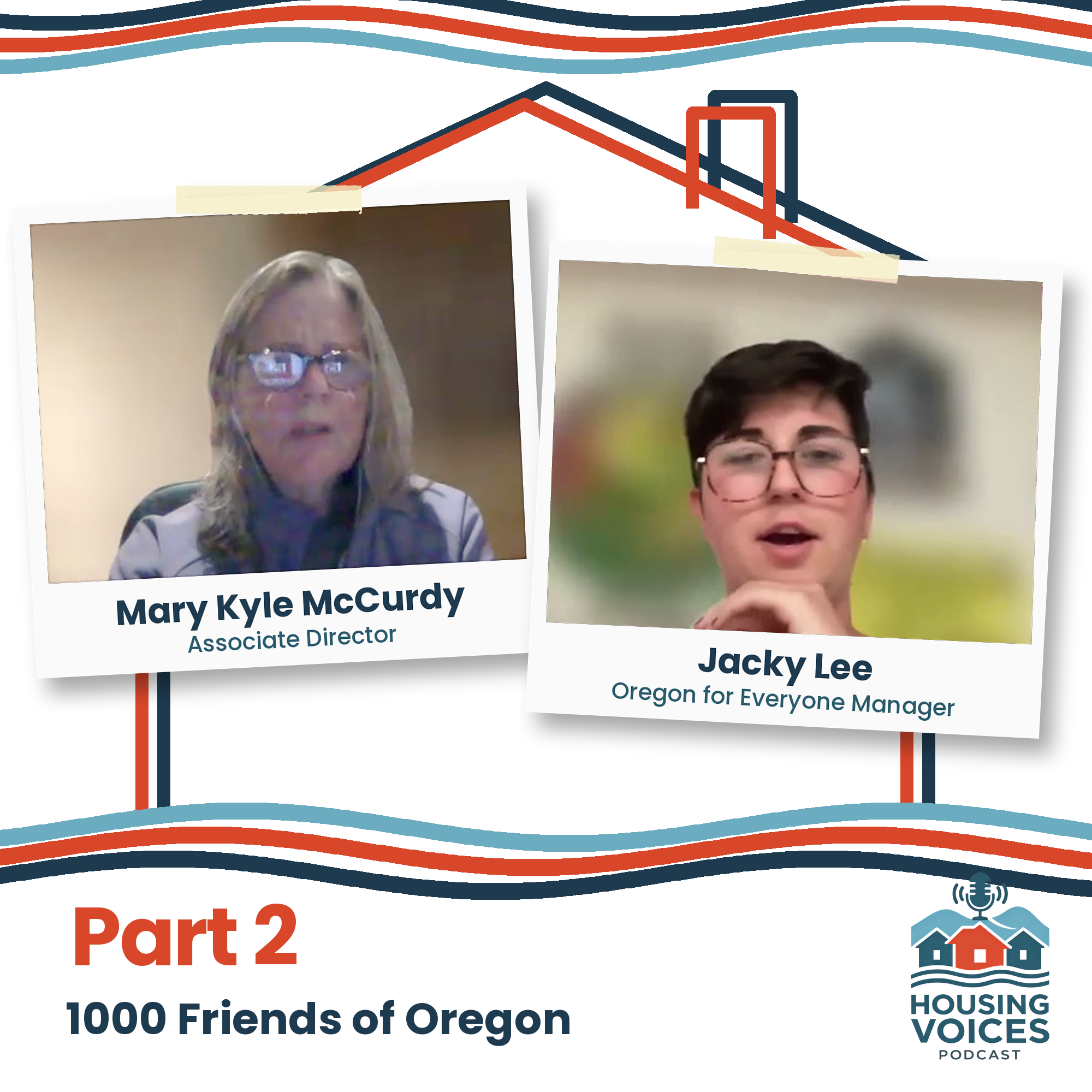
[00:00:35] Speaker A: We're continuing our conversation with Mary Kyle and Jackie Lee with thousand friends of Oregon. We had an incredible conversation with them first time around. And this is part two, continuing our great conversation that we had with them. And I'm looking forward to it.
[00:00:53] Speaker B: I am, too. I really want to listen to and hear about the land grant portions because I know Jackie was really excited about that and wanted to talk about that.
[00:01:02] Speaker A: And the community land trust.
[00:01:04] Speaker B: Yes. And when I say land grant, Community land trust, tomato, potato, potato. I mean, I'm only in the industry.
That's fine. Whatever.
[00:01:13] Speaker A: That's what. That's what you meant.
[00:01:15] Speaker B: That's what I meant when I said what I said. Right.
[00:01:17] Speaker A: And social housing, I'm interested in talking about that.
[00:01:20] Speaker B: So many people talk about social housing all the time.
[00:01:23] Speaker D: Right.
[00:01:24] Speaker B: Especially what's interesting to me is older women, they're all like, okay, let's. I mean, it was like with a nonprofit last Friday where they're like, okay, we'll do this one building, we'll do this. And then everybody has their own private spaces because, you know, people can. People and sometimes you by yourself. Yeah. But it was really fantastic. And I've been lucky enough to sell a few homes that were with community Land Trust. And it was a lot of work. Right. A lot more paperwork, but these people wouldn't have been able to get into a home without it. And so I'm excited to talk to Jackie more about that. What about you?
[00:02:04] Speaker A: I. I love all of that and espes, especially the social housing aspect of it.
I brought this up a couple different times without explicitly saying social housing, but I think the conversation is, is. Is moving and I'm excited to hear from them.
[00:02:21] Speaker B: You could blow me over with the feather, Bree Irish.
[00:02:23] Speaker A: I know, shocker.
[00:02:25] Speaker B: You did not say legislative.
[00:02:26] Speaker A: I know today's topic covers legislative and finance and homeless. There we go.
[00:02:33] Speaker B: There you go. Because that's what Ed writes on our scripts, but we don't really follow that.
[00:02:38] Speaker C: No, we can't be contained.
[00:02:41] Speaker B: So. Welcome back to Housing Voices. I'm Marty and I'm Bri from the
[00:02:46] Speaker A: porches and shelters, streets and the room.
If the house have voices, the truth could break through.
[00:03:02] Speaker B: Welcome back. Mary Kyle and Jackie, thank you for joining us again. We are really excited to to have you here today.
[00:03:10] Speaker A: So for part two of our conversation, if folks want to hear all of the good topics that we got into the first time around, that was so good that we needed a part two, you can jump back into previous episode 21.
Oh, okay.
[00:03:28] Speaker B: The producer wrote it down on our
[00:03:29] Speaker A: sheet of paper, episode 21.
But I'm really thankful for both of you to coming back on our podcast and I wanted to jump back in, particularly on community land trusts. We touched on it a little bit at the end of our episode and folks may not be aware of exactly what community land trusts are, so if you could just give us a little bit of a primer, that would be super helpful.
[00:03:59] Speaker B: Could we do pause just one more moment?
[00:04:01] Speaker A: Yes.
[00:04:02] Speaker B: Could you guys, just in case someone didn't listen to episode 21, just tell a little bit about who you are, what you do, and then we'll get into community land Trust.
[00:04:11] Speaker A: I was getting a little excited.
[00:04:13] Speaker D: Sorry about that. Well, I'm Jackie lee. I'm with 1000 friends of Oregon with Mary Kyle here.
We both work on housing policy in. In a Thousand Friends. I've been here for about a year. Mary Kyle's been here for like 30 years.
But do you want to say anything about yourself, Mary Kyle?
[00:04:30] Speaker C: Just Mary Kyle McCurdy. I'm the Associate Director and Managing Attorney at 1000 Friends of Oregon. As Jackie said, I've been here quite a while, and I work on state level housing climate policy for the urban issues for the most part.
[00:04:46] Speaker B: Fantastic. And you guys are so incredibly knowledgeable.
We have been able to talk in our community about many things that we've learned from you. And I feel like I'm like, oh, this is really nice.
[00:04:57] Speaker C: Yeah.
[00:04:58] Speaker B: So thank you for that. We want to get back to you.
[00:05:00] Speaker A: So back to community Land Trust. Thank you for that reminder, Marty, that we should know who we're talking to.
That's a good point.
[00:05:08] Speaker B: So please go ahead.
[00:05:12] Speaker D: Do you mind if I back up for a little bit and talk more about the concept of homeownership in general? Like.
[00:05:17] Speaker B: Yeah, no, go for it. Go ahead.
[00:05:19] Speaker D: Yeah, yeah. So. So the. The kind of prevailing notion that we have in our society around home ownership is very much that it's like a privilege. It's something that you must earn, that you must work very hard for, unless, of course, you're kind of inherently privileged towards it. And in which case it might be easier, but the notion, that notion is kind of damaged. And it's something that a lot of people are working hard to change.
And instead viewing homeownership as part of a fully formed housing continuum that has opportunities for everyone.
And so community land trusts are really an essential tool as part of that of enabling people to move from rental to home ownership, really allowing people to gain stability through homeownership without sacrificing affordability that typically is associated with rental home.
Rental housing.
And I was, well, I wanted to share with you guys a little passage from a book.
I, I was gonna have it with me, but I don't have it with me right now. But it's by Matthew Border Strauss. It's called the Spark model. Yeah, he's a really, really cool, very smart, kind of visionary leader down at the south coast. And if you haven't talked to him before, I would definitely recommend it.
But the Spark model is, is kind of a very different way of, of thinking about moving people out of homelessness. It really conceptualizes, and not just as, not just as like a shelter provision. Like, you know, it really thinks about the entire thing and how all the different pieces relate and flow together.
But one critical component of that is that, is that they really think about homelessness doesn't end with like, transitional housing. It doesn't end with rental housing. It has to end with feasible pathways towards homeless homeownership. Which of course is not necessarily going to happen for everyone in our current system. But we want to be building a system where the full flow of the continuum is actually possible.
[00:07:45] Speaker B: And that's the first time, Jackie, that I've ever heard that theory that homelessness doesn't end when, you know, we are able to find someone housing and get them, you know, fully supported.
I am really excited about reading this book and learning more about that. That's awesome.
[00:08:00] Speaker D: Yeah, you gotta read it. It's like mind changing. And I've thought about housing, as I'm sure you have a lot.
And so reading something very radically different in that way was very interesting to me.
But yeah, part of that theory is that you have to have feasible pathways to homeownership.
And our current system really does not create feasible pathways to homeownership for the vast majority of people.
The community land trust model that we're going to dig into does create more of that feasible pathways.
And basically, if I can kind of summarize a slightly complex idea, the community land trust model separates the value of a house or a structure from the value of the land itself and what that does.
And the land is owned collectively by a land trust.
So the person or the family buying a house can buy just the house, but not the land.
And that significantly reduces the cost. The land itself is managed by a collective land trust and that enables the land trust to sort of maintain permanent affordability at the point of resale. And I have a bunch of different examples that I would love to share with you if you want.
[00:09:29] Speaker A: Yeah, that would be great, I think, for folks to be able to conceptualize this a little bit further.
[00:09:36] Speaker D: Do you feel like you understood kind of like what the community land trust model was with that description?
[00:09:41] Speaker A: Yes.
[00:09:42] Speaker B: I thought you did a great job describing it. Yeah, well done.
We are in the kind of industry, so we do understand this maybe more than some of our listeners. So if you think that there's something additional that would be beneficial to others, please, please drop it.
[00:09:57] Speaker A: I think it would probably be helpful for folks to understand kind of functionally how this keeps housing more affordable from a buyer's point of view. Let's say if I wanted to buy a home that is part of a land trust, what does that look like and what am I getting into essentially?
[00:10:19] Speaker D: Yeah. Yeah.
Okay. So we can start in central Oregon. This is, this is a really good example. They have a super thoroughly developed community land trust called Rooted Homes.
And their, their model, they create these, these cottages that, that's mostly a cottage cluster style of housing. And they're all net zero homes. They're kind of smallish, they're like two bedroom homes. They're fairly densely close together like cottages are.
And because the land value is separate from the house value, all of their homes are, are being sold for about 250,000 to about 400,000, which pretty affordable, a lot of money. But if you're thinking about the, the average home sale price in Bend, for example, it's like at least 800,000 right now.
So that's like a, a much more affordable price for someone in that area.
And then because all those homes are net zero homes, they are then not paying really expensive electricity bills or natural gas bills or anything like that.
And they're able to accrue equity. It's, it's kind of a limited equity situation. So if they decide to RESELL like in 10 years or whatever, they, it's still going to resell at an affordable rate. So the, the homeowner is going to get some equity which might enable them to put a down payment on A market rate house.
But it's not going to be as much equity as if you're just like flipping a house outright and selling it for the maximum value.
[00:12:04] Speaker A: So these homes can, for, for folks who are new to this, these homes can be bought in kind of traditional ways. They qualify for, for financing. Somebody can get a mortgage on this.
It doesn't affect anything like that, right?
[00:12:22] Speaker D: Usually not. As far as I know that that's kind of the standard model. Most people, a lot of times community land trust will have a provision that you can't have owned a house within like 10 years prior to that. So, so they're not.
They really are creating pathways for people to get into ownership. Homeownership for the first time, I've sold
[00:12:45] Speaker B: two homes that went on a community land trust and I loved it. It was a lot more work from an agent standpoint. Right.
But these were people who wouldn't have been able to traditionally get into the home that they got at an affordable price that they were comfortable with.
What I also loved about it is that they brought people through a home buying process.
Right. In order to make sure that they were fully educated on to what they were getting into and supported by the organization that holds that community land trust.
In these examples, the community, the person owns a house and then the CLT takes care of the land and they pay that community land trust a small amount of money every month.
And this community land trust puts in reserve a portion of that for any maybe future needed repairs.
Is that something that normally happens with community land trusts or is it just the one that's right around our local area?
[00:13:49] Speaker D: I believe that's kind of the standard model. Yeah.
[00:13:51] Speaker B: Okay.
[00:13:52] Speaker C: It's like a home, a standard homeowners association model, right?
[00:13:55] Speaker B: Yeah.
[00:13:56] Speaker C: Thing where there's a collective management, however, that collectivity is set up, but that everyone is paying into it to some degree.
[00:14:06] Speaker A: And can anybody, anywhere set up a community land trust?
What are some of the prerequisites for a community that's interested in something like this?
[00:14:19] Speaker D: Oh, gosh, I have no idea.
[00:14:22] Speaker C: I assume the community land trust entity itself is established as a non profit corporation, so they're going to have to go through that.
[00:14:29] Speaker A: Okay.
[00:14:30] Speaker D: As far as I know, they're all non profit
[00:14:34] Speaker C: or potentially government, but I'm not publicly owned, but you know, at least a nonprofit model.
[00:14:41] Speaker B: One of the.
[00:14:42] Speaker D: Anyone, anywhere who knows what they're doing.
Okay.
[00:14:46] Speaker B: All right, Jackie, we'll see what you do next with that.
One of the topics that we didn't get to really talk about Too much the last time you were on. And that, Mary Kyle, is you mentioned. And my reminder here in our notes. Thank you, Ed, for that. Called infrastructure the biggest barrier for, for developers.
And so can you bring in how the infrastructure goes along with community land trust as well as traditional development and how that reduces costs and makes community land trusts more affordable, as well as how we can help with the constraints of infrastructure?
[00:15:27] Speaker C: Well, as far as I know, and Jackie can correct me if they know of anything different in the community land trust.
The infrastructure challenge is across all types of building, whether it's market rate, a community land trust, a more traditional affordable housing or housing authority builder. Because they all need pipes, roads and sewers. Right. And to. And it's not just the ones that are. That are servicing immediately that home.
It's usually the builder developer of the home is paying for the extension to the, to the main sewer line or the main water line, whatever. But it's.
We are finding many cities that have, you know, fairly large chunks of land zoned for residential use, but the whole area needs a system through it. So they need roads, water, sewer extended from the existing urbanized portion of the city to these areas.
And so there's that simply just vacant land. And then there's also other cities with challenges. It's particularly true like in Bend, where they have a whole area that's scheduled for much more infill and dense development, but they need upgrades to the existing system, like a water pump and an upgrade to the sewage system. So it's not just the pipe to your home, but it's, you know, the pipe of the road.
[00:16:54] Speaker D: It's.
[00:16:54] Speaker C: It's the road itself. It's the pipes running in the road. It might be that there's pipes in a road there, but the system is old enough and it doesn't have capacity for this new hundred acres or this infill redevelopment. And it needs that additional investment or it just might be getting old.
And this is true in towns and cities of any size.
And in the way long ago, a lot of those infrastructure financing was paid for by the federal government and the state government. And so that local governments and the builders themselves and developers and eventually the homeowner or the renter didn't have to pay as large a percentage of that cost. But those days are gone where the public governments, the federal and the state are for a variety of reasons, not funding major infrastructure projects to the degree that they did.
And the property tax limitations passed in Oregon and other states. We're not the only one has really limited the ability of local governments to finance infrastructure.
So a model some cities are able to do because they have diverse enough flows of income is to, you know, front some of that infrastructure financing for an area and then they're paid back by the developers as that area develops. But not every city has that ability to finance that. So it's a challenge whether you're a non profit builder of affordable housing or you're a market rate, you know, developer.
And there's been various creative ways, you know, to try to get to eat at that, but a lot of it's just kind of nibbling around the edges. The legislature has over the last few sessions provided some money for infrastructure, but the backlog is significant. The League of Oregon Cities estimates that the need for infrastructure for all uses, not just housing, but this is true for employment, land, everything, and for new infrastructure for upgraded infrastructure across the board is about a billion dollars.
[00:19:15] Speaker A: So it's mind boggling.
[00:19:17] Speaker C: 10 million here, 10 million there. It's a long time till we're going to meet those.
So if a builder fronts all of that themselves, those houses are not going to be affordable to the average person.
So I'll just give one example and this is from 15 or 20 years ago. So it's quite a ways. It's an area of about 800 acres of farmland came into the urban growth boundary in the Portland metro region in Washington County.
And it's, it's developed now and it's developed with a variety of housing types. But it was not a challenging piece of land to develop. It was 7 or 800 acres had been in farming. That's not, there wasn't anything in the way.
And Washington county estimated that the cost of infrastructure per unit, this is again about 15 or 20 years ago, was $100,000.
That's if you're building that into the cost of your unit. Wow, that's not unusual today those, those kinds of dollars are. So to give another example, again, in the Portland metro area, an urban growth, a large urban growth boundary expansion in the south Hillsborough area, there's a supplemental system development charge, sdc. These are the kinds of charges that are put against development. To pay into these infrastructure funds, there's a supplemental charge of $17,000 per unit because of the additional transportation costs, just transportation. So beyond what every other new house builder, you know, in Hillsborough is paying, you have to pay another $17,000 per unit there because of the additional transportation costs.
You know, it's playing out in one way or another across the state.
[00:21:08] Speaker B: What are some of the Creative ways that people are, are solving this problem.
[00:21:14] Speaker C: Well, so the legislature has established some funds with, you know, modest amounts of money that are a revolving loan fund, which can be grants also, but a revolving loan fund for builders to draw upon.
You know, you have to go through a process and apply for it to the state agency. But it is designed to fund those upfront costs of, of site preparation, you know, the grading of a site and all that site preparation, the infrastructure, all of the things that you need before you know, the planning out of what, how you're going to design the infrastructure, those costs that you need to spend a fair amount of money on before you even start building a house.
So, and that's a revolving loan fund. And they also have a revolving loan fund for the infrastructure itself, meaning once you sell that unit or your subdivision or whatever, you pay that money back into the state. So it revolves again to help pay for more infrastructure, for more development.
Now, it's not a huge amount of money, so there's only so many times, you know, or so many units that will get with each churn. But the idea that it's revolving is nice. And if it's affordable housing, it can be turned into a grant rather than a loan to be paid back. That's one cities are looking at things like not assessing the so SDCs or system development charges, which cities can charge for the infrastructure costs, the incremental demand for infrastructure made by that, buildings for water, sewer, stormwater, roads and parks.
And there are cities that are at the request of builders now, saying rather than charging that upfront at the beginning of the cycle, before you've built and before you've sold those homes, instead collecting those SDCs at the point of sale or certification of occupancy, those sorts of things. So when there's actually money in the hand for the builder, because if they don't do it that way, the builder has to build that into the loan they're taking out for this whole building and then they're paying interest on it too, and they're carrying that additional cost
[00:23:40] Speaker B: well, and they're also extending that interest to the future buyers.
[00:23:44] Speaker C: Right, Right. So there are cities that are able to reduce the SDCs or wave them all together for affordable housing.
You know, that I think it's just actually been for affordable housing to reduce or actually for accessory dwelling units too in the city of Portland to reduce or waive those SDCs. But because of state law, if a city reduces or waves system development charges for development, they have to backfill that money somewhere from their coffers that because the.
The theory is the infrastructure still needs to be paid for, so you have to backfill that.
So again, that tends to be cities that can carry that kind of financing.
[00:24:33] Speaker A: That's one thing that it's kind of stuck in my mind is that there are some cities that are not in a position to be able to make those allowances for building and development. And if you are right on the line with your capacity for your infrastructure, what then are you to do? Right.
Who eventually pays for that? Right. Somebody's got to. And so often it is kind of taxpayer money fronting for a lot of these developers. And then folks end up, if they purchase this home, are then paying taxes on that as well.
And as folks, I think across Oregon and across the nation are a lot of working people are have a lot of burden when it comes to taxes and paying their fair share, let's say, or more than their fair share.
I think then it leads us to a problem where we're delaying the inevitable here.
These are intermediate measures to get us kind of halfway there. But is not totally solving the overarching problem.
[00:25:46] Speaker C: And the city of Portland is, has been now for maybe a year, is waiving development fees of all sorts for residential development.
I'm sure they'll reinstate them at some point, but because of like the patch we're going through, our organization did a report called More extensive is more expensive, meaning it's even more expensive for all that infrastructure if you are basically sprawling out from your town and city.
So even though even those infill projects might need infrastructure, it's still less expensive than the sprawling out. But we believe we have to be eyes wide open wherever the development is on how much it costs, where can and who.
Who is it fair to assess that or what groups of people. And so often it's partly whoever's the builder, developer, eventual homeowner, renter, the public dollars, the ratepayers, or maybe they're just lesser service levels. You know, your roads are going to stay redded for a longer period of time. And we're all absorbing that, whatever it might be. But we need to understand that and those costs are not going down, as we all know. Whether it's cost of cement, concrete, steel, whatever.
[00:27:05] Speaker B: In our community right now, there's a big argument going on regarding the SDC fees and not regarding housing.
[00:27:12] Speaker D: Right.
[00:27:12] Speaker B: Regarding some local businesses that people really want in here, food trucks, because we all want to eat and we all want different food. So it's really interesting how the crossover of those SDC fees have such an impact on our building, but also on our businesses. Right. And it flows over through all, all of the aspects in the city. And it leads me to think, you know, those cities who aren't fortunate enough to be able to reinvest into it Right. Then almost become dying cities. Right.
Or become places where people leave. Right. And only, you know, and so it's really an interesting thing. And it's not a problem that can just be solved on a city or a county level. It's really a statewide issue of how are we going to help the infrastructure and filling in the middle.
[00:28:08] Speaker C: And it's really pronounced. It's a really pronounced problem for smaller towns and cities. So there's a small city, big town in eastern Oregon that about eight or so years ago, its water reservoir had been down a couple of years in a row to two or three days worth of water in the summer because it was leaky and old and it needed to be repaired and they didn't have the wherewithal to do that themselves. That's a town that no one's going to build housing in or invest in for jobs, if you have that. Right.
And so eventually the mayor, because there's probably half a staff person in the city, wrote a grant request to the federal government for $2 million to repair their water system. And they got it and it's repaired and now they don't have that same issue. But that affects every single piece of land in that town or city. So it's not like, oh, we're going to charge that developer. It's irrelevant.
There's no developer.
And it's just these are, these are common across Oregon and it is really all of our, I think, responsibility because that's not fair to that community.
And we need to figure out how we fund infrastructure for housing jobs. What we've described is true across the board.
[00:29:38] Speaker D: Right.
[00:29:39] Speaker A: We had Representative Gomberg on actually talking.
Yeah.
[00:29:45] Speaker B: Yes, he was our first guest. Yeah.
[00:29:47] Speaker A: And had a really cool conversation with him about the upcoming long session and what some of his priorities were. And infrastructure was really number one on his list, as I'm sure you guys know.
Yeah. From, from your point of view, what, what kind of do you want to see as far as a legislative sol to this? It's probably gonna be, you know, a myriad of different solutions. But do we go for, do we go, you know, shoot for the moon and go for that 1 billion number or. I know that's like totally mind boggling and, you know, not Rooted in reality. That is a total magic.
[00:30:29] Speaker B: One question.
[00:30:30] Speaker A: Yeah, but what do you think? Kind of bare minimum maybe to help us get out of the situation in our short session. Obviously it's going to be a multiple level solution, multiple session solution there.
[00:30:45] Speaker C: Right. Even if we had $1 billion, we wouldn't be able to spend it all at once.
[00:30:48] Speaker B: Right.
[00:30:48] Speaker C: So there needs to be.
The state needs to assess and prioritize working with local governments, their needs and they have some mechanisms, mechanisms in place to do that. But it can't just be just the squeaky wheel or the powerful legislator or the business or whatever. We have to have an objective way of assessing the needs across the state and then funding, prioritizing those or classes of those and funding them with geographic and size fairness too.
And to do that is going to require at the scale the scene because it's going to take us a while. But we don't want to take 100 years, maybe 10 years or something.
And the sources of funding to do that are going to.
This is not an official position of my organization, but it's going to take some changes to how we. To our tax system.
[00:31:44] Speaker A: Absolutely.
[00:31:45] Speaker C: And to, to have a meaningful financial structure to deal with it. So there's different ways of reforming our tax structure and some other financing mechanisms. But you know, I think that's what it's going to take. Otherwise the legislature will continue to do 10 million to $100 million a year maybe.
And it's just, you know, drop in the bucket. Great.
It's great. It's hopeful, every bit counts.
[00:32:22] Speaker A: But we need more.
[00:32:24] Speaker B: Now I know you have to go and we get to hold on to Jackie for, for a little bit. But I'm going to ask you one last question because I'm. I feel like I'm being a little bossy here, but does a thousand friends go in and work with the legislature legislators to come up with solutions? Are you guys do any lobbying with that and how does that work?
[00:32:45] Speaker C: Yes, we do.
We have an active presence in the legislature and always have every session.
And for the past decade or more we've been very active working with legislators on creative solutions to address housing from middle housing, which I think you all know about. We were the lead organization in organizing other advocacy organizations in support of middle housing and we work closely on that with then speaker of the House Co Tech.
And that was the middle housing bill itself was her concept.
And so we were part of the advocacy, leading the advocacy efforts to get that passed from the non governmental organization world. And we've Worked before and since then on a variety of things.
Both aimed at reforming land use, zoning, planning policy in order to ensure that we're meeting the promise of goal 10, that there's housing, that we've laid the table with all of the land use and related tools that we can to make it possible for Oregonians of all incomes to have a house or a home or whatever. Apartment, a home of their own that's affordable in every town and city, in every neighborhood.
And we've also worked with legislators on innovative ways to produce housing.
So there's several legislators, particularly Representative Marsh from the Ashland area, who have worked on this on factory built housing.
There's a lot of different forms that that can take. Jackie has worked with. I think you've actually met Gus, haven't you, Jackie? Yeah.
There's different factory built housing which can be built in a factory somewhat less expensively and then assembled on site less expensively and therefore they're able to deliver housing product for sale. Most of them are, I think, or a lot of them are at about 25% less than the average sale price in that area. That's what I heard it.
[00:35:01] Speaker A: We spoke to Jacon Taylor of Hope Homes out of Eugene. They worked closely with Rep. Marsh.
Her work kind of helped kickstart them, actually.
[00:35:15] Speaker C: Right. She did. She insured pilot projects with funding to build the. The factory built that capacity to build. Factory build homes. And then they're in five different communities. And she's working on a build this session to scale that up, which I've been in communication with her about.
[00:35:32] Speaker A: That's very exciting.
[00:35:33] Speaker C: Mm.
[00:35:34] Speaker B: Well, I can see the person is coming in behind you because you've got an early go get ready, an early day off tomorrow. But I appreciate your time. Thank you. Thank you so much.
Heil.
[00:35:44] Speaker C: Bye. Bye. Bye, Jackie.
[00:35:46] Speaker D: Bye.
[00:35:47] Speaker A: Safe travels.
[00:35:48] Speaker B: Jackie, thanks for staying with us. We really appreciate it.
[00:35:51] Speaker A: We won't keep you too, too much longer.
[00:35:54] Speaker B: Yeah, we will.
[00:35:55] Speaker A: But I, I really wanted to talk with you on. On social housing, particularly, I think how it really reinforces something that you were alluding to when we were talking, when you were talking about kind of the concept of homeownership and how housing is, I believe housing is a human right and how social housing really supports that. And again, I'm going to ask you to give us a kind of a little description on what social housing is for folks who may not be aware of it.
Doesn't have to be like the, the Webster's dictionary definition.
[00:36:33] Speaker B: She describes things you don't even need to Tell her that this woman can just explain it all.
[00:36:37] Speaker A: She can do it.
[00:36:38] Speaker B: Yeah. Or anytime I can hush this woman down, I'm going to take it, Jackie, just to let you know.
[00:36:45] Speaker D: Well, I am nowhere near the expert on social housing, but my understanding is that it is basically government owned, government run housing.
And so there are many examples, I think in the United States, Maryland has probably been one of the leaders in social housing around the world. It's really common.
Vienna is really famous for their social housing models.
It's, it's kind of the same as regular housing, but instead of being run by someone who's making a profit off of it, it's run by an entity that is not making a profit like a nonprofit, but they generally have a much bigger budget and scope than a typical nonprofit would.
[00:37:33] Speaker B: So how does that. When I think of social housing or when I first started thinking of social housing, I thought of like the projects in Chicago. Right.
Government run, all of that. And that became scary to me. Right. That became almost like, oh, I don't know that that's something that I want. How can we make it differently and more kinder?
[00:37:53] Speaker D: Yeah.
[00:37:54] Speaker B: And maybe it's just me being weird, right? Thinking of it that way.
[00:37:58] Speaker D: No, I don't think it's, it's you being weird. I mean that's, that's an example of I guess, sort of strategic government disinvestment. Right. Like that's the government creating something that they have no intention of, of maintaining or, or following through on versus social housing models that work well are like the government is, is behaving as a responsible landlord, which is what you want, and, and using it as a tool to build people up, not to, you know, segregate them and, and kind of tear them down.
[00:38:35] Speaker A: Yeah, I think social, the social housing that I, when I envision is a really, a really robust kind has consistent investment and consistent support from the government and from the community that it serves itself. When we think of the projects, that is something that was designed not to actually functionally support people's wellbeing and was kind of funding of an opening salvo, so to speak, and then was left essentially to derelict for, for decades. And as we have proceeded over the years, there has been, you know, lingering effects of racism and, and redlining and all of the things that we've talked about as roadblocks to really supporting the, the flourishing of these communities. And one of the reasons why I'm, I get personally really excited about social housing is because I feel like in a lot of ways we are Inching closer and closer to that model through some of the ways that we've tried to address our housing crisis by subsidizing so many different parts of the housing creation process.
And I brought this up on some of our other podcasts of, you know, if we as taxpayers are funding the creation, we are supporting folks staying in that housing through various people programs and, and we are also then taxing people that buy the homes that were helped created by our taxpayer dollars.
I, I think we're, we're so close in so many ways on how we are funding our housing to get ourselves out of this housing crisis that we are maybe a couple steps away from actual social housing models. And that was a long, a long tangent that I.
[00:40:35] Speaker B: That wasn't a tangent, babe. You know what that was? You know what I'm going to say?
[00:40:39] Speaker A: Yeah, by soapbox.
[00:40:40] Speaker C: Yeah. Content.
[00:40:42] Speaker B: No, no, that was her soapbox.
[00:40:44] Speaker D: Oh, soapbox.
[00:40:45] Speaker B: Yeah. She really is very, very passionate about it and I love it so.
[00:40:50] Speaker A: Well, just like, just, I'm just trying to conceptualize how many ways that we support housing right now with our, with our money.
In a lot of ways I feel like we are just a couple steps away from, from just the government continuing to operate these houses that we have subsidized the creation through whatever means possible in different communities. And I feel like we are so close to that where we can make sure that everybody has an opportunity to have a home.
[00:41:25] Speaker D: I feel like community land trusts are the closest I've seen a lot of times what I see is, is government subsidies go into creating some kind of affordability thing, but it sort of gets immediately lost to the private market.
Like for example, if you just do a down payment assistant or like if the government provides a down payment assistance that's like one person is supported, but the long term result is that house will continue to be unaffordable in the long term.
[00:41:58] Speaker A: Well, we have a lot of programs in my day to day, there are programs that support folks staying in their rentals, you know, emergency rental assistance, rapid rehousing initiative, things like that that are keeping folks in maybe market rate housing as well. So if we're funding, you know, this, you know, this rental, right, with our taxes paying dollars, why don't we own the building? Right. If this is an entire complex or the majority of this complex is being supported and the rent is being paid by, you know, a fund through Oregon Housing and Community Services or another agency. Why don't we just own the building and operate the building?
[00:42:48] Speaker D: Yes, totally with you.
[00:42:52] Speaker B: Okay, we're going to get actually back on topic. Sorry, I was.
[00:42:55] Speaker A: Okay, I'm done with my soapbox now. I'm done.
[00:42:57] Speaker D: I'm done.
[00:42:57] Speaker B: Yeah. I have so many things came through my mind during that conversation that were a little terrifying.
All right, so Jackie, when you were with us before, we asked the magic wand question, and your first answer was very passionate and immediate, and you said in a very warm tone, but it was really firm and this really stood with us.
It was about now I have to find my notes where I just lost my place when I looked up at you about homelessness and criminalization.
And so I wanted to follow up with that on who pushes that. How are we keeping the focus with that in parallel and alongside land use and policy?
[00:43:44] Speaker D: Yeah, for sure.
And, and from, from all of this, I'm speaking from a personal perspective, not from a thousand friends, but I, I do feel like we are aligned on this topic as well.
So my personal history with this was joining an organization called Stop the Sweeps a few years ago, like in 2021, I think I joined.
And for a long time this was a, this was just a group of people that was providing meals for unhoused folks in the places that they were staying, like in their camps and supporting during what we call sweeps. And so if you're not familiar with sweeps, they're kind of like the government essentially is coming in and making people move their belongings.
Oftentimes they're. They're throwing away people's belongings, even things that are valuable to them, like medications, paperwork, those sorts of things that. That can be really hard to recover from.
And that, that experience of like, supporting people when they're having to like, move their belongings, move to a new place, like kind of re. Uproot their whole life, basically was. Was pretty eye opening to me.
It just really emphasized that that is not a good.
Well, it's not a good thing to do. Like, we can talk about all day about how it's. How it's harmful to people, but if we're talking about from a perspective of governments, it's a really poor use of governmental funds.
[00:45:27] Speaker B: That part.
[00:45:27] Speaker A: Thank you.
[00:45:28] Speaker D: Do something that is.
Is going to have to be repeated over and over and over again because you're not solving the problem.
If we instead use that money that we're using to, you know, criminalize people to directly address the problem, we would get so much further, so much faster.
So when I say end the criminalization of homelessness, I do realize that that means that for some amount of time, until we figure some Things out. There's going to be people living in our parks for a long time and. Well, maybe not for a long time. Ideally, once that's out in the open and we're no longer able to resort to criminalization as the only step, then we are actually going to start going into problem solving mode and we're going to say, okay, all of these people are out here. What are we going to do about it? How are we going to get them into a better situation?
[00:46:25] Speaker A: Well, from my own.
[00:46:26] Speaker D: Oh, go ahead.
[00:46:27] Speaker A: From my own personal experience, I have been doing street outreach for, for more than a year now, just here in Corvallis. And the use of funds, which is something that I, I always want to bring up the costs associated with just doing the sweeps.
The, the workers to that are physically doing the cleaning.
Many times there are police also standing there to make sure that nothing happens.
And then the things that they're throwing away are oftentimes a lot of equipment that say the county will give out because the county sometimes through programs will give tents and sometimes sleeping bags and other things. I've seen basically brand new tents get thrown away in the sweeps. And that is, those aren't cheap.
[00:47:23] Speaker B: Right.
[00:47:23] Speaker A: I mean, if anybody's gone to try, you know, buy a tent, some of them are, are really nice. They're. Yeah. Thrown away in the garbage. And we're those staff time for those workers, for the police who could be doing literally anything else.
That's a lot of, a lot of money when you think about it. And then additionally, I've also seen people, as you mentioned, paperwork, lose id, the copies of their identification. And there have been cases where folks have gotten jobs and then they could not continue through their, they get a, an offer of employment and then they couldn't continue with their job because they didn't have their identification to verify who they were. And so they couldn't get the job by the time they had left the interview, gone back to their camp to get their identification to continue the process. By the time they had gotten there, all of their belongings had been thrown away.
And that is a huge cost in and of itself. Not to mention all the people who are on lists to get in a wait list to get in a treatment program, a wait list to get into housing because around here it's about a four year wait through the housing authority.
That's a cost. All of that adds up. And it's not a solution to just throw their stuff away. And I'm on my soapbox again.
[00:48:43] Speaker B: You are. And we're gonna Go back to Jackie. She's our guest. We're gonna ask her her opinions.
[00:48:50] Speaker A: I'm done.
[00:48:51] Speaker B: For the rest of us, we're gonna see Jackie. How long do you want to bet that's gonna last?
I apologize. No, don't apologize.
You know, you care about humans, and we all want to do what's right for all right? People get afraid when they see people living on the streets and in shelters or intense. And sometimes they do have mental health issues. Right. And so the sweeps are coming from a place of fear, and it would be nice to figure out a place of love and how we can change this through kindness and compassion versus through, you know, fear and cruelty and excessive cost and waste.
[00:49:28] Speaker D: Right.
[00:49:29] Speaker B: Because, you know, many of much of Oregon wants to preserve and protect our environment. Right.
And reduce, reuse, recycle.
Sweeps are not in alignment with that, and they come from a place of fear because things that we don't understand or don't know are scary.
How do you see land use rules changing in order to stop the legalization of homelessness?
[00:50:00] Speaker D: I mean, the criminalization.
[00:50:01] Speaker B: And when I say, yes, legalization, I mean, I think we talked about that before the show started. How I said. And when I say that this. I mean that. Yeah. This is another example of that. Jackie, thank you.
[00:50:12] Speaker D: Yeah.
How do I see land use rules changing around that?
That is a really interesting question.
I.
I would go about answering that in terms of. I believe last time we talked a little bit about ona, the Oregon Housing Needs Analysis. But one of the critical components about that, in terms of the way the rules have changed since 2023, when. When it was updated, cities now have to very actively and intentionally plan for their populations that are homeless currently, that are. Have no income, that have very, very little income, that have very intense housing challenges. Cities do have to build that into their zoning. Like, they straight up have to make it possible to make that type of housing possible.
The cities don't necessarily have to directly build it themselves. That would. That would be social housing. But it's not required yet.
Yet the cities do have to take whatever steps they can within the context of zoning and programmatic incentives to make it possible and feasible and reasonably expected that those things could occur.
[00:51:32] Speaker B: But those are rules that people, even activists like Bri and I and you.
[00:51:36] Speaker D: Right.
[00:51:37] Speaker B: How do we enforce our local governments to do what they're supposed to do? Right. When there's such a great need out there for so many things?
How do we go in and prioritize the issues of housing in terms of.
[00:51:52] Speaker D: Ona the Oregon housing needs analysis process.
Part of the good news is that the state is doing a much greater job at enforcement now than it has historically done.
So the state will throw some carrots and sticks in to make sure cities are doing what they're supposed to do. On that.
We will see. This is the first year it's getting implemented, so we'll see how willing they are to do that.
But hopefully they're. They're willing to do that. Enforcement from the. The citizen activist. I shouldn't say citizen. The resident activist side there.
There is still a very strong need for. For people to participate and to make sure that the, the types of experiences that they are having or that they're seeing are actually reflected in the planning process that cities are doing.
Cities have a statutory requirement to engage their communities, but the communities are not legally required to engage the city. So if we want.
If we want to make sure that everyone's needs are actually accounted for, we have to make sure that everyone's needs are being analyzed.
So that's part of it.
[00:53:11] Speaker B: Well, it's hard because the people who are doing the analyzing. Maybe I'm going to get on a soapbox spree.
[00:53:15] Speaker A: Go ahead, let her rip.
[00:53:18] Speaker B: Are not necessarily coming from a position of love and care for all.
And so sometimes that vision or their agenda or their thought processes are really skewed to what they want. And I think that's a normal human condition, but we're seeing it constantly and repeatedly, and I don't know how to change that.
[00:53:42] Speaker D: Yeah, I. Yeah, I mean, I think a lot of people who go into planning do go into it from a place of goodwill. I. I don't think there's any planners who are like, I hate people. So I want to go into zoning,
[00:54:00] Speaker A: Maybe.
[00:54:01] Speaker B: Interacting with your people, right? Yeah.
Sometimes I don't want to interact with people. I can't blame them. That's. Yeah.
Sorry, Jackie. Please go ahead.
[00:54:13] Speaker D: Well, yeah, I guess. I guess what I mean is there needs to be kind of support from all sides. It needs to be support from the resident base about, like, making sure that the types of housing people need. It's not getting a major public backlash that we aren't all, you know, showing up at the city council meeting and yelling because they're putting permanent supportive housing in our neighborhood. Right.
We need to be showing up and supporting that.
[00:54:39] Speaker B: Right. Yep.
[00:54:40] Speaker D: There also needs to be support from the, the city council side, from the state to, to show up and, and make sure that planners have the support they need to do what they need. To do so there's a lot of components of it. We need to all be flowing in the same direction. And I think that's not always happening, but when it does happen, it works really well.
[00:55:05] Speaker B: There was one really big topic that we kind of tickled on the last time that is really curious to me.
And it was really about infill, both with ADUs and how that's kind of been from the state level pushed to the local communities. And so we're seeing ADUs for the most part, being able to be built.
[00:55:27] Speaker D: Yeah.
[00:55:28] Speaker B: What we haven't been really seeing is ADUs in rural residential in Benton County.
So you guys talked before about these eight pathways, and I was like going through, looking through my local MLS and looking through my local realtor resources to find what are those eight pathways? Why haven't I been teaching my clients about these? Right.
I really don't find that accessible information.
And so I'm like, where do we go to find that? How can you help us? That's question number one. I'm gonna be like Bri and ask like a 10 tiered question. But I'm not Bri, so it might be two or three.
Okay, I'm teasing you. It's a compliment, my dear.
Yeah.
[00:56:13] Speaker A: So you ask really long questions that we get lost in the middle of. That's what I heard. No, it's a compliment.
[00:56:23] Speaker B: I think of it as that you ask very layered questions.
[00:56:28] Speaker A: Yeah, I am just multifaceted. You are.
[00:56:31] Speaker B: It's fantastic.
[00:56:33] Speaker A: Oh, my gosh.
[00:56:35] Speaker B: We're gonna have to have counseling after this episode, I think.
[00:56:38] Speaker D: Jackie, wait, wait. Let me respond to the first part, because it will fall out of my brain.
So first of all, Mary Kyle knows a lot more about this than I do. But my understanding on the eight pathways for housing is that's specific to farmland. So when we're talking about that, we're talking about EFU exclusive farm use land, which is different from our rural, rural residential land.
So when A Thousand Friends gets really involved with like housing on farmland, it's usually because we're trying to protect farmland to be used for farmland with regards to res. Rural residential land.
My.
So this is. This is residential land outside of urban growth boundaries that sort of was developed prior to the creation of our land use system. So we kind of call them rural residential exception areas because they're places that are developed sort of similar to urban areas, but they're not within our urban growth boundaries. So that history is kind of important.
My understanding is that A thousand friends supports ADUs within rural residential lands.
And Benton county has not yet legalized it.
[00:58:01] Speaker B: Correct.
[00:58:01] Speaker D: And I'm not entirely sure why they haven't legalized it, but I. I know that several of the commissioners support it, so I think it could happen. I don't. I don't know if there's any significant opposition to it, perhaps from the community. There is.
[00:58:17] Speaker A: That sounds like a question for the Benton county commissioners.
[00:58:22] Speaker D: Yes, it does.
[00:58:24] Speaker B: And even the planning commission.
And it's going to be on November 3rd. Comes our peanut gallery here, who's on the planning commission for Benton County. But they are starting to address that. And I think they did have a hearing.
[00:58:38] Speaker A: Yeah, I think so.
[00:58:39] Speaker B: I think the commissioners voted on something. You're legislative.
[00:58:43] Speaker A: Yes.
[00:58:44] Speaker B: You know all.
[00:58:45] Speaker A: Yes, I am. Yes, I am.
[00:58:47] Speaker B: Get your cape out there, girl.
All right. Yes. Because we did notice that 20 of the 36 counties do allow for ADUs on rural residential. I didn't realize that was the history behind rural residential. Maybe I should have.
[00:59:03] Speaker D: There's a lot of history.
[00:59:04] Speaker B: There's a lot. So much history.
I would like for it to be called her story. Right?
[00:59:10] Speaker A: Oh, yeah. Amen, sister.
[00:59:12] Speaker B: All right. What else was it that we have? We have more notes here that we have for Jackie, but.
[00:59:16] Speaker D: Well, I did not tell you about all the community land trusts I was going to tell you about.
[00:59:20] Speaker A: Yeah.
[00:59:21] Speaker B: Oh, please do go back. Yes, we love community land trusts.
[00:59:24] Speaker D: Well, yeah, I can. I can tell you about a couple others because the ones in central Oregon I feel like, are a very like, I guess, standard model. I feel like that's just like a really solid community land trust.
There's an example in Eugene that's. That's really interesting to me that I actually got to go tour.
They. They have what I would call extreme affordability for homeownership. So they actually are building that pathway for unhoused people to go from the streets and get into, you know, shelters or transitional housing or whatever their pathway might be.
And then some people are able to get into homeownership via this Eugene, they call it Square One Villages, the community land trust down there. And so they have a couple different models. They have like a tiny home model and they also have kind of attached cottages model.
[01:00:20] Speaker B: And
[01:00:22] Speaker D: my understanding, and, and we went and toured here. They have homeownership. And I'll give you the numbers. You can own a home with a $5,000 upfront payment. What do you call it? The down payment, with an option to have that be lowered through a revolving loan fund. So you could potentially only have to pay $1,000 upfront for the deposit. Wow. And then your monthly cost, total monthly cost, including insurance, including utilities, including everything, is between 400 and $700, depending on what size of unit you're in.
[01:01:00] Speaker A: That sounds beautiful.
[01:01:02] Speaker D: Yeah, it is extremely, extremely affordable.
[01:01:05] Speaker A: I'm on my way.
[01:01:07] Speaker D: Right. And, and, and the units themselves are pretty small, like the studio units. Which is this the most affordable unit?
It's kind of a loft system, but it, it has room for like a twin bed.
So it's not like spacious, but it is giving people really high level of stability.
It's giving people a really high level of affordability and creating a community as well. So this is a cooperatively managed, like housing community. Right. So people are, are chipping in to do like collective chores, programming and that sort of thing.
Which some people go into it because they want the affordability, but they don't really want to be in a cooperative. So this can sometimes be dynamics related to, you know, if people actually want to be in community.
Um, but the fact that that is an option for people at all, I think is really incredible.
[01:02:09] Speaker A: I love that. I would love a tiny studio. I lived in a 396 square foot studio in D.C. for a while. I loved it. It's my favorite place I've lived.
[01:02:20] Speaker D: Yeah, it's cool.
[01:02:21] Speaker B: What are some of the requirements and restrictions for people who are purchasing in a community land trust?
[01:02:30] Speaker D: I mean, it would depend on the, on the system.
So I think some of them are income restricted.
Some of them, like, like the Big River Community Land Trust in the Gorge, they have a requirement you can't own property beforehand or, or like you can't have owned real estate within the last 10 years or something like that.
[01:02:56] Speaker B: There
[01:02:58] Speaker D: are often requirements to go through like classes to learn how to be a good, you know, tenant basically, or homeowner.
Sometimes, you know, they'll, they'll vet people by, by asking if they're like, willing to participate in, in group structures like the Eugene Square One Villages. One was talking about how they, they interview people saying like, are you willing to, you know, participate in, in like chores and things like that that are kind of part of their community management model.
And I don't think it's legal to deny someone housing if they say no to that question.
[01:03:41] Speaker A: Yeah, that's what I was going to say. It sounds like they can kind of choose their, choose your own kind of respective model for the community land trust insofar as it adheres to fair housing laws.
[01:03:55] Speaker D: Right. You can't like deny people based on there's a lot of criterias that you cannot deny people housing based on. Which is a good thing.
[01:04:03] Speaker A: Yes.
[01:04:03] Speaker D: So the.
[01:04:05] Speaker B: What structures are in place to prevent someone who buys in a community land trust home from renting it.
[01:04:11] Speaker D: From renting it out to someone else.
That's interesting.
[01:04:18] Speaker B: Let's say they've lived there for five years and they're like, oh, I'm not going to get as much equity out of this.
But what I can do is I can just have somebody keep paying this mortgage and charge them a little extra. Is there anything safeguards in there on community land trusts to prevent that or is it based on each community land trust?
[01:04:38] Speaker D: I'm sure most of them do have some provision. I'm not familiar with the specific provision.
[01:04:43] Speaker A: My understanding was that I think the individual communities can make that decision.
[01:04:48] Speaker B: Yeah, I just thought, you know, and I'm only asking for the purpose of people who are like, well, what about this and what about that? Right. It's just kind of assuage that.
[01:04:57] Speaker D: Yeah, yeah, absolutely.
[01:05:00] Speaker B: Okay, so we, you gave us the time limit and we've come against the time limit. I was looking at the time and we were like, that's why we were looking at each other, like, who's gonna do it? I have more questions, but I want
[01:05:11] Speaker A: to respect your time.
[01:05:13] Speaker B: She's been over there writing.
[01:05:14] Speaker D: How about, how about one more question and then I'll go home. How's that?
[01:05:18] Speaker B: I thought you were home. Aren't you the. Aren't you the lucky one?
[01:05:21] Speaker D: I'm not home. Yeah, I want to go home.
[01:05:23] Speaker B: Oh, my gosh.
[01:05:24] Speaker A: You're not home. Oh, my gosh. Okay, we can't keep you any longer.
[01:05:28] Speaker B: Well, then we're going to go back to our magic wand. So you've shared with taking away the criminality of being homeless. Right.
I would like. This time I'm going to put conditions on my magic wand.
I would like for you to wave a magic wand about what you would like to see people do in order to help make a difference in any aspect of zoning, land use, community, any of that.
[01:05:58] Speaker A: The housing needs analysis.
[01:06:01] Speaker C: Yeah, yeah.
[01:06:03] Speaker B: But what would you in your ideal world like to see your fellow community members know, do?
[01:06:09] Speaker D: Bc if I could really get people to organize, I think having tenants organize tenants unions would be super, super powerful because a lot of, a lot of the work that we do around planning, it does take people to engage, but it takes like a, a slice of the population to engage. You know, it takes a representative sample to engage. And you really want to make sure you're getting enough people from underrepresented communities, but you don't need everyone. A tenants union. If I could wave a magic wand and get, like, a huge percentage of the population to, like, really deeply engage in. In housing organizing, then you could really start doing some good tenants advocacy and tenants organizing, because that's something that really does take a lot of people working together and being willing to put in a little bit of work towards something good.
[01:07:08] Speaker B: Is there attendance union that you would recommend us talk to so we can learn a little bit more about this and maybe get them on the podcast? Because this is a passion issue for Bri as well.
[01:07:20] Speaker D: I know Kansas City has some really cool, interesting models.
If you're not wanting to go outside of the state. I think Eugene's tenants organizing has been really strong. There's, like, a tenant opportunity to purchase campaign there that might be worth talking to.
[01:07:39] Speaker A: Yeah, I know some people.
[01:07:41] Speaker B: Of course she does.
[01:07:43] Speaker D: Yeah. You do?
[01:07:44] Speaker A: Yeah. I love tenants unions. I love labor unions. I love unions.
[01:07:50] Speaker D: We love unions.
[01:07:51] Speaker B: She's a union girl. All right, Jackie, thank you again for coming on the podcast. We really appreciate you. We love learning from you. We love talking to you.
[01:08:00] Speaker D: You.
[01:08:00] Speaker B: You're just.
You're a bright light in the world, and we thank you.
[01:08:04] Speaker D: Thank you so much. I appreciate that. Yeah, it's been so good talking to you guys.
[01:08:07] Speaker B: Yeah.
[01:08:08] Speaker A: Thanks for your patience as we go on our respective soapboxes. Some of us maybe more than others,
[01:08:17] Speaker D: but, yeah, a lot.
[01:08:19] Speaker A: Yeah, I appreciate you sharing your expertise and.
And your time with us. So thank you again, Jackie.
And I'm Bri.
[01:08:27] Speaker B: And I'm Marty. And this is Housing Voices.
[01:08:32] Speaker A: A special thanks to our partners MartyBulford.com and Cyanette.net for supporting thoughtful dialogue around housing in our communities.
Music for Housing Voices is provided by Karen DeWolf and Adrienne Kriz. Thank you for helping us set the tone.
You can find
[email protected] and connect. Connect with us under Housing Voices on Instagram, Facebook, LinkedIn, Blue Sky, TikTok, and our YouTube channel.
If you found value in today's conversation, share this episode, follow the show, and help us expand the dialogue.
Until next time, this is Bri. Let's keep listening, keep learning, and keep building practical housing solutions together.