[00:00:00] Speaker A: The truth can break through.
So housing isn't just about, you know, development and financing and. And housing supply. It is, but.
[00:00:13] Speaker B: It is. But it isn't all about that.
[00:00:15] Speaker A: No.
[00:00:16] Speaker B: Right. Because housing is a continuum. It's about those who, unfortunately don't have a roof over their head, and sometimes they just have a piece of nylon from a tent.
[00:00:25] Speaker C: Mm. Yeah.
[00:00:26] Speaker A: And I think we are only as safe as our most vulnerable community members.
[00:00:31] Speaker B: I think you're right.
[00:00:32] Speaker A: And I'm really excited about our conversation today.
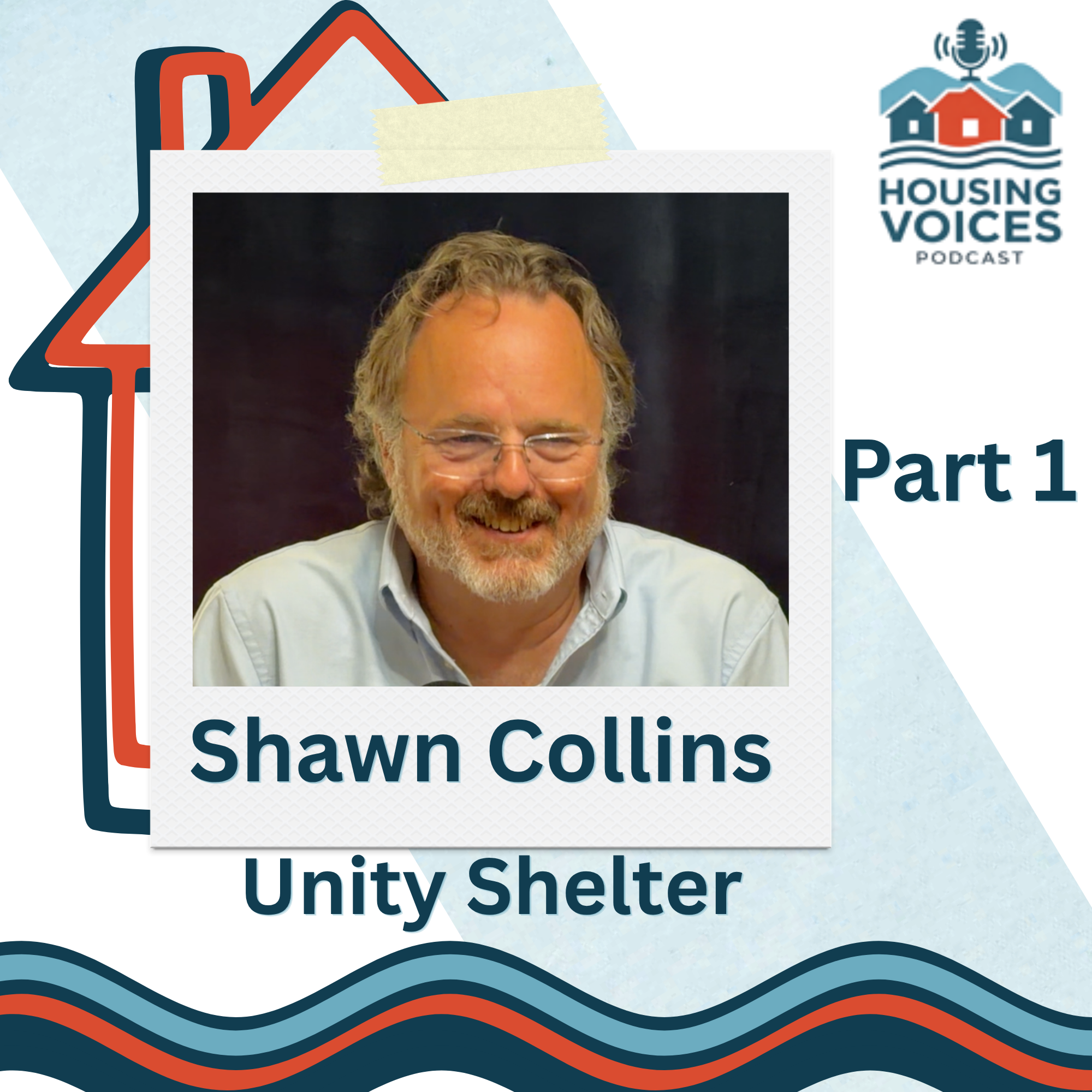
[00:00:34] Speaker B: I know today we get to talk to a good friend of mine, Shawn Collins. He's the executive director of Unity Shelter here in Corvallis, and they provide emergency shelter for people. Yeah.
[00:00:45] Speaker A: And I really look forward to hearing his perspective of, you know, supporting our communities and also the changing in dynamics and who they're seeing because our economy's changing.
[00:00:58] Speaker B: Oh, yeah. And I think we're getting more homeless. But I.
Let's go into Sean. Let's see what he has to say.
[00:01:05] Speaker A: I'm Bre
[00:01:05] Speaker B: And I'm Marty. And this is Housing Voices.
[00:01:09] Speaker A: From the porches and shelters, streets and the room.
If the house had voices, the truth could break through.
Welcome back to Housing Voices. I'm Bre
[00:01:27] Speaker B: And I am Marty. And today we have the honor and pleasure of visiting with a dear friend of ours, Shawn Collins. And he is the executive director with Unity Shelter here in Benton county in Corvallis. It's nice to have you, my friend.
[00:01:41] Speaker C: Nice to be here today.
[00:01:42] Speaker B: Well, will you just start us off with giving us a little bit of a bio about your background and how you got where you're at?
[00:01:50] Speaker C: Yeah, that's a good question. How I got here.
So I actually started my professional life as a librarian. I went to school in University of Tennessee in Knoxville to get my degree in library science. I'd worked in libraries for a while before that.
It was actually the degree is information Science that changed it about the year that I came in.
Worked there for about eight years, and somebody that I graduated with lured me out to HP. And I was another 13 years at HP, basically working on digital library projects and managing a research team internationally. When I left hp, I knew that I really didn't want to be in the corporate space anymore and wanted to be in nonprofits. I had worked with nonprofits for most of the time that I was HP because I was the head of the volunteerism committee at hp. And so we had a annual Day of Caring event that we turned out about 400 volunteers. We had a monthly event at the Sage Garden So, you know, it was pretty well connected with different nonprofits and particularly United Way.
So when I got out of hp, my friend Jen Moore, who was director at United Way at that time, called me and said, we have something that I think you would really be good at. We can't pay you much of anything.
[00:03:16] Speaker A: Many such cases in the non profit world.
[00:03:19] Speaker C: That's right.
And.
And I jumped in, sort of jumped into a position where I was the program manager for the Housing Opportunities Action Council for about three years.
And then after that I became the director of Unity Shelter once it got started up.
So it's. It's a strange journey.
I mean, I think that the, the move into homeless services has been super gratifying. It's also has some kind of personal connections for me. I've got a brother with disabilities that nearly lost his house at some point, and family kind of jumped in to. To make that change and keep him housed and realized very quickly he would have been a horribly unsuccessful homeless person. I mean, he just really didn't have the physical ability or the skill set to be able to survive well out. So shelter is pretty important.
[00:04:18] Speaker B: You got lucky.
[00:04:19] Speaker C: Yeah. Yeah.
[00:04:20] Speaker A: We had a conversation with some, Some folks from the arc, and they specialize in supporting people with intellectual and developmental disabilities and talked about the real struggles that exist for people with disabilities.
Maintaining their housing and navigating the entire process of, you know, recertifying, finding housing, catching up if you've missed payments. It is really hard for people generally, and then people with disabilities.
[00:04:52] Speaker C: Yeah, it is. And he had undiagnosed mental health issues and he's got a lot of physical disability, too. And between those things, it just, it was, it was a long. He was right on the edge of losing his house when he reached out to me and said, hey, you know, there's a problem here.
And I can. I've seen that story over and over again where people, they get overwhelmed by the by things starting to fall apart and they can't really.
There's no lifeline. Yeah. And so they end up on the street.
[00:05:22] Speaker A: Well, the overwhelm is easy because that is your housing.
[00:05:25] Speaker C: Yeah.
[00:05:26] Speaker A: You're one of your most basic needs.
[00:05:27] Speaker C: Yeah. What do you do next?
[00:05:30] Speaker B: And it's hard to ask for help.
[00:05:31] Speaker C: Yes.
Right.
[00:05:33] Speaker B: And people forget that we all, you know, have that horrible sin of pride. Right. We don't want to reach out to people and say, hey, I'm struggling here.
[00:05:41] Speaker C: Right.
[00:05:42] Speaker B: No, because we're, you know, the American culture is, you know, individualism. Yep.
[00:05:48] Speaker C: Yeah.
[00:05:49] Speaker B: So that's hard and that was brave of him. Right. And it also allowed you the opportunity to serve. Can you tell us a little bit more for those who don't know about Unity Shelter, what Unity Shelter as a whole is your mission statement, that kind of stuff?
[00:06:05] Speaker C: Sure.
[00:06:05] Speaker B: I'm sure you know that right off the cuff.
[00:06:07] Speaker C: I think I can probably rattle that off. Yeah. So Unity Shelter started really in 2020, right before the pandemic. We incorporated in January of 2020 and then three months later, it's pandemic time. So we started with two.
There were two overnight seasonal shelters in Corvallis and.
And they were both under the fiscal sponsorship of two different churches in town. Then Safe Camp. What became Safe Place later, the micro shelter transitional housing program was just getting started in the summer of 2019.
And the church there, First Congregational pastor Jen there realized this is not sustainable for the church to run indefinitely. So we're going to need some help.
So they joined that kind of growing party and we really got started doing both shelter and transitional housing.
Right off the bat.
It changed very quickly once the pandemic came. We had to kind of retool and think about what people would need to be able to shelter in place, what kind of services they would need.
There was a lot of growth during that period and kind of brought us to where we are now. But our mission is safe shelter through community care. And we started with collaborative Safe shelter through collaborative care.
We changed it a couple of years ago, partly recognizing that it's really about the entire community.
It's the people that we serve. It's also the rest of the broader community that are really part of that. It takes a lot of partners to do what we do. And so it's really a bigger effort.
[00:07:56] Speaker B: So what did it start off looking like? I think I know, but. And then where is it today?
[00:08:04] Speaker C: So it started out as I said. The shelters originally were just overnight seasonal shelters we ran from November through March and very few paid staff and a lot more volunteers.
As soon as pandemic hit, we pretty well lost all of our volunteer base we had at the men's shelter. In a typical year, we would have 400 volunteers in a five month season.
We have never recovered anywhere near that level of volunteerism since the pandemic.
But we've grown.
The men's shelter has gone through big renovations. So instead of Porta John's and a shower trailer, we've got showers and toilets inside and done a lot of work to bring that building up to code.
The women's shelter during the pandemic room at the end. Women's shelter went to a 24,7 model that really wasn't sustainable in the post pandemic period. Just financially we couldn't really do that.
So it's back to overnight like the men's shelter is.
So we've got 50 beds at both of the emergency shelters we operate right now. We operate a hotel shelter program that's about the only place that we're able to really handle couples or people with kids.
And then we've got 34 micro shelters in service right now as living units in six different locations.
And those are really transitional housing.
[00:09:37] Speaker B: And can you explain what a micro shelter is for those who might not know?
[00:09:41] Speaker C: Yeah, that's not a term. That's really super common.
Think of a 8 by 12 space, right? It's. We're built on an 8 by 15 foot frame.
It's kind of like a souped up garden shed.
They're built, they're built right now. They've been built by the. By two local high schools and Crescent Valley and College Hill. And they've done a terrific job of building those units. And it's been a great experience for the students that have been involved and it's helped us cost wise a lot too. But they're basically, you know, you end up with about an 8 by 12 room that is heat and air conditioning and LED lighting and lots of plugins. And it's a pretty small space. But we kit it out with furniture and have learned a lot about what people need in those spaces.
[00:10:35] Speaker B: When they first came out, I remember that the bed was lofted. Are they still all lofted or is it lofted?
[00:10:40] Speaker C: No, the, the. We have had bunk beds in a couple of them in the past. Bunk beds are really not great for a couple.
Most people aren't really excited about that and they're also challenging for anybody with mobility issues, which is often a part of what we see in our. In the folks that we serve.
[00:11:00] Speaker A: The.
[00:11:02] Speaker C: There's really only like we have a couple of different models. The ones that we typically call a couple's unit have a little higher ceiling and could handle a bunk bed.
We could loft that, but it's really not that practical to do it.
[00:11:15] Speaker B: Okay.
[00:11:16] Speaker C: Kind of moved. Moved away from that. So kind of a simple bed frame. We've been using roughly the same kind of mattresses, sealed mattresses for a long time.
And, and then dresser and some shelving units in there. And so it's, it's pretty basic and it's intended to be.
It's Got locking door.
So it's really intended to be a safe and secure space for people, but it's also not a long term permanent space. So, you know, we, we keep it pretty minimal.
[00:11:47] Speaker A: Can you talk about.
You touched on it a little bit post Covid and how really things have. The environment has. The funding environment has changed for folks in the, the homeless services community.
And we know that far too many Americans can afford really I think a $500 emergency at this point. And there are more people, I think that than they realize are closer to homelessness than they, I think want to admit or want to consciously realize.
Can you talk about how it has changed post Covid? And as we've seen housing prices increase and rent prices increase, how has that affected your community?
[00:12:33] Speaker C: It's a good question. I think there's really two pieces easily to talk to there. One is the funding environment.
The funding environments changed a lot during COVID There was a lot of federal money that moved out and it moved very quickly. The contracting was fairly simple.
The reporting requirements were fairly simple for us to meet.
The federal money has largely gone away in this space and some of that is reductions at the federal level and some of it is for a lot of providers and we are one of them. The strings on some of that federal money are so intense now that our board has said let's not engage in federal funding right now.
It's just the requirements for us to report.
We would have to check every resident of any of our programs, any user of any of our programs. We would have to run them through an ICE database and absolutely not. Not something that we really want to do. And it's, it's really counter to the idea of emergency shelter, which is you show up, you need a bed, let's get you in.
[00:13:46] Speaker B: Yeah, right.
[00:13:47] Speaker C: And fairly. I mean, we collect basic demographics and over time we might have a lot more information about a person, but we don't check citizenship or any of that kind of thing.
The. So the funding environment has really shifted to a lot more state funding.
That's been diminishing too over the last several years, but the state has become our primary funder and that's coming out of general funds. The.
Beyond that, it's. I mean, our donations have made a huge difference. I mean we last year had kind of a record year for donations, but it's still really only about 15% of our budget last year and then some private foundation money.
But it's, it's a lot more braided funding now than it was during the pandemic. When. When it was pretty much you'd get large chunks of change from ARPA or the CARES act or other. Other sources. I think that the other side is what's happened in our community in terms of who shows up at our door. And I think it's a lot more older folks that are a lot more medically fragile.
We see a lot more people car camping because of the hotel program.
We get a lot of referrals for folks that are a family of five and they're trying to work it out in their car or it's heartbreaking. Yeah. Some of the. Sometimes the kids are of an age that they can go to Jackson street and the family is willing to do that, but it still makes it really tough.
But we just see, you know, if you look at the pit count numbers from 2016 to now, and this number is actually a little low because I just updated, got an update on the pit count for 2026. But between 2016 and 2025, we saw 267% increase.
[00:15:41] Speaker B: That's huge.
[00:15:43] Speaker C: And the. The number of folks that are unsheltered right now has grown a lot. There's 330 in the last pit count. Well, that's three times our emergency shelter capacity and we're largely full.
[00:15:55] Speaker B: Yeah. Can we go back and talk about what the pit count is and how that's measured? Because the three of us might know. Right.
[00:16:02] Speaker A: But I helped in Benton county with our last pit count, actually. It was really eye opening experience.
[00:16:09] Speaker C: Yeah. One of the fun things about this, you know, this field is there are so many acronyms that you can often confuse people right away.
So the pit count is the Point in time count. It's a national survey of homelessness in America that is reported up through Housing and Urban Development and usually ends up in something called the ahar, the annual Homeless Assessment report to Congress.
It's done at the end of January.
It's a. In Oregon, that's a challenging time. And the pit count really had its roots in the East Coast. And in the east coast, typically they build shelter to.
To meet need. And so the expectation was, well, we'll do it in January because the majority of the people that we want to count will be in shelter, and it'll be easy. It's not always the case in Oregon and in Oregon and really across the west coast, we've typically built shelter at about half of what the real demand is. So a lot of people are out. And that makes the pit count really hard.
I think the.
[00:17:16] Speaker B: The.
[00:17:17] Speaker C: It's notoriously an undercount. You know, everybody kind of understands from the federal level on down that it typically an undercount. A lot of people don't want to be counted.
And so that's part of it. A lot of folks are just hard to find. And it's really. It literally used to be one day in January in previous years, and they've expanded it to where it's now about a week long period that we can do the count, but it still means you got to get lucky and find where people are.
[00:17:48] Speaker A: Well, especially in our area, we're a little bit more rural, so it is really hard. And then also there are the sweeps to contend with where it is. As someone who, who does street outreach regularly, it, it does become harder and harder to reach people to provide services, have a conversation that pit count, especially because they get swept and they move and it is harder to find them and they are pushed further and further out, but yet our services are closer and closer into the city.
And it is this, this push and pull and the sweeps then end up, you know, taking people's belongings, taking people's identification, things that they would need to get out of their situation.
And then it is such a. Is such a weird push and pull that you want these people to get out of their situation in whatever meaningful way that, that they, that they want, and then also taking everything away from them, essentially. To be able to do that.
[00:18:55] Speaker C: Yeah. And having to really start over. I think that part of the reality of those sweeps, you know, when the city kind of clears camps in the area, is it really encourages people to find not only more remote places, but also not make contact with people. Right. I mean, it's. You don't want to be known, of course. And during the pit count, when outreach teams show up with clipboards or tablets and.
[00:19:21] Speaker A: Why are you asking?
[00:19:22] Speaker C: Yeah, it doesn't really encourage a great rapport.
[00:19:25] Speaker B: So just to let people know, the sweeps are what the city of Corvallis here is doing to remove all belongings of those who are homeless in specific areas and taking them to the dump.
[00:19:40] Speaker A: Yeah, it happens across the nation. It's not just a city, it's a county, it's a state.
ODOT does sweeps. I've also heard some of the railroads also engage in sweeps and you will get arrested. I have, as I said, I do street outreach multiple times a week. And there have been people waiting to get into programs and they lose their identification, they lose their spots.
I've heard people get jobs, they lose their identification in a sweep. They can't finish getting into their employment, and they are back and saying, well, why do I bother? I just got a job offer and I was going in for my paperwork and they couldn't. They needed my ID to prove who I was, and I couldn't give it to them. And they said, well, sorry, if you can't prove who you are to me, I can't finish my paperwork. I can't offer the position to you anymore.
[00:20:36] Speaker C: Yeah. And that's a reality for any employer. Right. And I think that that barrier is going to get even higher because there's a suggestion that there's going to be i9 audits on nonprofit employers, especially where they're going to the i9, if you've not had to hire anybody, is a form that you fill out that basically verifies who somebody is. And they have to show multiple forms of id and then you have to retain that essentially forever as an organization.
The.
If they don't have one piece of that ID and it's going to take them months to get it, then.
[00:21:10] Speaker B: Yep.
[00:21:10] Speaker C: They're. They're basically forced into a different kind of economy.
[00:21:14] Speaker B: Oh, yeah.
[00:21:14] Speaker A: And I.
[00:21:15] Speaker C: Illegal.
[00:21:16] Speaker A: I totally understand, you know, the employer. There are a lot of private employers here in our city that have really worked with folks to get them employment, and it's great. And I totally understand the position that they're in as well.
But coming from the point of view where I'm interacting with these folks on the street who are really trying, really, really trying, they got a terrible start in life. Right. I mean, from the very beginning, or got hurt at work, missed a paycheck, lost their home or lost their health insurance. Right. And then you come in and repeatedly take all of their things away from them and their belongings. And I would be like myself, okay, what's the point? Right? If I try.
And this is what I get for trying.
[00:22:04] Speaker C: Yeah. And it's super challenging. I mean, the city.
So things don't go automatically to the dump lot does, but they're. They are obligated legally to identify anything that is potentially useful.
Personal belongings. But that's all in the eye of the beholder.
[00:22:24] Speaker A: That's subjective.
[00:22:25] Speaker C: And so if it's. If they can identify it and it seems useful and.
And they can, you know, preserve it, then they will put it in storage for 30 days.
Most people never go and collect their belongings. And so it ends up just being a time delay before it's in the trash. And. And it also depends on who it is. So the city has that obligation of 30 days ODOT does not. The railroad does not. Private landowners don't have to do that. Private landowners don't even have to give notice to anybody. They can just clear the property immediately. So it's, it's not a pretty picture.
[00:23:03] Speaker A: No, no. It's extremely complicated. And I think a lot of, a lot of people are stuck in a really tough crossroads of how do we escape this when there are so many different layers of challenges that people face and then organizations as a result face that as well. You mentioned the state is not funding things quite as well. And I think that is a frustration across the board. And then how do you plan for the future as an organization and would you talk about that a little bit is how you're looking at the future from your organization. So viewpoint.
[00:23:41] Speaker C: Wow, tough question. How long do we have.
That's a, it is a tough question right now especially I think that, you know, the goal of the, of the. There was a. And when I was with Housing Opportunity Action Council, we revised the 10 year plan.
HOAC became the housing opportunity planning and equity, the Hope board. Right. And so that 10 year plan kind of rolled into their responsibility.
But if you look at the goals of that revised 10 year plan and then the goals that the Hope Board identified, it's 24. 7 shelter.
It's, you know, enough capacity to bring people in. It's a lot of different things.
And, and that 24, 7 shelter should be year round and it should accommodate pets and couples and, and families and. Right. It should be an entire system.
We're not even close to having a real functional system.
And the state is very interested in creating.
They've got, in the last two years, the funding that we've gotten has been labeled statewide shelter program. So they are really trying to build a more consistent approach to shelter across the state, but the funding's not there.
And I think that we're looking at, you know, and I look forward at the next 12 months.
I'm pretty confident that we're going to have funding for about nine of those months to keep everything open.
And, and then it's, you know, I've got nine months to try and figure out how to fill out the rest of that 12 month period.
And as I said before, some of it'll be donors, some of it'll be grants and foundations. Right. But, but if we don't get there, it's not like we have a deep pocket that we can reach into as reserves and keep things going.
We've gone through a couple of periods where we've done layoffs and shutdowns or consolidated into one shelter instead of two, which reduces our capacity by half.
That's kind of the year we're looking at. And then the year following that, the state is projecting a 50% cut in the amount of funding that. That they're providing now.
[00:25:58] Speaker B: Oh, boy.
[00:25:58] Speaker C: And the expectation that they've communicated is that local communities will fill the gap.
And you know, our budget this year is down significantly from last year's budget. It's still $3.1 million.
The funding we'll get from the state this year is 2.1. So we've got a huge gap to fill now if, if we go down by half again from the state allocation next year.
That's right. We're gonna see shelter closures.
[00:26:28] Speaker A: Yeah. You can't recover from that as well. And I don't. I don't necessarily wanna start a tax policy conversation here today. Cause I know it's a good conversation. I know we're all jazzed about tax policy, but it's really interesting as we are still paying, you know, as taxpayers still paying the same amount of taxes. And how are we, our communities, reaping the rewards of those taxes as we are seeing less and less of that? And communities are supposed to foot more of the bill while still paying the same amount in taxes. And how is that sustainable? I don't think it is, but that's just me on my soapbox again. She likes soapboxes.
[00:27:09] Speaker B: I do, but she does.
[00:27:11] Speaker A: How have your conversations been with state legislators as we're going into the long session here? Because our long session is often the opportunity to get some more funding. A one off. Not consistent, but so more funding.
[00:27:25] Speaker C: That's part of the changing landscape. And funding is that.
So the short answer to your question about our relationship with state legislatures is directly, I don't have one.
[00:27:37] Speaker A: Really?
[00:27:37] Speaker C: Yeah.
And I think that our relationship with even Oregon Housing and Community Services, which is our big funding partner, has changed because the first year that we got funding from them, it was a direct one to one relationship with ocs.
So they contracted directly with us. And then very quickly they realized that that was overwhelming because they were dealing with organizations across the state.
[00:28:02] Speaker A: Yeah, that's a lot.
[00:28:03] Speaker C: And they said, okay, we're going to shift gears here and we're going to route it through local planning groups, or what's now called the regional coordinator.
And so our relationship is actually mediated with the state by the county. And so the county really holds a lot of that responsibility to navigate this relationship with the state.
And so they're the ones that are sometimes talking to us about, you know, maybe you should testify or write a letter on xyz. But a lot of that relationship is direct between the County Coordinated Homeless Response Office and the legislators or the state agencies.
[00:28:41] Speaker A: I understand why, as you've explained it, why they went that route instead of directly appropriating from OHCs.
But it feels like a lot of added bureaucracy that slows things down, I think, makes things slower to react to changing conditions in communities especially.
I find that really troubling that there's no connection between your organization and our state legislators. Because while there's direct funding that comes from general funds and comes from the grants through. Oh, there is a lot of funding opportunity through what's colloquially called the Christmas tree bill, which is direct appropriations from the state lottery funds, which is what that is. And it provides a lot of funding as well. And I think it's really important for legislators to hear directly from folks like yourself and folks who work in the industry on the ground to know what it is like in a day to day basis. Because I think a lot of people, you know, we all are stuck in our bubbles and we only know what we see in our daily lives.
And I'm always advocating for our politicians to be on the ground.
[00:29:52] Speaker C: I think the, you know, we talked a little bit about the, the history of Unity Shelter and that growth period.
I think you're right. It would be helpful if we had a more direct relationship. I also know kind of what the stack is right now for an organization like ours and, and we're actually pretty good size compared to a lot of non profits and in, in our community and, and probably in Oregon, like it's a, it's a 14 hour day to keep the wheels on the bus.
[00:30:24] Speaker B: Yeah.
[00:30:24] Speaker C: And so the idea of trying to build relationships with legislators and show up and say, oh absolutely, is super challenging.
[00:30:31] Speaker A: Right, Totally.
[00:30:32] Speaker C: And I think particularly.
[00:30:33] Speaker B: And where's that coming from?
[00:30:34] Speaker C: Yeah, and particularly when the funding isn't there. Right, yeah. You know, on our base funding. So what you end up doing, I think as an organization, and this is something I have testified to legislators about, is you're creating an environment where the very people that need to be the most creative in trying to find solutions to some of this, the problems that we have are so conservative. Right. Like I've got unfilled positions that I've had unfilled for years. I've got, you know, we, we hold tightly to those dollars for as long as possible until we have to spend and that's not always the way to actually innovate. You know, when I'm. When I look back at my days at hp, and a lot of what I did at HP was research around business development and new business development.
Like, that's not how it works. Right. You've got to have some working capital. You've got to be able to innovate. You've got to be able to work pilot programs and see what works. You don't do that when you're worried about making payroll. Every.
[00:31:39] Speaker A: We have the studies that show that from a scarcity point of view, in terms of capital, there is less creativity. Families who are in poverty tend to make, quote, unquote, worse decisions with their money because of the environment that they're in. And as far as the connections with our legislators as well, to be clear, the onus is. Is on them because it's their job, really.
[00:32:04] Speaker C: Sure.
[00:32:05] Speaker A: Right. That's what they sign up for.
[00:32:06] Speaker B: So we're having reduced funding. Right. Coming down from the legislatures, and it's not just to Unity Shelter.
[00:32:13] Speaker A: Right, Right.
[00:32:14] Speaker B: So this is across all of it. Who are some of your best collaborators that you work with? But maybe we take a step back for a minute and talk about what does the homelessness look like here that you're dealing with and what does it look like from your perspective versus somebody who's not deeply entrenched in the work?
[00:32:37] Speaker C: I think that it's hard sometimes to explain to people what we see every day, partly because it's not a picture that everybody wants to absorb.
And I think that that idea that Bri, you mentioned, that so many people are one paycheck away from being homeless and like, that's a really hard thing to face and kind of intellectually grapple with every day.
[00:33:06] Speaker B: Right.
[00:33:07] Speaker C: And so you find ways to distract yourself and look away. Right.
I think that what we see is a lot of myths about the homeless population. That they're all from somewhere else, that they're all drug addicted, that they're all, you know, just living the life, you know, that they chose, you know, and.
[00:33:29] Speaker B: Because they all want to be homeless.
[00:33:30] Speaker C: Yeah. Because everybody really.
[00:33:31] Speaker A: People don't want to be helped.
[00:33:33] Speaker C: No. And it's very exciting to live in a tent in the mud. Right. So everybody would want that.
And it's camping. Right. You know, we go camping on the weekends and it's fine. Like, why. Why is this such a big deal? The reality is it's the. The people that we see. And we just had somebody pass away yesterday, so I'm sorry, the.
He was 54. Right. Was homeless for off and on for 20 years. Like the reality of the people that we see is that their lifespan is dramatically shorter and more miserable than people who are housed. And the that oftentimes it's not a matter of they don't want to work, they're injured, they're on, they're disabled in some way.
The num. The prevalence of traumatic brain injuries among folks who are homeless is super high.
[00:34:29] Speaker B: Right.
[00:34:30] Speaker C: The prevalence of other intellectual disabilities is super high. And so.
And then the physical disabilities are super high. So you've got a population that largely they're not going to be suddenly flipping into a 40 hour week job and turning their lives around.
They're going to need supports.
[00:34:48] Speaker B: And so that's what you do with the case management.
[00:34:51] Speaker A: Right.
[00:34:52] Speaker B: So you're not just saying, hey, go here, sleep in this bed. Right. You're saying, go here, come in, sleep here. And here's what else we're going to help you with. Yeah.
[00:35:03] Speaker C: And I think that that's been part of our evolution over the last six years is coming to understand just how much we can do and where we need to lean in. The We've got partners that we've had from before there was Unity Shelter like Corvallis Housing First. So Corvallis Housing first has been our case management partner.
When I got involved with the men's shelter, they were already there. They had been running a men's shelter before I got involved. So they knew that space and their case managers have been involved with us and walked alongside us the whole time.
We shared Space at the 3rd Street Commons project when it first opened. So we ran shelter there for three years with them. So they're a huge partner. The Drop in center, the Corvallis State Town Drop in center is a big partner. Benton County Health, there's so many great partners.
It takes all of them to really make it work, but it's still not enough.
And so we developed a care team that has traditional health workers and peer support. Because a lot of times, yeah, you get them in for a bed once they're in and you start building a relationship, you realize, oh, you're a diabetic and you haven't actually been a controlled diabetic for a long time, you know, and part of that's your access to insulin, part of it's that you haven't seen a primary care physician.
[00:36:27] Speaker B: Right.
[00:36:28] Speaker C: Maybe in a year or 10.
[00:36:30] Speaker B: Right.
[00:36:31] Speaker C: And so part of the work of that team is to start to get people re engaged in some of those systems. But those systems aren't friendly to the people that we serve. And so they often are accompanying them to appointments, they're serving as almost translators in that medical setting so that people can understand the system that they have to navigate, making sure that they understand the medications and the treatment plan that they're getting.
And then if. If they can't actually follow that in shelter, trying to figure out, okay, what other options do we have? Would this be person be a more appropriate candidate for a micro shelter because it would be able to heal better or do they need to get into assisted living, supervised nursing facility? What is the issue here? And so our care team has placed a lot of people in assisted living, which is very difficult.
We've got somebody that's getting ready to go into memory care.
That that's going to be a months long process. And so that's been part of where we've been able to grow our program as we understand more about what their real needs are.
Because it's never, excuse me, it's never just about a roof.
[00:37:46] Speaker B: No.
[00:37:46] Speaker C: It's always, you know, how do you deal with all the other things that this person presents?
[00:37:51] Speaker B: And that's. Those other things are parts of the reason why they're homeless. Right. Because people don't normally. How many of your clientele would you chose homelessness?
[00:38:02] Speaker C: It's a super small percentage.
[00:38:05] Speaker B: So. But that's.
[00:38:06] Speaker C: Yeah.
[00:38:06] Speaker B: I mean that's a misconception that's out there in the world. Right.
And unless you've worked.
[00:38:12] Speaker C: Right.
[00:38:12] Speaker B: Because I started off and got to know you by sleeping at the room at the inn. Right. And I did on a weekly, I would bring people in for, you know, dinner nights because there was a lot more engagement. Right.
And very rarely did I see someone that didn't have some sort of disability. Right.
And that didn't need help. But it took a lot of time to gain the trust so that they can start opening up, so that they can start getting additional helps and supports that are needed.
Because if you don't know what's out there and you can't accurately assess what your needs are. Right.
You can't progress and get through a system. Because many of the people from our experience. Right.
Didn't have the family support young or the family support left or the parents or siblings or whoever also had drug or mental illness or physical disabilities.
And that it just becomes the cycle.
[00:39:19] Speaker C: Yeah. And the number of generations of homelessness and extreme poverty that we see are. Is huge.
And the.
I know lots of grown parents who have kids that are in their 18 to 20 year old range who are homeless.
[00:39:38] Speaker A: Yep.
[00:39:39] Speaker C: And they grew up here. You know, they went to Corvallis schools or Floma schools. You know, they're, they're local folks. They've just, this is the life that they've had and it's, that's a hard cycle to break.
And I think particularly if you didn't have that deep support network when you were growing up, you don't really even understand what's possible and how to ask
[00:40:02] Speaker B: for that, because there's no way to know that.
[00:40:04] Speaker C: Right.
[00:40:04] Speaker B: If you, if you've never had that or been blessed with that. Right.
[00:40:08] Speaker C: Yeah.
[00:40:09] Speaker B: How would you know?
[00:40:10] Speaker A: You grew up in foster care and on 18 you are, I know personally, quite a few young adults that grew up in foster care and on their 18th birthday they're out and. Okay, now what?
[00:40:26] Speaker B: Right.
[00:40:26] Speaker A: Or I know of veterans that are unhoused on the street because of things that they experienced while serving our country and they are left on the street. Yes, there's VA support, but that means that you can get a ride, you can access that and that's not always
[00:40:46] Speaker C: easy in the catchment area. You know, the area that the VA serves really is centered in Roseburg, you know, or Portland. So we're kind of in that gap.
[00:40:55] Speaker A: Well, my own grandfather, he was a veteran and I have had to give him rides to his appointments in Eugene and Roseburg. Even if there are rides for veterans, it's not always available and it's not always accessible, so I've had to step in. But if people don't have a family support network, are you going to make it?
[00:41:17] Speaker C: Yeah, it's, it's been one of the real educations for me is to see, you know, many of us have had a variety of traumas in our life. I mean, you know, if you look at my ACEs score, the adverse Childhood Experience score, you know, it's easily a six.
I had a lot happen before I was 12 years old and, But I also had a very supportive family and grandparents that cared and teachers that cared and neighbors that cared and, and would step in at times and, and mentor me, talk to me, connect me with jobs, you know, like I had, I had that support.
And you see so many people that have never had anything like that and don't trust it when it's there.
I think that one of the things that I've learned is you have to open the door and then you have to keep opening the door long enough for people to trust that it's Going to be open.
[00:42:26] Speaker A: Trust is hard to build, especially when you've been taken advantage of by pretty much everybody you've ever known.
[00:42:33] Speaker C: Yeah. And the systems that we have, you know, are not terribly friendly.
[00:42:38] Speaker A: Nope.
[00:42:39] Speaker C: And so it's really easy to lose trust in the system. And if you were say that you aged out of foster care and then you end up on the street like it might have been a bad experience while you were in foster care. And then you're out like, okay, you're, you've pretty much burned that bridge. You're not going to trust the system of care that is supposed to be looking out for you. Because they didn't.
[00:43:03] Speaker B: Yep.
[00:43:04] Speaker C: And it's, it's very similar with people that come out of incarceration.
They're often discharged onto the street at 2 or 3 in the morning with nothing.
And while they were incarcerated they lost their benefits. They may have lost their access to meds. Maybe they got them while they were in jail, but they're not exited with a supply they don't have. Ohp. You know. And, and if there's not a system that at exit reconnects them with all of those services, they're going to be lost and end up back in, in the shelter or they're going to gravitate right back to the community that got them in jail in the first place.
[00:43:42] Speaker B: Right.
[00:43:43] Speaker C: The community and activity. So it's, we don't, it's.
I don't want to get on my own soapbox here. But, but I don't think we have a system that actually cares about people.
[00:43:53] Speaker A: I would agree with that.
[00:43:55] Speaker C: We defend property to the end of the earth.
[00:43:57] Speaker B: Yep.
[00:43:57] Speaker C: We will sacrifice people for the sake of property.
[00:44:00] Speaker A: Absolutely. The almighty dollar, the almighty capital. And if you are not a productive member of society, you have no worth if you can't generate capital for somebody, period. And that's something that's actually a great segue for, for something I wanted to talk with you a little bit about is, is how much more affordable prevention is than rehabilitation and how much better our communities would be if we truly invested in them.
I say a lot of times we are only as safe as our most vulnerable community members because we will all become disabled at some point. We will all have some type of medical need. Something will always happen to someone.
I think, and there are studies to back this up, that investing in people, in our systems, in our communities, actually makes our communities more thriving and robust and more wealth generating in the long run. Right.
[00:44:59] Speaker C: So I recently had a reason to look at the growth in the number of people that we serve versus the growth in the cost per person.
Between 2021 and 2025, the number of people that we serve in a year went up 65%.
Our per person cost went up 8.
[00:45:22] Speaker B: That's fantastic.
[00:45:23] Speaker C: It's. Yeah. Like we beat inflation by a long shot, right? Yeah. And so it's about $135 per person per month for the to do what we do.
If we were funded at even 200amonth per person, that would be huge for us. Right. I mean, it would open up huge possibilities for us to increase services, maybe open a new shelter. I mean, there's all sorts of things that we could do. But that's like we're struggling to make sure that we can get that $135 per person per month. That is nothing. Right. That's probably the coffee budget for a lot of us.
[00:46:06] Speaker A: Yeah. When we're talking about the real costs and comparing it to the other places that we invest our money in.
Right. I'm not going to go in on that. A government budget conversation.
[00:46:18] Speaker B: She loves the legislature.
[00:46:19] Speaker A: It's really thrilling.
[00:46:20] Speaker B: It's rare. She really dives deep in and yeah, sometimes I'm like, okay, Bree, blah, blah, blah. You know what, let's take a break for a second and let's come back with Sean because there's so many more questions that we have that we want to talk to you about.
This is Housing Voices Practical Solutions Meet.
[00:46:39] Speaker A: A special thanks to our partner, MartyBullford.com and Cyanette.net for supporting thoughtful dialogue around housing in our communities.
Music for Housing Voices is provided by Karen DeWolf and Adrienne Kriz. Thank you for helping us set the tone.
You can find
[email protected] and connect with us under Housing Voices on Instagram, Facebook, LinkedIn, Bluesky, TikTok and our YouTube channel.
If you'd found found value in today's conversation, share this episode, follow the show and help us expand the dialogue.
Until next time, this is Bri. Let's keep listening, keep learning, and keep building practical housing solutions together.