[00:00:00] Speaker A: The truth can break through.
[00:00:04] Speaker B: Hey, it's Bre and Marty and we are here at Housing Voices. Thank you for being with us today. Today and every day and any day we're here.
[00:00:15] Speaker A: Yeah, we're here so much.
[00:00:17] Speaker B: We feel like it some days. But housing is such a complex issue. And today we've got a really fantastic guest to speak with us.
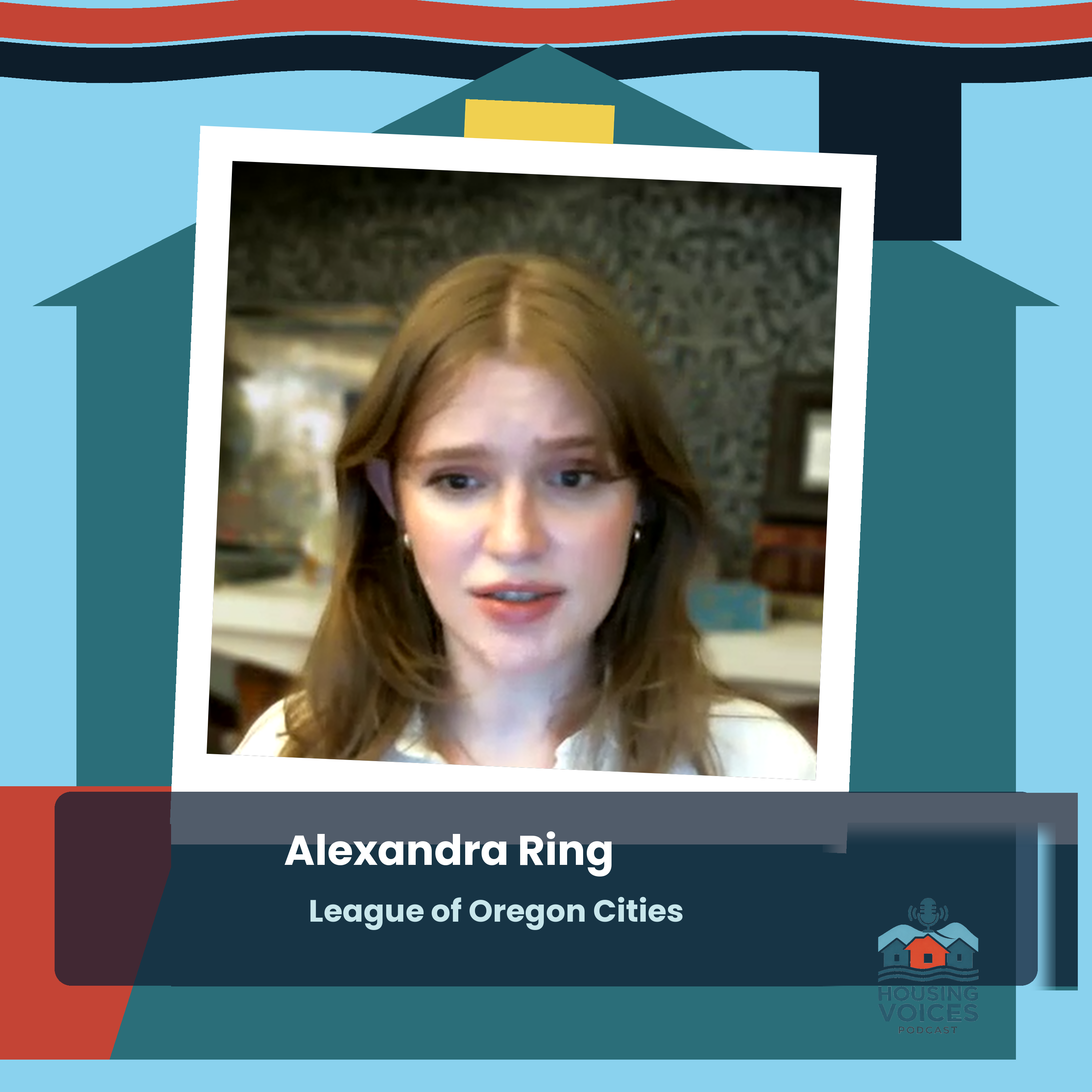
[00:00:25] Speaker C: Yeah, Alexandra Ring. She is a lobbyist for the League of Oregon Cities, which is, which is an organization that represents 241 cities across the state. And so she represents all of their housing and land use needs and complaints and goes to the state legislature to make those happen. Or as it happens in the legislature, maybe not.
[00:00:51] Speaker B: Well, I'm trying to determine what's the most important. That's what I'm really interested in hearing is how do they determine what issues they that the LOC is going to advocate for and promote.
[00:01:02] Speaker A: Yeah.
[00:01:02] Speaker C: And I think it's also a really good conversation for our, our buckets that we have here on the podcast and really talking about the legislative bucket and infrastructure which is brought up time and time again as a reason why we're not building enough housing. So I'm interested to talk with her.
[00:01:20] Speaker B: Me too.
[00:01:22] Speaker A: From the porches and shelters, streets and the room.
If the have voices, the truth could break through.
[00:01:38] Speaker B: Okay.
[00:01:38] Speaker C: Well, Marty, we are here with Alexandra Ring with the League of Oregon Cities. Hi.
[00:01:44] Speaker B: Hi.
Thank you for joining us here on Housing Voices. We're so glad to have you.
[00:01:50] Speaker A: Wonderful to be here today.
[00:01:52] Speaker C: I would love for you to tell us a little bit more. We talked about your bio, a brief bio before we jumped into this episode. But could, could you please talk a little bit about yourself and your role at loc?
[00:02:07] Speaker A: So I'm Alexandra Ring. I am the housing and land use lobbyist at League of Oregon Cities. We represent all 241 cities in our great state, from small frontier towns to large urban centers. So we run the whole gambit.
I've been with the league for about two years now. I started at Oregon Housing and Community Services prior to that. So I've been in the housing world for a long time at this point, or at least it feels like a long time.
But I've only been really in the land use world, in the city world for two years
[00:02:43] Speaker B: now. What drew you into that?
[00:02:46] Speaker A: So I, growing up, my father thought it was extremely important for me to understand all parts of Oregon. I grew up in Portland, but my parents are both from small timber communities in Oregon and thought growing up that I needed to have kind of a Greater understanding of our state and all of the different communities and people who live, live here.
And so during the summers, we would go on road trips to everywhere, from John Day to Westford to the south coast, all over our state, and see people my father had grown up with have conversations about what different folks lives were like across the state. And I think that really kind of engendered in me a deep love for Oregon and all of its people and communities. And so I really wanted to go into kind of helping other folks in our state, folks who are coming to our state, make this as a place that other people wanted to live and raise their families and grow up and have the experiences that I had.
And so I started working in politics first when I was 16 and kind of worked my way up there. And I was working for a congressional office during the pandemic, doing social media and casework, and I was really burnt out.
[00:04:07] Speaker C: I can relate.
[00:04:07] Speaker A: It was really hard. We'd gone through the 2020 fires and, you know, it was. It was hard. It was very rewarding. But it was a challenge. And I was looking for a new challenge. And somebody called me up that Oregon Housing and Community Services was looking for a lobbyist. And they were going through, you know, a very hard period of growth and expansion. They were running the state's first major rental assistance programs. We'd had the state's first major disaster. They were in line to be the agency that received all of those funds.
And I remember talking to my hiring manager, who is ironically still my boss to this day, and she's like, are you sure? You know, this is not going to be an easy job.
We're, you know, trying to manage a lot of things and not a lot of it is going exactly how we'd like.
And I jumped at the chance and I really found my place first in housing, and then when the opportunity to join League of Oregon Cities to work both in housing and cities and in all of the communities across our state was like the most perfect fit.
And I've been with League for two years now, and it truly, I have to say, I couldn't be luckier getting to work on both an issue area that I love working on and also getting to work with all of our different communities.
[00:05:32] Speaker B: So normally I grew up in D.C. so I'm a little bit familiar with lobbyists, and most of the time they're attorneys. But your.
Your background is not in law. So tell us about that.
[00:05:46] Speaker A: Yeah, so I think it really depends in Oregon as to whether or not you're an Attorney or just, you know, someone who is deeply kind of versed in policy.
It's not particularly common for housing lobbyists in Oregon to be attorneys by trade.
We have legislative council attorneys who help us with all of the little legal things that we get to do. And, and really being a lobbyist is much more about knowing things about different communities and the issue areas that you're lobbying on, rather than the exact nuances of law.
Other forms of lobbyists, you know, once you get into lobbyists who work more in the, in the criminal justice space or in, you know, general government, you might find more lobbyists who are also attorneys. But by and large, in the state of Oregon, most lobbyists are just, maybe they have a master's in public policy or they're just someone who's found a real passion for working for communities.
[00:06:47] Speaker C: And Alex, I want to go back to something that you said earlier.
That LOC represents 241 cities.
And when we're talking about housing, that is a lot of variation in city size, in housing needs and you know, the fiscal environments that a lot of these cities are operating in as well. I think, I mean, here in Corvallis we're facing, I think, a $4.1 million budget shortfall.
And I know that there are other cities out there in similar positions.
Can you talk about how do you support cities effectively when they're so different?
[00:07:32] Speaker A: It's never dull. There is never any singular day that looks the same.
You know, we have communities like the city of Portland or even Eugene that are looking at, you know, tens of thousands of housing units that they need to build. And how do you incentivize that?
And then you get down to, you know, our smaller communities where they're looking to see if they can find a non profit to build their first duplex.
And there is no, there is no common solve. There is no singular fix that is going to magically make all of our communities across the state have housing.
It really is trying to create the broadest possible policy basis that can help out as many communities as possible. And knowing that no singular policy, no singular budget line item, anything of that nature is gonna, is gonna solve all of it because there are common needs. But you cannot hit all241 with a single piece of legislation.
Makes sense.
[00:08:40] Speaker C: And particularly with, with regard to that is. Do you see as we're going kind of into the new session here in the new year, we still got got some time can you talk about. Because we had Representative Gomberg on earlier on the podcast. He was our first guest yes, he was. And he talked about some of his legislative priorities going into this next session with regard to housing, and particularly of interest for him was infrastructure.
And I used to work for Senator Wyden and had a lot of cities here in Oregon that I was supporting, you know, wherever there was a federal nexus. And a lot of, you know, same, same kind of story I kept hearing in a lot of these cities was that, yeah, we would love to build housing, but there are some cost barriers here, whether that's, you know, buildable land or whether that is infrastructure as well when it comes to water, sewer, those types of things.
Is that on your radar at LOC as we're going into the next session? And can you talk about those kind of conversations? I know we're really preliminary here, we're way out ahead of the session, but I would love to hear your thoughts on, on where we're at on that.
[00:09:56] Speaker A: Well, luckily at LOC, we start our planning well ahead of session. So we actually had our kind of like preliminary policy agenda setting process in the spring. So we got a bunch of our members together in different topic areas and had conversations about, like, okay, in water, what are you seeing in housing, what are you seeing, you know, in general government, like, you know, finance, what are you guys seeing and what are the fixes that you need? So we are currently kind of out for voting. All 241 of our members get to vote on. You know, I think it's 15 this year, different agenda items and say, like, hey, you said these are the things. But how, what are we prioritizing this session? Knowing that there are common themes that we hear every session, we don't have our voting back yet. Our members still have a little bit more time, but really initial voting is telling us exactly the same thing that we've been hearing last couple of years, which is infrastructure is one of our largest barriers to economic development, to housing, to pretty much everything.
And it's such a complicated issue because you have road infrastructure, you have water infrastructure, and I think water is the one that most commonly comes up when we put in that kind of infrastructure bucket and then we put transportation off to the side, but it's also things like broadband that are huge issues for our community and allowing folks to grow and thrive. On the water infrastructure side, I think at last, guess the need for water infrastructure was $6 billion in Oregon. Ish.
[00:11:31] Speaker B: Okay. Yeah. What about sewer infrastructure? Are you enclosing that's including that in the water?
[00:11:36] Speaker A: Okay, yeah.
[00:11:37] Speaker B: Okay.
[00:11:37] Speaker A: Generally. So, and, and some of that is just system maintenance that's been deferred.
Some of that is the decline in the federal cost share for infrastructure, which has been on the decline since the nineteen nineteen seventies.
It's really hard to manage aging infrastructure systems. And a lot of our cities put in infrastructure Systems in the 20s and 30s and those systems are reaching their 100 year mark. And if your community has grown, your sewer infrastructure probably needs to grow too. And people find it rather upsetting when their sewers stop functioning and doing what they're supposed to do. And so you have communities that want to grow, they need housing, but they can't put the burden of paying for that infrastructure on the new housing coming in, at least not entirely. So they're having to find federal resources through their federal legislators, through Wyden and Merkley or Bonamici or Benz or any of those, or they're having to talk to their state legislator to ask for something very similar.
[00:12:44] Speaker C: That's really interesting. I'm sorry, if I could just.
It's really interesting what you just said about putting the costs on the new housing because something that we've talked about is there are some cities that have done like SDC waving or like mupti, the multi unit property tax exemptions as well as a way to incentivize building.
And then, and I get why they, they did that. But then who, like, who's going to pay for that right at the end? Right? Because then there's going to be a levy that has to be passed or people's rates have to go up as well. And that puts a lot of, of in kind of a pickle, right?
[00:13:28] Speaker A: There is no perfect solution to paying for infrastructure. It's coming out of your pocket at some point. If it's coming from the federal government, you have paid your federal taxes to pay for that. If it's coming from the state government, you have paid your state taxes to pay for that. And if your local government is having to do it through a levy or a bond or any of these other resources, especially if it's coming directly out of your water bill, you are paying for it. And so really, you know, cities use SDCs to try to offset some of that. They try to do the delicate balancing act that is near impossible of SDCs, levies, increasing rates, all of those things to try to make it manageable. And we don't really have a, there is no magic bullet to make, you know, all of these large scale infrastructure projects that we haven't done in so long. Pencil all of a sudden,
[00:14:26] Speaker B: so I heard that you said that each of the cities vote on the topics that they are most concerned about. You send them out of voting.
[00:14:35] Speaker A: Do they do.
[00:14:36] Speaker B: Is it ranked criteria? How does that work? I have a couple other questions along with that.
[00:14:41] Speaker A: They do their top five.
So generally we'll send out anywhere between, like, we try to keep it reasonable. 15 each different policy area. There's a combination of cities who, who work with us at LOC to set those kind of what they want, what they think the other members are going to say are the most important in that area.
We'll use housing as the example. They said shelter resources and eviction prevention. No shock there.
Housing development dollars also no shock there. And then like little land use tweaks, tweaks around wetlands, you know, URAS statute cleanups, things like that.
[00:15:22] Speaker B: But so you've got, as you mentioned before, cities of different sizes. Right.
Which also encompasses people.
[00:15:30] Speaker A: Right.
[00:15:31] Speaker B: And so therefore, how.
How do you play with the value of the, of the human vote? Right. Is Portland just getting one vote so that, you know, or does Portland get 15 votes? Right. How does that work out? And so can you kind of take a step back and explain how the structure of the LOC works and how do voices get heard? Right.
[00:15:55] Speaker A: So it's deeply complicated. I think being an organization that is tasked with, you know, representing such a variety of membership, you kind of have to come back to it every so often and ask yourself the question of, like, are we truly accomplishing the goal right now through our policy process?
How we lay it out is you have, you have different regions of the state. They're available on our website, and each different region of the state gets a certain number of representatives in the policy committee process. For areas like, you know, the Portland metropolitan region and the Eugene area, you may have a greater amount of representation based off population just to kind of even that out than you would, you know, if you're in, you know, deep eastern Oregon. We can't quite get to the, the fully proportional representation because things would get really out of whack really fast. But we try to balance that best we can, along with having folks from our women's caucus and our people of Color caucus. And, you know, in my work group, we get folks from the electric utilities just because electric hookups and utility hookups are a huge thing for housing.
So we try to balance that through that process kind of best we can.
And then it goes out to the members for the vote. One member, one vote.
I think one of the surprising things is that when our membership votes on ballot items.
It's not that different for the most part. You know, small towns are still going to have the same shelter and homelessness concerns that large cities do. The scale may be different, but the concern is still the same. And so when we look at our voting, we don't see regularly large gaps where we're only seeing large cities vote for one issue and the small cities are voting for another.
That being said, we do have a board that sets our final priority list and that they may try to add or rebalance things and they also have regional representation and all kinds of other ways to try to balance our membership.
[00:18:10] Speaker B: So where. So we had Jamie, what was her last Cloud Skinner. Thank you. She's way better with the names than I am.
So we had her come talk about how the wildfires affected the housing in southern Oregon here a few years ago.
So when a catastrophe like that happens. That was a weird.
So sorry.
When a catastrophe like that happens, how do you come in and balance that coming into a session in the legislature? Right, because we've got, I mean, we
[00:18:40] Speaker C: have fires burning right now and.
[00:18:41] Speaker B: Yeah, how is that balanced? Right. With the needs to protect those, those families who are suffering, but it's not necessarily the majority of the population.
[00:18:53] Speaker C: Also not part of long term planning. Like when you're talking infrastructure as well. How do you, how do you maintain the long term goals as well as short term emergencies too?
[00:19:03] Speaker A: Thank you.
So we're doing, you know, a lot of work on what that looks like right now. I think historically what we've said is like, you know, we have 241 members. We have to do what, you know, impacts the majority of our members.
But I think in practice that's never really been, you know, we're always going to be the ones who come in and pitch hit and are the ones on the phone with the mayor being like, hey, these are the people you contact.
Here are some resources. We'll plug you in with. Folks, Even if that's not our official policy, we're really working on establishing more of a do no harm principle as an organization of saying what is good for one community is good for all. If we're not harming other communities, we can have more of a holistic view of our membership.
It's a struggle because I wasn't here in 2020 when those wildfires happened and we have staff beyond our legislative staff who are, you know, the ones who, who do a lot of those direct points of contact with their city manager and things like that. When there's more specific Crises, we're here to pinch it. When there's a legislative ask or they need to know which legislator we're contacting.
How do you get in touch with hud, all of those kinds of things when.
[00:20:28] Speaker B: No good. I've been
[00:20:31] Speaker C: this kind of alludes to what you were, what we were talking about before, the difference between the larger cities and the smaller cities. A lot of these cities, when we're talking about legislation and specifically housing legislation getting passed and it could potentially, you know, contribute to a lot of a burden that maybe one person in a small city is doing three jobs. Right.
How, how does loc, I guess, kind of one, smaller cities who have extremely limited capacity, and also two, in a legislative perspective, how do you then try to make these big housing moves happen for Oregonians and across the state while not, you know, totally screwing over the small cities who are tasked with sometimes what feels like impossible tasks?
[00:21:23] Speaker A: It truly does feel impossible sometimes. So 2/3 of our members as LOC fall into our small city categorization, which is cities under 10,000 and a large portion of those are well under 10,000.
The, the vast majority of our membership, you know, if they have a planner on staff and are not reliant on either a contract planner or a planner at the county, it's, it's truly amazing.
Our large cities may have planning staffs of, you know, 5, 10, 15, 20, but for the small cities, you're, you're in real hard shape. Your city manager is probably pinch hitting. You're probably pulling in a city attorney that's on contract with questions.
In some cases, you're going to LOC's legal support team to ask your questions.
It really is for a lot of our small towns, kind of existential when you have to deal with the scale of change that we're talking about.
Because in most cases you are not dealing with the kind of capacity needed to deal with session after session changes and changes and changes.
It's hard to balance because obviously you want to make pro housing changes, but you want to do things in such a way that it doesn't incredibly crunch that capacity.
So things like for larger lifts that are going to be things that are easier for large cities to do, putting a cap on population size, saying, you know, this applies to cities over 25,000.
It's not, you know, ideal, but it is a way to deal with capacity constraints and giving other tools to smaller communities that are more compatible with the amount of capacity that they have.
So for, you know, large communities, they have ona, and for smaller communities it's talking about what the correct proportion of that is, is. And there's no right answer and none of it is perfect. And most of our cities, regardless of size at this point are feeling the crunch.
[00:23:34] Speaker C: Well, and as I guess maybe this is kind of asking you to prognosticate a little bit because you haven't necessarily gotten all of your information from your member cities.
As I think from an outside perspective, for folks that are not in the legislature or not working actively with the legislature as well, they see a lot of some big price tags with some of these pieces of legislation. Right.
And maybe not necessarily seeing in their day to day life, you know, the evidence of those big price tag legislation passing through.
How do you kind of balance those views with a huge problem that is a huge need as costs are rising. Right. For pretty much everything across the board.
How do you deal with that with the cities? Because the cities are going to have to answer to their taxpayers like, I'm paying this amount of money in taxes and I just saw you pass this, this bill and you're supposed to be doing all this and where is the action?
[00:24:41] Speaker A: I think the simple answer is, you know, 50 or so years of systematic disinvestment in infrastructure and housing in essentially all of our social systems is not going to magically fix itself overnight.
Cities operate under Measures 5 and 50 in the state of Oregon, and the state is also incredibly constrained in their revenue. So these may seem like big price tags. They are drops in the bucket that we are trying to fill.
And so you referenced Corvallis budget hole. I can tell you the vast majority of our members are facing a very similar situation where they're having to do more with less. Even the state legislature is now trying to do more with less. And you know, we've passed a lot of housing bills trying to fix, you know, fix a monetary problem for no money.
And those can help.
But at the end of the day, unless we get kind of the economic wins on our side, unless we put, you know, our, our money where our policy is, we're not going to get there in kind of the, the timeline that we want to.
[00:25:54] Speaker C: Can you. I'm sorry, I'm doing a. Marty right now. Can you go back to talk about measures 5 and 50 because it comes up a lot in budget conversations and we've talked about it a little bit in the past on this podcast, but if you could explain 5 and 50 for us, that would be great.
[00:26:14] Speaker A: So I am by no means a 5 and 50 expert. I just play one on TV periodically we have a lovely tax and finance lobbyist who can answer your every little itty bitty question that you want to get into the nitty gritty details. But essentially measures 5 and 50 are a pair of measures passed in Oregon in the 1990s that significantly constrained the revenue that we can collect primarily off of property taxes, but also constrained just kind of general revenue that local governments specifically can connect collect. And it also capped how much we can increase. Things like our property tax rates were capped at 3% a year. And if you're a jurisdiction that had a very low property tax rate back in 1990 and you've been increasing it at 3%, that's not going to get you much of anywhere. Whereas if you were a community with higher one, you're still probably not in great shape because inflation has not exactly increased at that rate or cost of living has not increased at that rate or the cost of materials and supplies has not increased at that rate. And so it really is, it's one of our long term projects is League of Oregon Cities. Even if it doesn't end up on our agenda every year, it is always kind of that underlying core tenant of trying to figure out a better way to fund our government and all of the services that it provides.
[00:27:36] Speaker C: It seems like, and I'm not going to go too deep into it because you know, you said you're not an expert on that specifically, but seems like it's, that's taking a lot of power from our local jurisdictions. When I'm thinking of, you know, why LOC kind of exists is to advocate for these, these smaller cities or just cities, excuse me.
And it's, it seems like kind of like a power grab from the state from our smaller cities and taking away a lot of their control over their own budgets.
[00:28:13] Speaker A: It has made things exceptionally difficult. We are a local control state. So you know, when we talk about LOC's view of the voices of people versus the voices of government versus, you know, all of those things, at the end of the day we are one of the smallest units of government and we believe firmly in, you know, the power of the voter. This was a voter based decision, but I think in reality it's, it's not serving the voters and the legislature, I think in recent years has kind of woken up previously. It's been kind of a yeah, yeah, yeah, that's you guys problem, like have fun. And I think increasingly as they face their own budget shortfalls and they are increasingly being asked like, hey, we have an infrastructure problem, can you help us Pay for that. And they're going, hey, whoa, whoa, whoa. Don't you have money? And our response is no, actually, like reminder measure 5 and 50. And so we've seen the tides kind of subtly shift over the last couple of years towards more of a view that something needs to change, something needs to give. We need to figure out a better way to finance all of the services that people look for in government, from your roads and your transportation package, which is what is facing the state, to housing and social services and all of those things. And cities increasingly, in addition to having these kind of measures, 5 and 50 budget shortfalls, also have been asked to take on increasing bodies of work.
It's not just land use changes. It's also like, hey, can you also get involved in the housing game? Can you provide subsidies? Can you provide SDC deferrals? All of these things that have a very real monetary cost somewhere in the balance sheet.
And cities have not, you know, always historically been asked to do. They may have done it because it was what was right for their community, but it hasn't been like a, you will do this.
And so we're asking more of them, but asking them to do it for increasingly less.
[00:30:21] Speaker B: That's a hard ask, huh?
Yeah. Yeah, I guess. Yeah. That's why you're the fancy one around here.
[00:30:30] Speaker A: How are you?
[00:30:31] Speaker B: How is it strategically planned? Here are our list of priorities and what we really want to accomplish. Right.
And all of these other lobbyists are going into the same people in the legislature. Right.
How do you position yourself to be different?
How do you position the mission?
Right.
Because I'm assuming you're not throwing others under the bus. But, you know, that doesn't seem like good business practice.
[00:31:02] Speaker A: Right.
[00:31:03] Speaker B: So I'm kind of curious as to how you and your team go about that.
[00:31:08] Speaker A: So my team is very lucky. There are only six of us internal to loc.
We all have our different portfolio areas, but a lot of our larger cities also employ some form of government relations staff, whether they're like in house government relations staff who only work for that one city and know every minutiae of what that city does to, you know, contract staff who may work for a few cities or we've had small cities go in on. On sharing a lobbyist who can represent their interests. And we are very lucky that they are all wonderful partners in representing cities. And even if they are kind of there for their individual member, they're also there for. For the common good for. For all cities across Oregon. And so, you know, we get to be more than just six people.
A lot of the time we have, you know, the resources of more than just six people. But, you know, at the end of the day, we're representing another form of government, another branch of government. So a lot of times we kind of get to come in and be like, hey, listen, let's, let's speak the same language for a moment. Let's have those conversations about like, like what it's like to be an elected official and what it's like to have to manage a budget and all of these, these different ways.
It's not always the easiest relationship between cities and the state. You know, my measures 5 and 50 is a good example of, like, sometimes we butt heads, sometimes we don't always see eye to eye.
At the end of the day, we're serving the same voters, though, and that I think is frequently a helpful kind of uniting force.
[00:32:43] Speaker B: Am I understanding or inferring correctly or incorrectly that the other lobbyists who are coming in from housing, right, be they contract, be they from the city, that they're all coming in with the same mission that LOC has, or are they coming in with their own divided interests or interests that may be different?
And if. And if so. Right, like, how is the LOC handling that?
[00:33:09] Speaker A: Yeah, it's also on a theme, just like with our policy priority process, where we don't actually see that the policies are, that folks want to pursue in a given session are really that radically different from city to city. You know, a city might have a little pet issue like we want to go get, you know, $5,000 radically low for this one project that we're doing, or we may, you know, want, you know, one little policy bill that only applies to their city or something like that. But when it comes to those big kind of pushes like infrastructure funding, everybody's going to show up for each other. And we have, you know, there are ups and downs. It's a, it's a large group of people. You got to balance all things.
And we by no means have lobbyists for every community in Oregon by, you know, we never try, we try not to work at cross points to each other, and we're very successful in that.
And, you know, we may go off and do our own little things and everybody gets to do their, their, their city's individual interest, but the, the broader priorities.
You find unity on
[00:34:26] Speaker C: switching gears a little here bit here.
So one of the reasons I think that this podcast was originally started was to support housing production, and the governor passed a housing production bill that we're still seeing the beginnings of the implementation of that bill.
Can you talk about, from the League's perspective, for the cities that you represent, like, how that is going and if there's any thoughts or critiques or good
[00:35:04] Speaker A: things about it, you know, it.
There are so many different housing bills from the governor.
[00:35:11] Speaker C: Yeah, I'm not.
[00:35:13] Speaker A: Not a criticism, but it is just a, you know, some are going better than others. Some, you know, had, you know, a better thought process behind them than others. Some have faced more challenges than others in implementation.
You know, it comes back to the magic bullet conversation. There is no singular magic bullet. And any single piece of legislation in a void is really hard to measure.
We're currently in the process of doing a housing data project of just, like, exactly what is getting permitted? Where and when is it starting? Is it actually getting completed? All of those kinds of questions. And I think it is so hard to parse what any singular piece of legislation has done, because you look at the numbers, and they've been going down for, you know, 3ish, 4ish years now.
The number of new housing starts has been going down. And we can look at other factors outside of legislative changes and say, hey, it's probably the economy.
But then it's really hard to attribute the starts that do happen to any particular piece of legislation. There's no, you know, we've ended up with kind of a.
An odd situation where if you had had perfect economic headwinds, you probably could have said, like, okay, this has had a real impact.
But because of that, really, we're in a situation where it's hard to measure. I think a lot of our cities would say, you know, some of these changes we've never seen anyone come in and use, which seems to indicate that, you know, either those weren't the needed changes, or there's something else that's a barrier to that housing getting produced.
[00:37:05] Speaker C: What would.
What would LOC consider like, a win on. On housing?
Is it more houses being built? Is it the infrastructure that we talked about?
Is it more. More buildable land? Is it action on the. The wetlands? What would LOC kind of consider a win?
[00:37:27] Speaker A: That is such a hard question.
[00:37:28] Speaker C: I know it is.
[00:37:29] Speaker A: There is. There is no purpose.
[00:37:33] Speaker B: I remember what I said before we went live. Yeah. See?
[00:37:36] Speaker A: Yeah, there is no, like, I don't think there's winning in housing.
More housing getting built is, like, the end goal, but in between here and there, there's no winning.
[00:37:59] Speaker B: Yeah.
[00:37:59] Speaker A: And there's no one issue that you're like, yeah, got it. Like this is going to fix everything.
You know, at the end of the day, our members are probably the most stressed about infrastructure because that's the easiest, most, you know, in our wheelhouse way to fix it. Like if we can build you the roads and the water and the fiber, you can put a house down and it's going to cost you less.
But also at the same time, like, you know, a direct subsidy for that home may also be the thing that gets it over the finish line or you know, some kind of SDC deferral or all, you know, there is no comes back to, there is no magic bullet. The biggest win for us will always be, you know, infrastructure for a lot of my members because it is the, it is the most common cause. It is the one where every community can get infrastructure dollars and say, okay, I'm going to put infrastructure dollars in here. And then regardless of what kind of housing you need or for what demographic or any of those things, you can let the market or a non profit kind of of do the work from there and get that built in a way that is, you know, so much cleaner than having to go, okay, well, this community needs a duplex and this community needs student housing and this community needs housing for seniors or we need to mix it for this community.
And so infrastructure is kind of the ties that bind.
[00:39:31] Speaker C: Yeah, I wasn't trying to grill you on that one. I was genuinely curious since Marty's making me self conscious for my hard questions.
[00:39:38] Speaker B: Oh my God, no, I like her because, well, I can. And I have a mic in front of me which gives me that.
[00:39:46] Speaker C: Yeah, who did that?
[00:39:47] Speaker B: I think it was you. Okay, so what do you see as the top three housing priorities for the state? Right. What three areas do you think we need to most focus on to build and create or to create and build or whatever order that goes in infrastructure,
[00:40:09] Speaker A: which is everything from like needing a new sewer plant to like individual site readiness to say, okay, this is stubbed and hugged. You could put a house in there tomorrow and you'd be good.
Housing subsidies, sometimes having the infrastructure there is not enough. Especially when we're talking low income communities that really getting to the price where the material pencil and you know, everything else surrounding it pencils, that's really what you need. And it's one of our biggest shortages.
And I had one for the last one and it has escaped me.
Oh, land availability.
So some of our communities have a lot of land available, some have, you know, a lot of land, but the landowner is unwilling to sell. And so you're now trying to negotiate with a landowner who doesn't want to develop but also doesn't. Doesn't want to sell.
And the state in the meantime is counting that as buildable land that you haven't built on yet. So you can't bring in new land.
But then also wetlands are a huge buildable land issue. If you have wetlands and they're slated as buildable land, but you can't get wetlands mitigation credits or you can't do payment in lieu or some other method to allow you to build there, never mind the actual remediation costs and all of those things that can cause a housing development to not pencil. But that creates a huge burden on our land use system because we don't want to, you know, pave over every wetland, but we still have to, you know, we have a system of orderly development in the state where you're supposed to develop what's inside your ugb and then you look outside and if what's inside your UGB is too hard to build, you end up in kind of a catch 22.
[00:41:52] Speaker C: Yeah, that's. The wetlands issue is something that we deal with here in the Albany Corvallis area. There's a lot, a lot of land within Albany's urban growth foundry that is wetlands and not necessarily the wetlands that you think of. When I say a wetland, it's, you know, a field with, you know, a wet spot or a big puddle. And it's not, it's not like a, you know, animals and a marshy type of thing. It's. It's really interesting. And I, I also wanted to also talk a little bit about, hear from you from some of the cities in an loc. And I know you probably don't have favorite cities, but are there any cities out there that are doing good work or are doing some creative stuff around housing?
[00:42:44] Speaker A: They're all doing work in their own way. I have no favorite cities by any means, except for on the days when I will tell you that I do. But really it's just because they're my favorite on one particular issue and they're, you know, the problem child on another. Who knows? Actually, all of my members are wonderful, but Albany is actually a really great example.
They've grown tremendously in the last couple of years in a way that is, you know, for a lot of our members, terrifying.
They've managed to balance it well, they have some really, truly wonderful, thoughtful planners who are balancing that. But also, you know, city of Portland, they may. They make their flack some days but they're, you know, they have some really wonderful dedicated planning staff who are the majority of the folks that I spend my time with who are or trying to, to make things work.
Cities on the coast are always wonderful and delightful and have, you know, new creative solutions for me every day because they're some of our most land constrained communities.
[00:43:48] Speaker C: Yeah,
[00:43:51] Speaker A: they really, they all have their little high points.
[00:43:54] Speaker B: How does it work? And is it something that you do is inside the UGB and you've got a person with land that's not farming using, doesn't want to develop, but doesn't want to sell is imminent domain at all a tool that is being used.
[00:44:13] Speaker A: Something who's spicy, spicy, spicy, spicy.
[00:44:18] Speaker C: Now who's asking the hard questions?
[00:44:21] Speaker A: Eminent domain is, you know, absolutely the last resort. It is such a challenge to actually be able to do.
And it comes at such tremendous cost. And a lot of the times, especially when you're talking about larger parcels, that cost is way more than a jurisdiction can afford to eminent domain. So, you know, there are carrots and there are sticks that you can use to get you hopefully. And we maybe don't have as many carrots as we would like.
But you know, it really does come down to like, this is this person's property. You're having a conversation with them about the potential benefits of that sale, the potential drawbacks, you know, what their concerns are, and just hoping that at the end of the day that gets you
[00:45:10] Speaker C: there and you brought it up. Carrots and sticks.
When we're talking about these big legislative packages with, you know, that I referenced earlier with, you know, a lot of money associated with it, and then what if, if, you know, it doesn't really turn out, what type of kind of accountability, let's say, and I understand that a lot of cities have a lot of very real constraints around their ability to build housing.
But at some point, whether it's the state or cities or counties who ultimately has to answer for all of this money and then not enough housing.
[00:45:55] Speaker A: I think it's so hard because the creation of this whole was not any individual factor. You have a combination of, of redlining, housing discrimination, systematic disinvestment, the, you know, disinvestment in our mental health system, like so many of those different factors have played into it. So it's really hard to say that as we look at trying to fix that, that this one singular party is responsible.
[00:46:28] Speaker C: Do you think that there should be some type of accountability metrics for counties or cities or the state for taxpayer money that hasn't Been, I think maybe in some people's point of view, used effectively.
[00:46:45] Speaker A: I think it's hard to say used effectively.
I mean, you have, you know, of course, your, you know, measures associated with individual grants or individual programs of like, hey, you, you know, did something funny with your money there.
And that's very different from like, the systemic accountability of how do we as a society fund housing?
You know, we've had that conversation a lot as cities because of course, you know, HAPPO exists, the Housing Accountability and Production Office.
We have at times a good relationship, at times a bad relationship. They're still getting their feet under them. It's, you know, growing and evolving. I think what we've seen is that they're much more prone to carrots, mainly because it's really hard to say why housing isn't getting built in an individual jurisdiction. Like, you can't say, like, hey, you have this one policy and it's stopping thousands of units in most cases. That's not what we're talking about. We're talking about, you know, little things here and there, or we're talking about, you know, there's no builders who want to build there or some other factor that there's no way that, you know,
[00:48:01] Speaker B: I think you're hitting, you know, the nail on the head there. Right. Because in Corvallis we might have a NIMBY issue. Right. And we initially back. The city went and. And was a proponent of that, of not building.
And so culturally it's changed.
And I think that there are probably other factors that are kind of different for other cities in order to block housing.
But how, how does the, how do you guys go about changing the attitude about lower income housing and shelter housing, you know, in order to really help and support the most needed in the population?
It's one of the spicy. Was it?
[00:48:49] Speaker A: No.
[00:48:49] Speaker B: Okay. I don't think it was.
[00:48:50] Speaker A: It's not spicy. That's a normal question. We also like spicy questions.
You know, it's. It's really hard because I think you've, you've talked about it. You know, city councils change, city's attitude changes.
And so, you know, realistically, one month to the next, you could have an entirely, you know, new city council depending on how your November goes, goes.
And so, you know, in some ways it, it's hard to kind of build up those relationships sometimes with city governments of, like, if you have that kind of turnover in an individual city, to have those conversations about what the common values are.
I think for LOC's part and for my part I spend a lot of time with our individual members, whether it's talking with their planners or a city councilor who has a question or a mayor or city manager and trying to have that conversation. Most folks are just trying to do what's best for their community, and there may be some kind of stigma or, you know, bias that they have, or their community may just be having a really hard time addressing something, and that can cause tensions to run really high. And, you know, sometimes you have to have a tough conversation even with your members about like, hey, we don't say that word anymore, or things like that of like, you know, we're all trying to be better.
But there's, you know, it's an ever evolving process of, you know, first date that historically I think has been very anti growth to try to try to grow into a more pro growth mindset.
[00:50:31] Speaker C: Totally.
[00:50:33] Speaker B: All right, we gave you the warning early on.
We're gonna ask you the magic wand question.
If you could wave a magic wand to help as many as possible and do no harm to other cities, what two things? I'm gonna give you two, because two things. You can only answer with one, because I did just switch it up on you.
How would you like to change? And what would you change?
You could wave your magic wand and it would just magically happen.
[00:51:10] Speaker A: Measures 5 and 50, or infrastructure funding, one or the other. Both would be lovely. But, you know, whatever, we'll take one.
Really. It is kind of the common uniting factor for our members of really trying to address that budget hole. I also think for from our perspective, it's one of the easiest ways to build our way out of the housing crisis is to get more infrastructure and communities that need it. We have communities that are in sewer moratorium. So even if they had someone who could build a new house tomorrow, they can't because you can't hook anything else up to their sewer plant.
I want to talk about the core issue that's imminently addressable. If I have all of the money in the world, that's it.
[00:52:00] Speaker C: And another thing that we do on this podcast is we try to give folks maybe an action item or an opportunity for them to take part in this process.
For, for the folks listening to this conversation, what would you say that they're really motive, they're motivated to change something in their communities around housing.
What, what would be that? That one thing.
[00:52:25] Speaker A: Talk to your city councilors, talk to your mayor. They are the like real folks on the ground. They're the people at the grocery store. Their kids go to school with you.
They are, you know, the ones trying to make it work for your community. And I am such a big believer in, in the smallest unit of government, essentially of, you know, the power that we can have to change and build our own community.
And that really is something that you could do tomorrow. They are right there. Some cities, they, you know, you may have greater contact than others, but they're right there. They want to hear from you.
They're just a call away.
[00:53:08] Speaker C: And I, I'm really glad that you said that. Especially in, in smaller cities as well, there are city councilors and city staff are, are pretty darn accessible for conversation.
And a lot of times they are also, especially our city councilors and our mayor, a lot of times just regular folks like everybody else. And there are, we have a lot of really smart and expert people in our communities.
And I think it's, I think it's not safe to assume that your city councilors and your mayors always have all of the good ideas and access to all of the information, because as we talked about in this, on this podcast today, that there are cities where one person does three jobs and maybe they just don't have the capacity to think and noodle on creative ideas or research a new. A new idea for the city. And I think it's always best to say if you've. I've been thinking about this one idea. I don't know if there's a there there, but I need to talk to somebody about it. And especially in a smaller city, you, nine times out of 10, can get in contact with a plan or your city councilor or the mayor. To say this, does this sound crazy? Is like, I'm gonna throw some spaghetti at the wall here and they'll talk to you.
[00:54:29] Speaker A: Yeah. I mean, the majority of mayors in Oregon, you know, maybe they receive like a, a stipend for the day they do some mayor duties. Like if it's $25, I'm truly shocked. Frequently they're, you know, a school teacher or, you know, they run a small business locally or, you know, they're, they're your local doctor or EMT or, you know, they work for the county coroner's office. Like, they are doing the same things in your community as you are. By and large, they're, they're also community members just trying to figure out how to make it work.
And they are such an incredible resource. And also, I will plug a lot of the times, you know, your community has a committee of some kind, whether it's a charter review commission or Some other way for you to directly get involved in.
[00:55:22] Speaker C: Planning commission.
[00:55:24] Speaker A: Planning commission.
You can join. I know we have one city that has like a homelessness commission. Like there are different ways to get involved and serve your community best. And it's all about like what time you have and what resources you have. And so often the best resource kind of get to engage in that system. But there, there are access points at all levels.
[00:55:48] Speaker C: Oh yeah, I know some mayors that will take after hours meetings. They'll meet you for coffee, they will meet you wherever you need to. Which I really appreciate because there's a lot of people who work nine to five and then, you know, the city offices maybe close at five, right?
[00:56:08] Speaker A: No, I know one county that does four tensions so that their like plan, encounter and things like that can be open later so folks can get to them after work.
[00:56:20] Speaker B: That's cool.
[00:56:20] Speaker A: I like that. I hadn't heard that.
Yeah, there's just one. It's Clackamas County. We don't represent them, but you know, it. There are different ways that cities and other forms of local government try to make themselves accessible. And there's such a great variety in ways to engage.
Awesome.
[00:56:37] Speaker B: Alexandra, thank you for joining us. We really appreciate having you. And as advocates for housing and for housing solutions, we are grateful for the work that you and the LOC are doing. And sorry if we were too spicy today.
[00:56:53] Speaker A: There's no such thing as too spicy. I love a hard question.
[00:56:57] Speaker C: Awesome. Well, I am Bri.
[00:56:58] Speaker B: And I am Marty and this is Housing Voices Solutions.
[00:57:03] Speaker A: Meet.
[00:57:04] Speaker C: A special thanks to our partners martybulford.com and cynet.net net for supporting thoughtful dialogue around housing in our communities.
Music for Housing Voices is provided by Karen DeWolfe and Adrian Chris. Thank you for helping us set the tone.
You can find
[email protected] and connect with us under Housing Voices on Instagram, Facebook, LinkedIn, Bluesky, TikTok and our YouTube channel.
If you found value in today's conversation, share this episode, follow the show and help us expand the dialogue.
Until next time, this is Bri. Let's keep listening, keep learning, and keep building practical housing solutions together.