[00:00:00] Speaker A: The truth can break through.
So housing isn't a singular issue. Not to state the obvious.
It's. It's what connects communities. It has effects on our health care, on our workforce, pretty much everything.
[00:00:19] Speaker B: It's not random. Right.
[00:00:21] Speaker A: It's pressure.
[00:00:22] Speaker B: There's lots and lots of pressure. It's real, and it affects us all in very different ways.
We're here to talk about housing, but we're not here to argue.
Well, okay.
We're here to structure a conversation, and we're going to move from noise to clarity to action.
[00:00:42] Speaker A: From the porches and shelters, streets and the room.
If the house had voices, the truth could break through.
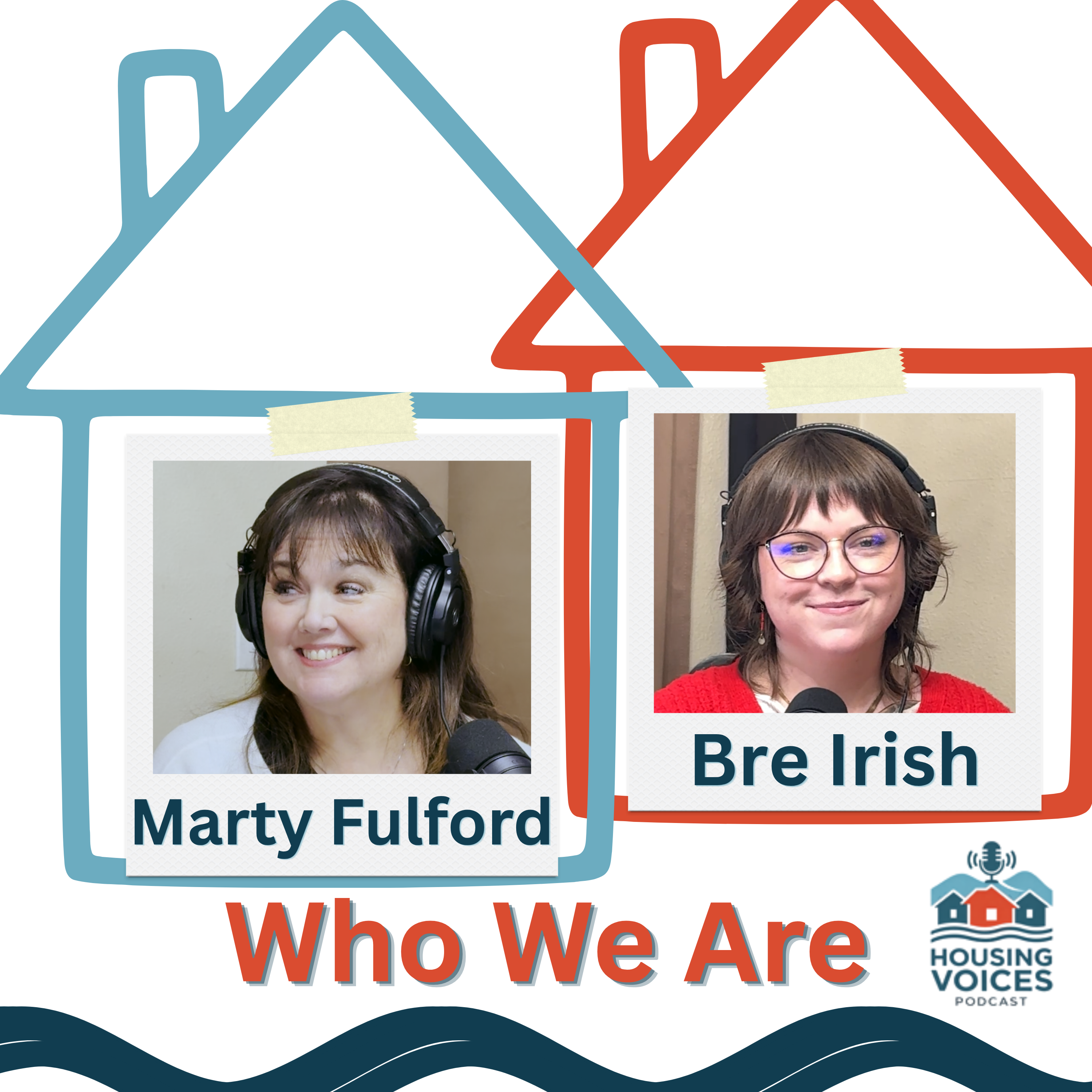
So welcome. My name is Bre.
[00:01:00] Speaker B: And I am Marty.
Welcome to Housing Voices.
[00:01:04] Speaker A: So Oregon ranks 45th nationally in housing production, and that's not that good, knowing that there's only 50 there. Yeah, there are 50 states, and our governor, Tina Kotak, had set a target for housing production in the state of 36, 000 units a year.
And last time I checked, I don't think we were hitting that. Right.
[00:01:30] Speaker B: We were not.
[00:01:30] Speaker A: Yeah.
[00:01:31] Speaker B: Yeah, we're not hitting that.
You want to continue?
[00:01:35] Speaker A: Yeah, I mean, it is my part. I guess it is.
[00:01:37] Speaker B: That's what it says on our screen.
[00:01:39] Speaker A: I think probably one of the reasons why it is not going as well as I think a lot of us, or most of us would, would like it to be going is that we're having 10 arguments at once. Right. It is so much more than just, I'm going to go build a house on this blank piece of property, and then, you know, I'm done. Right. My work here is done. There's so much that goes into the creation and production of housing because it's an ecosystem.
[00:02:07] Speaker B: Right. And people are passionate about singular issues versus looking at it from a broader or zooming out and looking at it from a broader perspective.
So here we're going to create a framework.
[00:02:19] Speaker A: Right.
[00:02:19] Speaker B: Going to zoom out and look at the broad picture, and then we're going to narrow it down and focus in always connecting back to the system.
[00:02:29] Speaker A: Absolutely.
[00:02:30] Speaker B: Housing touches on so many things, which is why we try to make this kind of consumable into eight buckets in, like.
[00:02:39] Speaker A: Drum roll, please.
[00:02:41] Speaker B: Oh, I have no.
Okay.
[00:02:44] Speaker A: We'll practice that for the next episode.
[00:02:47] Speaker B: Okay.
[00:02:47] Speaker A: Do you want to tell us what are the eight buckets, Marty?
[00:02:49] Speaker B: Eight. I can count to eight. All right, so we've got legislative and finance. We have climate and environment. Nope. Please. No, I'm just going to pause this for a minute.
We have met as a podcast team for weeks trying to decide on these buckets. They are not all inclusive. We probably are missing something here or there, I'm sure.
But, but be patient and kind with us. We're trying here. So I'm going to start back at the beginning again. All right, so the first one we have written is legislative and finance. And then we're going to the climate and the environment.
We're going to continue on with the third one being workforce, housing, the development and infrastructure of housing, how that works together.
Mental health and homelessness or houselessness, seniors and those with disabilities. So those are our eight buckets.
[00:03:44] Speaker A: And these overlap constantly. Workforce ties to employer retention, climate ties to insurance rebuilding costs, seniors tied to health care capacity. And also we all carry multiple identities at once and we don't cleanly fit into one single bucket always. Right. I mean, we're humans. We, you know, are not easily categorized, or at least I am not. But I, I actually. So on the seniors note, I actually met a woman this last weekend in Florence and she is on Social Security and she was, and she gave me permission to share her story as well, that she makes $1,245 a month from her Social Security payments, which is shockingly low just on its face right there.
But she got an increase in her, her monthly payments to a whopping, wait for it, $1,266 a month.
[00:04:43] Speaker B: So that's what, $22?
[00:04:45] Speaker A: Yeah, yeah. And I mean, Right. You know, don't spend it all in.
But then her Medicare premiums went up $17 a month.
So, you know, in two months she can get a nice coffee at Dutch Bros.
And she is, is stuck in her house that her and her husband owned for, for years and years. She cannot.
[00:05:08] Speaker B: Does she own it free and clear? Yes. Does she? Yes and clear. But that's a blessing.
[00:05:12] Speaker A: Yeah, it is an absolute blessing. And she really lucked out compared to a lot of other seniors in her position who don't own their homes free and clear.
And if she didn't have that house, we, we talked about this. If she didn't have the house free and clear, she wouldn't have anywhere else to go that she could afford in her price range. She's not wealthy. She's not independently wealthy. She's, you know, she was a teacher.
Right.
[00:05:37] Speaker B: Probably a really good one, too.
[00:05:38] Speaker A: Oh, yeah, yeah. But she also has disabilities. Right. And she can't just move anywhere. Right. It has to be accessible for her. And that's another layer on top of this, too.
[00:05:49] Speaker B: Well, it's interesting to me is that if she got now three extra dollars a month. $3, what is going to happen with her utilities?
[00:05:59] Speaker A: Oh, they better not go up.
[00:06:01] Speaker B: Right, right. And we all know that they do rapidly.
That's tragic. And she's probably staying in this really lovely home that she's cared for.
[00:06:12] Speaker A: It's lovely.
[00:06:14] Speaker B: However, is it the right place for her? Is it taking a space that maybe could be better used for something or someone else?
[00:06:22] Speaker A: Or also, she probably should be in a safer environment because she's not super mobile. And that presents its own hazards as well. Right. Just as we age.
[00:06:32] Speaker B: So this is kind of why we want to talk about housing. Right. And the voices of our fellow Oregonians and how housing is really interrelated to everything.
Our eight buckets, we'd like to say yes.
[00:06:48] Speaker A: So she would fit in a couple of those buckets just right off the bat, right?
[00:06:53] Speaker B: She would, absolutely.
But this is like a wheel or
[00:06:57] Speaker A: as I, your 3D puzzle.
[00:07:00] Speaker B: A 3D puzzle that's circular with at least eight pieces.
[00:07:04] Speaker A: Just imagine it. Imagine that it's right here, right now.
[00:07:07] Speaker B: It's right here. It's in my hand. I really want one. But I keep getting TE by Bre and to others regarding this 3D puzzle, but it's all interlocking and it's all interconnected. And so each episode we're going to try and fill in a little piece of that circular puzzle.
[00:07:27] Speaker A: But before we jump into, you know, the Megamind 3D puzzle that you've got cooking, I do like the 3D puzzle.
Yes, we do love it.
Why are we here?
[00:07:41] Speaker B: Right.
[00:07:41] Speaker A: How did we get to this housing podcast, Housing Voices. Right.
I firmly believe that the world needs to hear more of us talking, but
[00:07:54] Speaker B: I guess we'll see if others agree with us or if we're just doing this for fun.
[00:07:58] Speaker A: I mean, jury's out right now.
But we didn't just think, oh, you and I, we should sit down and talk about housing. That's not how this came about.
This actually as part of our the Housing Voices team, it's with Liz and Ed. Liz Irish and Ed Fulford. They were part of the Benton County Planning Commission and were tasked with being team members of the Regional Housing Subcommittee. And through Benton county, they worked to identify, you know, look at the full housing continuum and listen to folks from affordable and workforce housing to senior middle income housing and looked at how infrastructure, land supply, development codes, funding barriers all intersect. And, and they learned that a lot of of the problems that were being faced and limiting housing Production in Benton county were statewide problems.
[00:08:59] Speaker B: Right.
[00:08:59] Speaker A: You know, we're not in a vacuum here in Benton County. Other folks face those same problems. Right. Major employers were seeing housing as. As workforce infrastructure, and that was a limiting factor for their developers were avoiding regions due to complexity and costs associated with developing that land. Right. There were infrastructure gaps, wastewater also.
[00:09:23] Speaker B: Some towns may be easier to build in than others. Right. So sometimes towns in the legislative portion of our eight buckets hinder growth and hinder development.
[00:09:37] Speaker A: Yes, exactly.
And there's other really good things going on in the state to address, address our housing production issues. And we also want to shine a light on those really cool programs and, and plans and, you know, public private partnerships, you know, all of those, you know, lingos. Right. And then after two years of these meetings, they figured, why don't we have more of a conversation?
[00:10:07] Speaker B: Well, they did bring it up to the planning commission. Right. And they tried to get things done, but it kind of. Well, they're going to correct me if I'm wrong. It kind of went into this black hole of nothingness.
Right. It's such a complex issue that we all don't understand in its full and complex nature. And so, yeah, we thought, let's. Let's take another avenue. Let's go the podcast route.
[00:10:34] Speaker A: Exactly. And. And we're going to be bringing this conversation to the public, to everyday folks who, you know, are part of this conversation and part of addressing this problem. We're also going to be bringing in community leaders, builders, heads of nonprofits, employers, the whole kit and caboodle to have a conversation. Right.
[00:10:55] Speaker B: Holistically, I like to think of it as an enchilada.
[00:10:59] Speaker A: Oh, the whole enchilada.
[00:11:00] Speaker B: The whole enchilada.
[00:11:01] Speaker A: Right.
[00:11:02] Speaker B: Let's just get in there, of course, get a little extra cheese, but. Okay. All right.
[00:11:07] Speaker A: Somebody's hungry.
[00:11:08] Speaker B: Somebody might be, yeah. Okay. But there you go. So we're gonna break this up into different segments, Right. Our interview structure. And so it's in the reality section of what is actually happening, what is misunderstood and what is the public and us and maybe even the people we chat with getting wrong.
[00:11:31] Speaker A: I. I'm not going to get anything wrong, though.
[00:11:33] Speaker B: Oh, of course not to go on the record.
[00:11:40] Speaker A: And then segment B constraints, Right. What are the policy barriers, financing gaps, infrastructure problems. Is there community resistance to some housing
[00:11:50] Speaker B: that could never even be around?
[00:11:52] Speaker A: No.
And then, you know, good old staffing capacity. Right. If anybody's ever been before, you know, a city council or, you know, a county commission meeting, and, you know, we have to focus on staffing capacity.
Not that I've heard that before.
Yeah.
[00:12:10] Speaker B: Did you go into your background at all here?
[00:12:12] Speaker A: Oh, no. Oh, no, not yet.
[00:12:14] Speaker B: Oh, okay. All right. Well, the third section is going to be the questions, and some of them are going to be hard questions. We're going to ask people, what are the trade offs of these actions and who is taking accountability?
What are we avoiding? And more importantly, why are we avoiding that?
And asking, what would you change?
Right.
We're going to be kind and gentle.
I'm looking at you.
[00:12:44] Speaker A: I don't know why you're looking at me.
[00:12:49] Speaker B: But we will be firm. Right. And warm because we want everybody to come together as a solution based.
[00:12:57] Speaker A: Yeah, absolutely. Realistically, what would you change? I want to ask, you know, what is the pie in the sky? You have a magic wand. What would you do right now to change the situation?
[00:13:08] Speaker B: But each, each episode, sometimes words are hard. I'm just going to share that. Each episode is really going to end with, you know, if you had full authority, what would you do?
What should leaders understand differently?
What's one realistic next step? And what can citizens and our friends and listeners do? What is an action item that we can take with us?
[00:13:33] Speaker A: Yeah. And it's going to be addressing a whole host of different topics that relate to the eight buckets.
There are so many different scenarios that we can use this framework for to go through and different parts of the housing continuum, really.
And our call to action also is, you know, we're not just going to sit here and, you know, spin our wheels and talk about things that I think a lot of us know pretty acutely in terms of, you know, housing affordability conversations and all of that.
But we also want to encourage people to get in and into their communities where that, where they can and be effective in their own right instead of, you know, just going in and talking about, I don't want that, you know, multifamily development coming because I don't think that you have enough parking for it. Right.
But I also, we also want people to show up and say, this is what I want in my communities, this is what I want to see. And, you know, hold elected officials accountable if that is the appropriate thing for that situation. Right. Or go talk to somebody in the community or reach out to like a school district or however that may work. Right. Whatever situation we're talking about.
[00:14:52] Speaker B: So we're going to do a call to action and we're going to start. And this time we're even doing a call to action, even Though this is our very first one.
We're going to ask you to start making conversation with your friends, with your family. Right. With people you work with, and just ask them, what do you know about housing? Right. Where do you see are some of the problems? Are you one of those where sometimes I work with people who are relocating to the area and the affordability index is really hard. These are professionals. These are people with the big degrees and big brains. Right. They could be anywhere from professors at the university to people working in the tech field to people working at a hospital system. But can they afford to live here? And if they can afford to, do they want to? Are the services, are the amenities, are they all available and desirable?
[00:15:48] Speaker A: Or say, families in our communities that, you know, Corvallis is a very unaffordable city for a lot of folks that are renting or even if you're looking to buy a home. And there are. I. I know there are families that are doubled up in apartments, tripled up. Right. We have that data from our school districts. They know that there are families that are crowded into apartments because that's what they can afford. And then there are ramifications beyond that, that effect that ripple through the community with regard to, you know, property taxes. Those families aren't in homes and aren't paying property taxes. Right. They're just renting an apartment. And. And that affects the funding for our infrastructure and our services in our communities, too. Right. Not to mention the real effects on. On those kids and those families. Right.
[00:16:41] Speaker B: That studies have shown that kids who grow up in a house that their parents have purchased and owned succeed in a different and higher level. Right. They have a better tendency to graduate from high school, a better tendency to go to a professional job. Well, why shouldn't every child have that same.
Yeah.
[00:17:01] Speaker A: And I can tell you my family experienced homelessness when I was in high school, and that was extremely hard to focus on my school and also juggle what was going on with my family and my personal life. Right. And I want every kid to be in a situation where they can focus their entire energy on their homework and their schoolwork, to be the best person that they can grow up to be. Right. And if they're worried.
[00:17:25] Speaker B: Yeah. Because kids shouldn't worry about the food. They.
They shouldn't worry about the shelter that they have.
[00:17:29] Speaker A: Yeah.
[00:17:30] Speaker B: Yeah, Right. Maybe walk into school's okay. Even if you have to go uphills both ways, like my dad did, barefoot, you know, but we'll take care of the barefoot, too.
[00:17:41] Speaker A: Yeah, exactly.
[00:17:42] Speaker B: We really Would like for you to go out and start asking your friends, your family, your co workers, what is the housing issues that you see and what does it affect and how does it affect.
[00:17:54] Speaker A: And what are we missing? Right.
What more is there that hasn't been addressed? Because there is, as we talked about, so many different things feeding into our housing situation right now.
And it's. It's not just the eight buckets. Right. We've. We tried to narrow it down as much as possible. It's more of an art than a science. Right. And there are, you know, subcategories within those buckets as well. And how. We just want to have a complete holistic conversation to address it. Because I'm tired of talking about this consistently and reinforcing that. We know that this is a problem and not much is getting done. And I, for one, would really love, as. As somebody that's turning 30 this year, I would love maybe one day to be able to buy a house.
[00:18:43] Speaker B: I want that for you, too. Yeah.
[00:18:45] Speaker A: Or in other people that I know who are in the same situation that maybe have given up the possibility of ever owning a home. Right. And when we live in a system that's predicated on how much money that you can make as possible and have as much generational wealth as you possibly can, that's a recipe for disaster.
So how are we going to address that? Right.
[00:19:06] Speaker B: How are we. Right.
[00:19:07] Speaker A: Exactly.
[00:19:08] Speaker B: I'd also like to give you a little bit of background on Bre, because she didn't. So she was a legislative aide with Senator WYDEN over in D.C. for many years, writing all sorts of policy.
[00:19:22] Speaker A: Yeah, I did that. Yeah.
[00:19:24] Speaker B: So she's a little bit passionate about the project.
Yes.
[00:19:27] Speaker A: Yeah.
[00:19:27] Speaker B: And about actually making effective change. Yeah.
[00:19:30] Speaker A: But you don't have anything to do with housing either, so I don't know why you're here.
[00:19:34] Speaker B: No, no, not at all.
But we wanna. I just would like to ask you, if you're somebody who would like to be on the podcast, please reach out to us because we want to hear what you have to say. And I'm avoiding.
[00:19:46] Speaker A: She kept going to make me look like a jerk. She has a reason to be here.
[00:19:51] Speaker B: She hasn't tried to make you look like a jerk.
[00:19:53] Speaker A: That's. Mm.
[00:19:54] Speaker B: Sure.
[00:19:55] Speaker A: She has an illustrious career.
[00:19:57] Speaker B: We're 15 years old.
[00:19:59] Speaker A: Would you let me talk about you?
[00:20:00] Speaker B: No. Because it's uncomfortable for me.
[00:20:03] Speaker A: Marty has an illustrious career in the housing industry. She's been an incredible broker, real estate agent, the whole nine yards.
And she is amazing in the community working and advocating for housing issues within the community and a number of different nonprofits and organizations.
So, yeah, I gotta make sure to talk about Marty a little bit too.
[00:20:28] Speaker B: Yeah, we just want to see effective change and we really want to make sure we're taking care of our community and our state and maybe even the country if we can get that big.
Probably not, but we can try. We do have. If you want to learn more about any of us or about the conversations that we want to have, please check us out @ housingvoices.com we are on all the social medias. What are all of them? Because the blues I
[00:20:58] Speaker A: the TikTok, Facebook, Instagram and LinkedIn.
Just kidding.
[00:21:06] Speaker B: She can tell. She's almost 30 and.
[00:21:08] Speaker A: Yeah, but keep an eye out for our next episode and check out our social media. You can reach out to us through any of those platforms and of course like and subscribe.
[00:21:19] Speaker B: I think that's what all the podcasters.
[00:21:20] Speaker A: Yeah, that's what we're supposed to say there too.
So thank you for joining us.
Housing Voices is about clarity.
It is about action and it's also necessary to have courage in this conversation. Right. Somebody's got to say it, right?
[00:21:37] Speaker B: Somebody has to say it. And one thing about you, Bre, you've got courage.
[00:21:42] Speaker A: Yeah, I'm going to say it. I mean, you too, right?
[00:21:44] Speaker B: Yeah, we're just going to say it a little bit differently.
This is long term work. So join us where Housing Voice. Housing Voices is where people, policy and practical solutions meet.
[00:21:57] Speaker A: Practical solutions meet.
A special thanks to our partners Marty Bulford.com and Signet.net for supporting thoughtful dialogue around housing in our communities.
Music for Housing Voices is provided by Karen DeWolf and Adrian Kriz. Thank you for helping us set the tone.
You can find
[email protected] and connect with us under Housing Voices on Instagram, Facebook, LinkedIn, Blue Sky, Tik Tok and our YouTube channel.
If you found value in today's conversation, share this episode, follow the show and help us expand the dialogue.
Until next time, this is Bre. Let's keep listening, keep learning, and keep building practical housing solutions together. Sam.