Episode Transcript
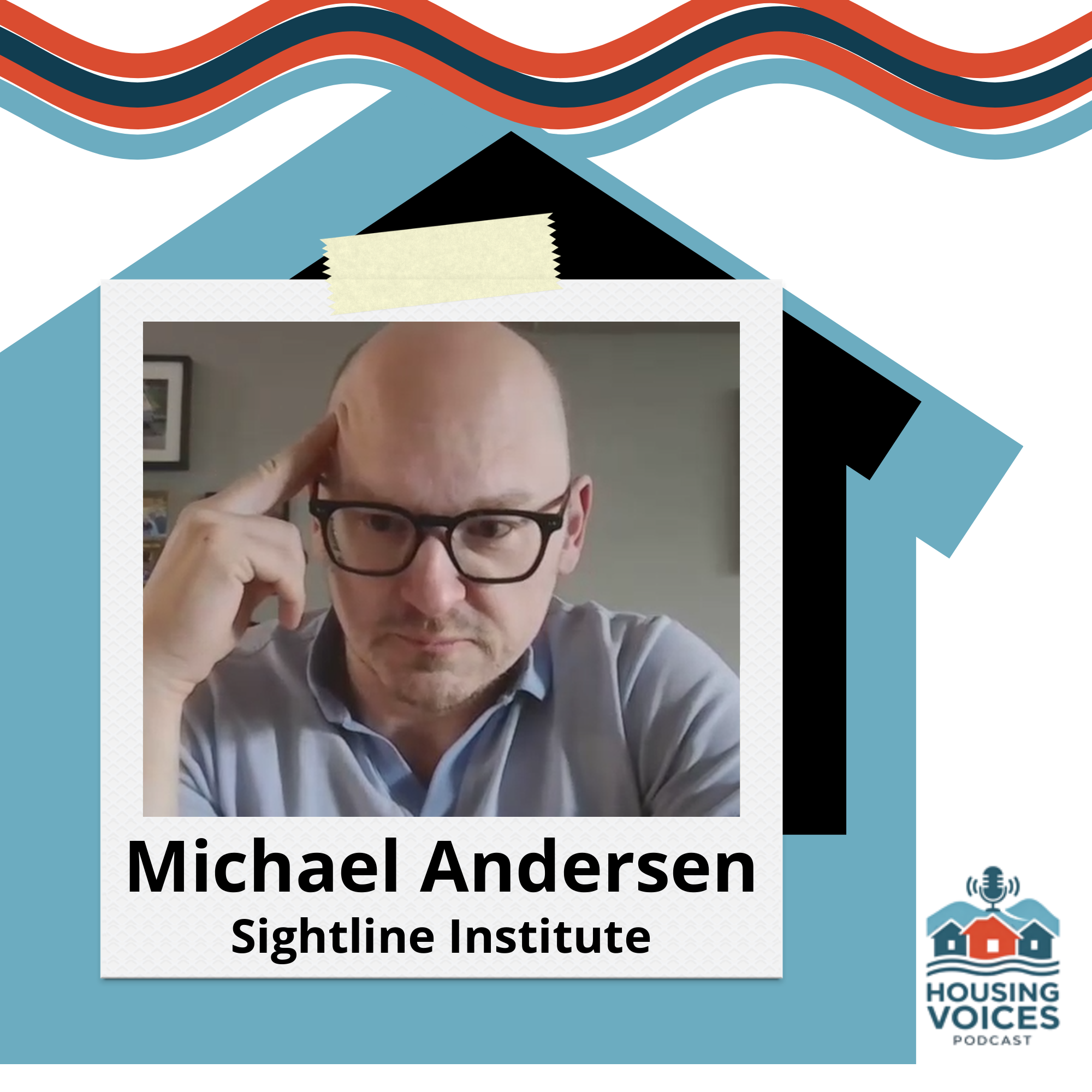
HOUSING VOICES — Michael Andersen, Director, Cities + Towns, Sightline Institute
Corrected transcript (names, partners, and terms QA-checked)
Speakers: Bre = Bre Irish (host) · Marty = Marty Fulford (host) · Michael = Michael Andersen (guest) · [Theme] = theme music lyrics
Items marked [VERIFY: ...] could not be confirmed from the text; check against the audio.
[00:00:00] [Theme]: The truth can break through.
[00:00:03] Bre: Welcome back to Housing Voices. I'm Bre.
[00:00:06] Marty: And I am Marty.
[00:00:07] Bre: And today we have another awesome guest, Michael Andersen with Sightline Institute, a think tank that focuses on a lot of housing in the Pacific Northwest region. And I'm really looking forward to talking.
[00:00:21] Marty: Yeah, it's interesting what Sightline does as a think tank in regards to trying to bring things together.
Right. And really looking at seniors at disabilities and how to make it more efficient.
[00:00:38] Bre: Yeah, I think Sightline really gets into some niche stuff when it comes to building codes, zoning.
I'm interested to hear about their thoughts on, you know, the urban growth boundary, because that's kind of a hot topic sometimes in, in these circles it should
[00:00:53] Marty: be, well, as like the cottage clusters.
[00:00:56] Bre: Right.
[00:00:56] Marty: And you know, the out of box thinking and how are they supporting that and helping and changing.
[00:01:05] Bre: Yeah.
[00:01:06] Marty: And how much they're in alignment with the League of Oregon Cities.
[00:01:09] Bre: Yeah.
[00:01:10] Bre: Ooh, spicy.
[00:01:12] Marty: Maybe we won't get too spicy today.
[00:01:15] Bre: But anyways, I'm super looking forward to talking to Michael Andersen and yeah, so I'm Bre.
[00:01:22] Marty: And I'm Marty.
[00:01:23] Bre: And this is Housing Voices.
[00:01:26] [Theme]: Streets and the room. [VERIFY: theme lyric]
[00:01:29] [Theme]: If the house have voices, the truth can break through. [VERIFY: theme lyric]
[00:01:29] Bre: Hi, welcome back to Housing Voices. I'm Bre.
[00:01:40] Marty: And I am Marty. And today we have the privilege of having Michael Andersen with Sightline Institute here with us today. Thank you for joining us, Michael.
[00:01:49] Michael: I'm so glad to.
[00:01:51] Bre: I was reading through your bio. You've got, you got quite the bio. Done some really amazing stuff. But currently you are the Director of Cities + Towns at Sightline Institute, which is a think tank here in the Northwest. Can you tell us a little bit about what it is you exactly do? And for folks who may not know what a think tank is, if you could just parse that out for us.
[00:02:14] Michael: Yeah, sure. So Sightline Institute is a nonprofit, nonpartisan research and policy change organization. We're sort of a think-and-do tank. We still say we're a think tank because we are, but we, we also try to come up with specific policies that we think are informed by research and data. We try to make a research and data based case for them for why they're in alignment with both our values as an organization and the values of people in the Pacific Northwest.
And then we try to get those policies into action one way or another.
So our geographic territory is all across what we call Cascadia, that is from the very top of California up to Anchorage and over to the headwaters of the Snake in Wyoming and Idaho.
Anywhere the salmon can swim is one way to think about it. And so that includes the Willamette Valley, among other places. And I live in Portland, so my main focus is here in Oregon. I work mostly at the statewide level to come up with things the state can do to help people live closer to each other if they want to.
Because if people want to live closer to each other, and in so doing, save their energy bills, reduce their energy consumption, save money, build stronger connections with each other, we think that that strengthens our economy, our society, and our future. And so we want to get the heck out of the way of anybody who wants to do that. Now, not everybody wants to live closer to other people. We have no pretensions that that is always the case. But we do think that there is a bunch of ways that we, as a society, mostly through laws, have often accidentally made it impossible for people to make those choices to live closer to each other. So we wanted to stop that.
[00:04:16] Marty: So what brought you here? Or how did you get here?
What was your path?
[00:04:21] Michael: Yeah, me personally. Yeah.
[00:04:24] Marty: And then Sightline.
[00:04:25] Michael: Sure, I can talk about both.
So I was a journalist and I was covering.
I was working in Clark County, Washington, so the northern suburbs of Portland, and covering county government. And the two things that county government does most is it provides services of various sorts to poor people in the court systems, the prisons, the social services, etc.
And it regulates development on the urban fringe. And so I was doing both of those things and learning about both of those things. And I was talking to people frequently who were saying, well, my life really fell apart when my car broke.
And then I couldn't get to my job, or I couldn't get my kid to school, or just I sort of fell out of my social circle and one thing led to another, and here I am in a pretty bad spot.
And at the same time, I. I was writing about the ways that we were literally casting into stone the need to drive a car everywhere on the edge of town, right?
And I was thinking there's got. And at the same time, I was like a 20-something in Portland, and a bunch of my peers didn't have cars. And it wasn't a big deal because in the midst of an urban area that has pretty good options for other sorts of transportation, there's not a $10,000 anvil hanging over your head at all times.
And it's a much different sort of freer, less constraining situation. And so I was thinking, what are the ways that we can like, make this more like that? So that people can have more resilience in their personal lives and.
And then gradually that.
So as the. As I got older, I saw more and more people also being priced out of Portland and Oregon in general and thinking about. Or the place that they wanted to live in Oregon so that the place that was best for them, it may not have been priced out of Oregon completely, but they would be priced to somewhere else, or somebody wouldn't move to Oregon like I did when I was moving here from.
Actually directly from Maine, but earlier from Ohio.
And I didn't want that to be the case either. So I was trying to think, what are the things that we can do that will allow us to give people the options to live where they want to live without pushing somebody else out? So it's not a.
We're not stuck in this sort of a cage match with each other at all times. I want the housing market to feel more like a grocery store where when I take an orange or I take a can of soup off the shelf, I'm not stopping somebody else from getting that. Actually, it's helping somebody else. Somebody else is more likely to get an orange if I buy an orange.
[00:07:20] Bre: And so how did you get to Sightline? And can you tell us about how Sightline kind of got to where they are today?
[00:07:27] Michael: Sure. So Sightline is.
We're essentially an environmental organization. We were founded in 1993, so, I don't know, the second generation of the environmental movement maybe. And our way of thinking about things has always been informed by the insights of economics. That doesn't mean we think that the market knows best. It does mean we think that, like, market forces are real in the way that gravity is real. If you want to build an elevator, it's very important to understand gravity. That does not mean you think the fuel should never go up. [VERIFY: likely "the elevator should never go up"] It means you think that, you know, it's important to understand gravity. So in that way, Sightline has tried to use the insights of economics to come up with ways that we can build policies that help people thrive sustainably, that is to say, thrive without destroying our futures in one way or another. So that eventually led us, like I mentioned, to the realization that, like, a huge, unintentional, unnecessary part of our energy expenditure as a society is people, is the heat that leaks out of our homes or the heat that seeps into our homes because we're not very well insulated, because we're not sharing walls and roofs and so on with other people, or the gas that we burn when we're driving around, not because you know we want to drive somewhere, but because the trip takes longer than it really needs to because things are more spread out than they need to be.
So we're trying to think of ways to upstream ways to change those situations as much as possible without, you know, doing things that people hate. People don't like to be told where to live. Right. And so we need to come up with ways to let people choose where to live in a way that maximizes the freedom of themselves and future generations.
So we started looking at zoning in the early 2010s that put us sort of at the early part of the curve of, I don't, I would say a fair number of sort of left-of-center organizations thinking about the role of zoning and how it interacts. And right now we work often in alliance with right-of-center folks as well as left-of-center folks to come up with shared agreements about, well, what are the ways we can all benefit from allowing more choices.
[00:09:49] Marty: So what do you think is the biggest hindrance to building sustainable as well as compact living arrangements?
[00:09:58] Michael: The biggest hindrance? Yeah, there's a lot. I mean there's a lot. Right. And that's how it should be. Right. There should always be lots of reasons for everything.
But.
I think it changes year by year. I think in the 2010s it was very convenient for me to observe the rush of money by which I mean the consumer as well as the like developers and home builders trying to build apartment buildings in cities.
And I kind of thought, oh, this is just the way of it that we. The, the. I remember the mayor of Portland made a speech where he was like the flight to the suburbs was a round trip, never. Who'd have guessed? And that was in like 2012 or so. And it was very smug.
And the, I think the last 15 years have impressed on me that that is not a one way directional thing either that people are constantly reacting. So right now, since the pandemic, every metro area in the country, but actually Portland, more than a lot of them, has decentralized. There's been sort of a doughnut effect in where people want to live because people are not needing to commute to close in jobs. There's 100,000 fewer people in central Portland during the day than there are. There are 100,000 fewer jobs destinations in Portland than there were in 2019. And that's on any given day. So that's a big shift in where people are pulled to be every day of the week.
And that has meant that there's a lot less demand for living close to the center of things. I don't know exactly how that's played out in a place like Corvallis. I think it's been a less dramatic change, but I think that you've got similar forces.
[00:12:06] Bre: I know in Wilsonville comes to mind that they were previously a commuter city for. For Portland, and since the pandemic, they've had a lot more people from home. And if. If folks have been to Wilsonville, you know that there is not much of, like, a central, like, downtown to the city. And in my previous job working for Senator Wyden, I worked a lot with the city of Wilsonville and working alongside them to support some of their plans to make essentially a more centralized downtown area, because that's what people wanted. Now, they weren't just going to Wilsonville to go to sleep before going to work tomorrow. They wanted to actually spend their days and their lives in the city that they live in, which is so radical.
[00:12:57] Michael: Right? Yeah, that's great in some ways. Right.
But Wilsonville's been trying for years and years and years to get that downtown to pop, and it hasn't come together yet.
[00:13:07] Bre: What do you think is going to. Is the thing that's going to help it move along? What's one of those barriers, you think?
[00:13:15] Michael: I don't want to pretend to be an expert in Wilsonville. I have run into this over and over again. I would love your takes, too. But the one thing it seems to me is that.
And this actually comes out of some research I did on my own time into Auckland.
My family lived in Auckland for a month earlier this year as part of a sabbatical I took. And one of the things that really worked in their zoning reforms was to have the same rules over a very large geographic area, because it was, you know, the people who make it their business to build buildings really have a lot of efficiencies when they don't have to make a custom thing.
And I feel like, understandably, in a lot of places, including Wilsonville and Portland and Corvallis, I'm sure people want to make like there's a local political process. People have some local ideas. It's not super important that it be that different from the way it works in Lake Oswego or Tualatin or whatever, but it's different. And so, like, everything's a little bit different. And so I talk to builders sometimes who are like, I can't afford to specialize in more than one city. I just need to pick a city, understand its rules, understand its people and build in that city. And that's good for a bigger jurisdiction like Portland or Auckland or Houston.
But it's harder for a smaller city trying to make a big scale happen unless there's a ton of demand, which means unless there's a ton of price inflation, which is not.
[00:14:48] Bre: Do you think that then that's the zoning and kind of local control has been pretty inhibiting of housing because I know especially here in Corvallis, their history going back decades is been pretty anti-growth. And we're in a tough spot right now, as I think many other cities are, where there are some very loud vocal anti-growth folks, particularly kind of the bane of my personal existence on parking minimums for developments.
And do you think that that's one of the hurdles that we need to tackle? Because the governor and the state legislature has done a lot on housing thus far and we're still the production of houses. We still haven't really reached the targets that the state and the governor set. Do you think that more zoning changes need to happen? Do we need to remove more approval control from our cities? Back to DLCD?
Talk to me about that.
[00:15:52] Michael: I think zoning changes take a long time to pay off. And like it takes a few years for the government to carry out legislation, even if it starts at the local level, especially if it starts at the state level. And it takes a few years for developers to figure out how to use that and it takes a few years to build it. And it takes a few years for any of that to have any effect on the market, let alone, you know, the thousands of homes that would be needed to really change things in the market.
So all of this zoning stuff that Portland has been leading on, I would say since 2019 has been a big deal and a slow burn. And that's coincided with a decline in demand for living in Oregon in general because we've had a weaker job creation. Corvallis is an exception to that. Corvallis has had some of the strongest economy in the state. And so it's important to the future of the state that Corvallis let people live there and put their shoulders to the economic engine of Corvallis. But the.
Yeah, so I guess my own sense is that we've passed a bunch of good stuff at the state level, including removing parking minimums in cities like Corvallis and allowing flexibility. That is for, you know, you can build as much parking as you want, but you don't have to build anymore.
And I think that we need to give that some time to take effect.
I think there are some other things we could be doing on zoning, but in terms of sort of the broad sweep, I think we've done a lot and I've been shifting most of my time over to building code stuff, actually, which is like, how do you build buildings? Can we figure out how to do that more cheaply? Because that will work sort of as a force multiplier on anything we do on zoning, on financing. When interest rates go down, it'll make that matter more. Right. Or it can make things work even at a slightly higher interest rate potentially. So I've been trying to focus on that as my area of expertise this year and sort of take the gas pedal on the zoning reforms back a little bit.
[00:18:15] Marty: We recently had Mayor Johnson from Albany on, on the podcast. Right. And they have been doing a really good job of creating housing using different tools in their tool bucket. Right.
And one of them was a sliding scale for SDC fees.
Are you familiar with that? What's your opinion of that? Is that something.
[00:18:38] Michael: Yeah. Is that a size, like based on the size of the home?
[00:18:41] Marty: Yes.
[00:18:41] Michael: Yeah.
[00:18:42] Bre: Tiered.
[00:18:43] Michael: Yeah. I'm also. I think that's great.
[00:18:45] Marty: Sliding. Yeah. It's all the same, just a different adjective.
[00:18:48] Michael: Yeah. So an SDC is sort of a fixed fee that you pay when you build a new home to cover the infrastructure costs that the people of that home are going to use in the next 50, 100 years or whatever. And there is no denying that people require infrastructure. And some locations have infrastructure, don't have the infrastructure that will be required for somebody to live there. And there's no great way to pay for that. We could pay for it out of the general fund, but then if you just write a blank check to anybody who wants to live anywhere, that gets very expensive because some people, some places do have higher infrastructure needs. If there's not a pipe there, there's not a pipe there.
So my sense is every developer is upset about SDCs and every person who wants to build anything is like, who runs into it is going to be startled by how high they are.
That's somewhat of a different conversation than how should we finance them? It seems to me there's not a better way to do it. But it also seems to me that like they are regressive. If you're charging the same fee for a studio apartment as for a single, you know, detached home.
And the.
And it's not only regressive, it's sort of like game-changingly like deal killing. Right. If you're trying to put if you're trying to pay for like a $30,000 SDC on one apartment, that's like, I don't know what that is per square foot, but it's a lot. It's a lot of the cost of the apartment and it's just not going to happen. And so you're actually not. You're going to be stopping. There's. You're killing the revenue source as well. So, like, it makes sense to have some sort of a sliding scale for SDCs. To me, the state is, I think, preparing to define a schedule that will create, I hope, a safe harbor for cities like Albany when they do this. They're currently exposed to legal risk because they could be sued by developers who says, oh, you slid that scale too hard or you didn't slide it hard enough or whatever. And so cities have to spend a zillion dollars in staff time to do the math on this stuff so they can defend it in court. If the state could come in and say, we have blessed this with our law and done some math and have it, then I think that would support efforts like that one. And I think we could hopefully get more sliding SDC fees. Another thing that the state could do would be to collect those fees or to make help cities collect those fees later in the process, because it doesn't really matter to the city when they collect that $30,000 or whatever it is. What matters is that they get it before that occupancy starts to demand the infrastructure.
[00:21:31] Marty: And that was one of the things that Albany is doing, is that they're doing it at the time, you know, time of completion. Right. That's when this.
[00:21:39] Bre: They're deferring it until the certificate of occupancy.
[00:21:42] Marty: Yep.
[00:21:42] Michael: Yeah.
[00:21:44] Bre: And can I go back actually on the building codes? Can you dig down on that a little bit? How exactly do you make it cheaper to build a house in an environment where costs are rising, what feels like constantly, everywhere?
[00:21:59] Michael: Yeah.
So the thing about building codes that I'm learning is that there's just a lot of knowledge about this one building code and that one building code and that one building code. So I can tell you a little bit about a few and more about some, but there's a lot that need to be looked at. You'll often hear people say, oh, we should do a top to bottom review of our building codes to find inefficiencies. And that's a great in principle, but it really, like, the truth is with every sort of regulation that there's a rationale for everything.
And in the world of building codes, some of it has been subject to a pretty good cost-benefit analysis. And a lot of it never, ever has been. It's just a matter of practice and people. People's perceptions of what is normal and what's safe and what's not safe.
And so I have a buddy who's a carpenter, and he's happy to complain about the ridiculous over-engineering required by the building codes to build anything. And so he builds a bunch of structures in his yard, and he's happy to build them. Well, undersized, you know, where he has to follow the building codes. And he's like, these are fine. Right. And I'm sure he's right.
But anyway, it's a tough set of choices. I can give you a few examples. So plumbing in the United States, everywhere except Philadelphia, we have a little curlicue in every, like, plumbing fixture up. There's a. There's a big pipe that goes up and down the building.
You know, if there are more stories, then there are more curlicues, one on each story. Right. Of this stack of. This pipe with a stack of. And the point of that is to maintain air pressure in the pipe so that we don't get a bunch of sewer gas blowing into our homes. Cool.
However, in Philadelphia and in France and in many other countries, they just have one curlicue at the top. And. And I couldn't tell you what the air pressure is, but it works fine then that way, too. And if you remove all the curlicues all the way down the stack, you cut the cost of plumbing by like 40%. And you cut the cost of the building by about 1%. That's 1% less. The rent needs to go up. Right. It's not a ton, but it's a measurable amount and it requires. Right, exactly. And there's a lot of little somethings like that that we need to find and we need to persuade people. No, actually, the sewer gas does not come pouring into everybody's homes in Philadelphia, nor does it happen in Paris. Right.
[00:24:36] Bre: The.
[00:24:37] Michael: We're building new buildings with this slightly different method, and it works fine. And there are some people whose interest it is for there to be a lot of pipe in the building. And maybe those people will see that this is a threat. I hope. I would argue that, like, this is a way to get more business because you can build more buildings around more pipes. But the.
That's one example.
There are some others, but. Yeah, that's one.
[00:25:00] Marty: What are some things with the upcoming legislature that you're really focused on in trying to create more housing for both low income and middle.
[00:25:10] Michael: Yeah. So my main focus right now is making sort of a, a sustained argument about the importance of age-friendly housing in Oregon cities.
And this is true everywhere the fastest. We don't have a fast growing population in all of Oregon at the moment, but we do have a fast growing population of people over 75.
Actually the 65-plus population has peaked or the. Sorry, the people who are like 65 to 75 is not changing. That's about going to be flat for the foreseeable future. But the number of the percentage of people over 75 is definitely rising.
And that's where it really starts to become important for people to get up and down stairs, or people start having trouble getting up and down stairs at pretty high rates by the time they're 75 and up.
And not everybody obviously, but about a third of people over 75 have an ambulatory difficulty. So the.
We've got a lot of townhomes thanks to the fourplex bill that passed a few years ago. So a lot of the new housing that's going into existing neighborhoods, like the neighborhoods people are familiar with, where they may have friends and family in, etcetera, we're good at creating townhomes. Those are great for people like me with a kid and you know, not a lot of money, but they are not great for me in 40 years potentially when I've got a bad hip. So people with disabilities, right, or people with disabilities today, Right, Exactly. People of every age with disability is not well served by most townhomes.
So what are the ways we could find to put homes on top of each other?
One layer only served by an elevator so that you can have a one level home, one on the ground floor. It probably has a stepless entry and ideally it would be great for you to have more of that. You don't have to walk up and down the stairs everywhere to get to your kitchen or your bedroom or whatever.
[00:27:16] Bre: So elevators are expensive too.
[00:27:18] Michael: They are expensive. They're very expensive. And they're three to four times more expensive in the United States than they are in rich countries like Belgium or Spain. Why?
Well, there are multiple reasons, but the biggest factor I and others suspect is that there are only four companies that sell elevators in the United States.
[00:27:40] Bre: Only four companies that sell elevators in the United States.
[00:27:43] Marty: Yeah.
[00:27:43] Michael: So I went through every elevator in Oregon from 2012 to 2022, and of that 92% were sold by these four companies. And the 8% may have also been, but I just couldn't verify it.
So the.
And two of those four companies are about to merge.
[00:28:02] Bre: So we're going to be down monopolistic.
[00:28:05] Michael: It is a bit monopolistic. Right. And so why, why are other companies not entering that market as they are in the rest of the world? So the, the big three are the big. They're soon to be the big three.
They're the biggest three companies in the world, but they're also only 50% of the market in the rest of the world. And they're almost the entire market in the United States.
The United States has its own special way of determining whether a certain elevator part is good enough.
Every company, every country in the world started with its own system of doing it. And all of them have gradually amalgamated to what you started out as the European system of deciding how, whether an elevator failure part is good enough. [VERIFY: possibly "an elevator part"]
And it's not that there's a different safety standard, it's just that it's a different process. It's just you have to do a different thing and meet a different test. And so it's very expensive to go through that process.
And the United States is now only 5% of the world's elevator market.
And so it's not really worth it to most companies to play this big fixed expense in this small share of the world elevator market. The only people it's worth it to are the biggest three companies. And those are the ones we've got.
And so they don't have much competition.
They're very professional.
There's a lot of good things about these biggest companies. That's why they're successful. And yet they can sell the product for much, much lower in other countries.
And I think we would have more choice and a lot more elevators because we also have the fewest elevators by far in the developed world here in the United States, if we had more competition in the market. So I'm trying to convince others in the state to issue a support, the support the official support of the state to the standards writing organizations to say we would like to harmonize just like every other country in the world has been doing to this international standard to bring down the price of elevators. There's some other things we could do. We could allow buildings that are big enough for an elevator to make sense. Two story building, a three story building elevator is almost never going to be included. But if you have a fourth and a fifth story, then the second and third stories suddenly become accessible. Right? But there's much, much land even multifamily land in every Oregon city that doesn't allow the fourth and fifth stories to exist at all.
And we could be doing more to let that happen.
[00:30:35] Marty: It's interesting because when you look at businesses or trades for people to go into that are highly profitable, actually elevator repair is one of the highest ones
[00:30:49] Michael: in the United States.
And we could have a lot more elevator repair jobs in this state. If we have more elevators, we could solve this problem.
[00:30:55] Marty: Right. But it was so astonishing putting those two things together that I'm like, oh, maybe I should become an elevator.
[00:31:01] Bre: Oh, yeah. I thought the same thing, actually, when
[00:31:04] Michael: I would love for all of us to have an option to become elevator repair people when there's a zillion elevators in 10 years. Yes, that sounds great.
[00:31:11] Bre: Well, that brings me kind of to my next question.
Having accessible units for people with disabilities housing.
We do not. We talk to Cassie Wilson, who worked for 1000 Friends of Oregon to talk about accessibility for people with disabilities in their homes and for, in her case, in her apartment. And we, through that conversation, really found out that there's not enough housing. Accessible housing for people with disabilities. And how do we address that? Because I think many of us will live long enough to become disabled, and it's. It's coming for. For all of us unless we die in a tragic accident before we get. Become disabled.
[00:32:03] Marty: How.
[00:32:03] Bre: How do we do a better job making our housing more accessible in the long term for as. As many people as possible?
[00:32:10] Michael: Yeah. So Cassie uses a mobility device most of the time.
And there's the specific category, as I'm sure she told you, is called Type A housing. So that has a bigger bathroom, maybe most notably, but wider doorways, lower cabinets and counters, and so on. So it's not ideal for everybody who's got an ambulatory disability, but it is a huge, huge advantage to anybody who's in a wheelchair or a similar device.
So right now, if you have more than 20 units in a structure, you have to have at least one that's like that.
And if you have 50 units in the structure, you have to have at least two.
But these are almost never advertised because I was told last week landlords and developers are terrified of being sued for false advertising if they make a claim that a unit is accessible and it's not, actually.
Which drives me.
That's very frustrating to me. Yeah, that, like, you're required to build it, but you're not allowed to tell anybody.
[00:33:16] Bre: Yeah, that's counterintuitive.
[00:33:19] Michael: Just. I'm sorry. Just like my son is asking something.
You can have some dessert, but I can't help you right now. You can get your own or I can help you in 20 minutes. Okay, thanks.
See, so.
Right, so Type A homes. The state has defined a significant density bonus for structures that include at least 10% Type A homes. So that would be in a 20 unit building, would be two units, you know, 30 unit building, three units.
But that is associated with the model multifamily zoning code that they have just defined a few months ago at the state level that has not yet been adopted anywhere.
That's just a sort of a set of suggestions. It's not required until maybe this happens. And that happens. There's a process that the state has defined that says if you're underperforming your housing and you're demonstrably not meeting your accessible housing goals, then we can require you to impose, we can require you to offer this model code in some of your, on some of your land.
Cities can voluntarily do the same thing.
And I think it would be great if more of them did. So I think that incorporating, just bringing this model family, this model zoning code the state has defined into more multifamily land would be a huge improvement to almost every multifamily zone in the state, including many of Corvallis's existing zones.
And adding the state defined density bonuses as an option to further give an incentive to projects that want to do more Type A homes would create a significant reason for people to want to do it. That doesn't solve the advertising problem. I would love to figure out how to solve that too. Create some sort of safe harbor for the, the landlord or whatever. But it does solve the existence of the homes more than we do today anyway.
[00:35:34] Marty: It would also be nice while doing that to solve the problem of getting those who are disabled out safely in the case of a fire and elevators aren't accessible. Right. Hearing her talk about that was absolutely abhorrent. Right.
Incredibly educational, but absolutely wrong and inhumane in so many levels.
I do understand that you're coming out or and that the think tank is coming out with a big paper this coming up month regarding middle housing and disabled housing. Is there anything that you can share in advance with us about it?
[00:36:09] Michael: Yeah, I mean that's what I've been talking about just now. The age-friendliness and accessibility arguments for specifically for like stacked flats in neighborhoods not only in the big cities but in the smaller cities. I think one of the big arguments that I make in this report that I think is based on fact is that the various things, including the cost of an elevator is one example of many where we have a high fixed cost of building a building. Right. There's a lot of risk in building a building.
And so all of that sort of steers the development industry towards bigger and bigger buildings. I've talked to one developer here who is like, I can't get out-of-state money for anything less than 150 homes in a single project.
So that means that there need to be big enough cities where 150 households are simultaneously looking for homes for that building to make sense. That's just not going to be the case in like Lincoln City or Sisters or Enterprise or a bunch of places where the prices are pretty high. Right. Their prices are high enough in all those places to support new development.
There's just not enough people to build 150 units all at once. Right. And so in order to reinvent the small scale multifamily building, which is also often going to be like tall enough to have an elevator, if we could bring down the elevator costs, we should be doing everything we can to reduce those fixed costs of development, including the elevators, including for a small footprint multifamily building, the secondary staircase. We have other safety measures that could be used to do that to allow small lot development.
The plumbing is another though, that's less of a fixed cost.
And I'm eagerly trying to assemble ideas for more because I think that this sort of like 20-ish unit building is something that a lot of smaller cities could use a few of and could finance a few of. It just takes like a dental practice worth of wealth to finance a building that size. You don't have to be a banker in Connecticut. And so it's worth it to somebody who knows their community, who knows that like that 20 unit building is going to make money. For me, it's a good investment. It's also something that's needed on this street, especially if a couple homes on the first floor wheelchair accessible.
[00:38:48] Bre: And another one, a topic that I really always like to talk about as well, on a layer on top of our housing conversation, is climate change and how we are working to address or mitigate the effects of climate change on the housing that we built across the state.
You referenced earlier about some of the heat that is seeping into our housing and how do we address that versus making sure our homes in different parts of the state are maybe more resistant to wildfire or air quality concerns and things like that. So how do you layer, especially from Sightline's kind of roots as an environmental organization.
How do you layer that over top of your housing work?
[00:39:38] Michael: Yeah,
[00:39:41] Bre: another easy question.
[00:39:42] Michael: All right. I know certainly part of our wildfire issue is people in the edge of the wilderness, right? And I don't think we want to stop people from spending time or even living on the edge of the wilderness. But the fewer people who need to, for one reason or another, the less of risk there is for wildfires. So I think some of the case for infill is to reduce the number of people who are just interacting with extremely flammable areas.
The cities are generally less vulnerable to wildfires because of the urban environment.
Like I was saying, like, most of my focus on climate is in the sort of like, how do we reduce the scope of future climate change? By making energy efficiency better.
And that's in part through electrification. Apartment buildings are disproportionately likely to be electric. And one of the, part of the reason to build them is that in addition to the fact that everybody gets to share walls and roofs and pipes, I think there's, as with every single potentially expensive thing that you can require homes to do, there's a trade-off where if you. We could say every unit needs to have an air conditioner and at some point there's going to be some unit on the margin that can't afford that air conditioner and it won't exist. Right. So in a sense you're just saying, like I'm banning the existence of any homes that don't have air conditioners. That's not actually a way to increase the accessibility of an air conditioner. It's an unfunded mandate on poor people, essentially because those are the ones who can't afford the air conditioner right now.
You're not going to. In the same way that you can't magically give everybody a backyard, even though it would be nice, by requiring detached housing everywhere.
You can't give everybody an air conditioner by requiring every home to have an air conditioner at the same time.
That seems like a pretty good use of public money in some situations.
And if the public has an interest in doing something, it should pay for it. And I think this is a case where sometimes it does.
And same with weatherization. You know, that's been a policy forever of like trying to improve the insulation of older homes and, and making sure that when we build, we're building efficiently.
That's not the best answer. It's not my field, really. I've got some colleagues who work more in that field.
[00:42:24] Bre: No, we had a great conversation with Jamie McLeod-Skinner about some of the wildfire response and how it coincided with housing.
And so it's just something that's on my mind, especially as we were dealing with some wildfire smoke here in the valley today and how we're going to deal with that. I always want to ask that question.
[00:42:46] Marty: Yeah, every time you do.
[00:42:48] Bre: I do, yeah.
[00:42:49] Marty: Yeah.
[00:42:49] Bre: Climate change is important.
[00:42:50] Marty: It is. It's very important.
So Sightline and you. My understanding is infill and up.
Does that mean that you guys are opposed to the expansion of the urban growth boundary?
[00:43:05] Michael: It means that we think that whatever the right rate of urban growth boundary expansion is, we will be better served if we don't need to do it as much. So I think I definitely, personally, my calculation is that sometimes urban growth boundaries need to move.
That's just the reality of it. And some cities are growing fast and some land would be useful when urbanized.
I think that's how Oregon's laws were always written, was that sometimes the UGB would move. I think 1000 Friends would agree with me on that, that it's been moved a bunch of times.
The question that Oregonians have been loving the fight over for the last 50 years is how much, how often, etc. What's exactly is the difference between urban and rural?
So I think of my work as being mostly reducing the need to move it because the less we can move it, the better.
[00:43:58] Marty: But I run in my.
[00:44:00] Michael: If we need to move it, sometimes we need to move it. Go ahead.
[00:44:03] Marty: Okay. In my business, I run across a lot of people who want cottage clusters. Right.
And it's kind of hard finding cottage clusters. Right. They want little gardens. They want, you know, their friends around them. They want little.
[00:44:16] Michael: Yeah, you know, I'm sitting in a cottage cluster right now. I love it.
[00:44:21] Marty: Tell me about that. How did that come about? Because you live in Portland downtown.
[00:44:26] Michael: Yeah, it's all. It's not really downtown. I mean, maybe it feels that way to other people, but here I'm living in the sticks.
Cully is a neighborhood that used to be was unincorporated Multnomah County until 1990 or so.
And so there were a bunch of bigger lots and three homes were, two of which were completely falling apart. Used to be on this parcel.
And the developer who actually still lives across the street bought them up and rehabilitated the one home that could still be salvaged, knocked the other two down and built 23 townhomes here. [VERIFY: "23" — possibly "two or three"] And so. And we share a common home where my neighbors just had potluck dinner and we've got all sorts of wonderful social relationships in our Luka cluster. [VERIFY: likely "our little cluster" or "our cottage cluster"] So that's.
It's a dream. I would love for it to be accessible to more people. It's possible, but it's very difficult to do only on infill lots. I agree that sometimes you just need a bigger expanse of land to make it possible.
[00:45:36] Marty: What are some rules and regulations on a statewide level that would help?
You know, things like that, which are a little bit more out of box thinking to occur to help solve the housing crisis?
[00:45:48] Michael: Well, one. I mean, one thing I think has been fixed to some extent, which is the middle housing law that passed in 2019 included cottage clusters is one of the types. That's cool. It was actually the. I was part of like trying to tell the story of that law and it was the easiest one to sell. People got it, people liked it. You go to pictures up and people are like, ooh, I like that. I would like to live in that.
And.
And yet what the law said was they all have to be detached from each other.
And in our cottage cluster, maybe because it's in an urban setting, but I think in general, it's a bunch of duplexes and triplexes around our courtyard, just not a bunch of single unit structures. Right. That's just one way to do it. But like, it means that when you have to have everything spaced out evenly, you have to knock down more trees. You don't have as much options for like weirdly shaped lots. Like, there's a lot of inefficiencies when you can't just put two homes next to each other.
Last year in the legislature, part of the governor's housing package said, we're no longer going to worry about that. Duplexes don't have to be attached to each other. Cottage clusters don't have to be detached from each other. You're just allowed to build more homes up to whatever the limit is in any combination of attached or detached. That's one simple thing that I'm glad we're doing.
There are other things like how do we handle utilities? And like, do we need a separate utility line to every single home? Do we need a separate power line?
There's some considerations about, like the transformers.
Where. When do you figure out in the process, when does the power company weigh in to say what.
Where the transformer needs to be and what the setbacks need to be in terms of state policy? I guess my sense is on the cottage clusters specifically, we're about to do the rulemaking on that law that I mentioned. From last year that anybody who's interested in this subject should be attuned to that rulemaking. And that should be your focus, making sure that's good, rather than trying to think about another law to pass after that. Just try and make this law good and see how it goes for a few years.
[00:48:00] Marty: Do you think that the cottage clusters or ADUs will also be more incorporated into rural settings, into county properties and things?
[00:48:09] Michael: Yeah. Well, this is a perpetual Republican suggestion. Right. And the, the argument from 1000 Friends as the guardians of the urban growth boundary is, well, no, the difference between rural and urban is you can't do an ADU, for example. And I am sympathetic to both of those arguments.
I will say, I don't know.
It's not my problem.
[00:48:38] Bre: Yeah, I agree with that.
[00:48:39] Marty: Yeah.
[00:48:41] Bre: Well, Marty, I think it's time for our consistent question.
If you had a magic wand to fix our housing woes right now in the state of Oregon, what is one thing that you would wave your magic wand for?
[00:48:59] Michael: Thank God you said one thing, because I. There's. There's no one thing that will solve everything that will fix our housing woes. I do have one thing that we should definitely do, and we should let people live in a home on wheels on each residential lot.
Portland does this.
Eugene does this.
It is hugely successful in Portland. And Eugene, maybe characteristically, they have said, you can do it, but you're not allowed to charge rent. So that is the old first solve capitalism, then solve the housing price crisis thing.
In Portland, we did the other way around. And the.
So you are allowed to charge rent to somebody who's living in your backyard, but it's almost always a family member.
But a huge part of the pipeline into homelessness is people who just. Something has gone wrong in their life and they need somewhere to move in the next few weeks.
And the more of those people we can catch by creating an option that costs less than $100,000 all in, but to prepare a site less than $15,000 and can be done in two weeks.
The more people who we can give that option to, the fewer people are going to be entering the tragedy of homelessness at the beginning. It's not going to solve it for everybody and it's not going to be like a great solution for everybody who is in homelessness right now. But it is something that we are doing in almost every city zoning that is contributing to the many people who are on the edge of homelessness situation.
[00:50:37] Bre: Well, as we know, there are more and more people on the margins because of economic conditions right now. And it is far more cost effective and fiscally responsible to prevent them from falling into homelessness than to try to get them back out.
[00:50:51] Michael: That's right.
[00:50:51] Bre: And then I have one more. One more question.
[00:50:54] Michael: All right. If.
[00:50:56] Bre: Oh, do you want to do it?
[00:50:58] Marty: Sure.
So what is one action item that you're going to challenge people to do in order to help them make a change and to be more involved?
[00:51:09] Michael: Ooh, you probably get this a lot. I am biased as a former journalist, but people just have to read the local news. And if that means spending a hundred dollars a year, it's like $8.50 a month or something to read a newspaper that you can actually like, just read the whole story, that's worth it. It's not that much money for almost everybody. And I despair when I realize the number of my own peers who just do not follow local and state issues at all because it doesn't come across their information radar when we could all make so much difference. It is like I'm in somewhat of despair about the federal situation in general in the United States right now. And I've never been more glad that I didn't spend my career trying to work in that field. That the state and local issue has been a huge balm for me as the federal government has felt more and more and more impossible to effect and compromise and action has felt more and more remote.
I see compromises and actions taking effect and changing the people's lives around me at the local level all the time. So I assume that your listeners are also of this mind already. But that would be my challenge to every Oregonian, is just to find a way to get local information.
[00:52:37] Bre: Well, in our Oregonians day to day lives, I mean everybody across the nation, you interact more with your municipal and your state government far more than you do with the federal government and the federal structures.
[00:52:51] Michael: Yeah.
[00:52:52] Marty: Michael, thank you for your time and we really appreciated you joining us and teaching us all sorts of awesome information. We really are grateful.
[00:53:02] Michael: I was so glad for the invitation. Thanks so much.
[00:53:04] Bre: Thank you. And I'm Bre.
[00:53:06] Marty: And I'm Marty. And this is Housing Voices. [VERIFY: transcript read "Housing Voices Solutions"]
[00:53:10] Bre (outro): A special thanks to our partners MartyFulford.com and Cynit.net for supporting thoughtful dialogue around housing in our communities.
Music for Housing Voices is provided by Karen DeWolfe and Adrian Kriz. Thank you for helping us set the tone.
You can find us at housingvoices.com and connect with us under Housing Voices on Instagram, Facebook, LinkedIn, Bluesky, TikTok and our YouTube channel.
If you found value in today's conversation, share this episode, follow the show and help us expand the dialogue.
Until next time, this is Bre. Let's keep listening, keep learning, and keep building practical housing solutions together.