[00:00:00] Speaker A: The truth can break through.
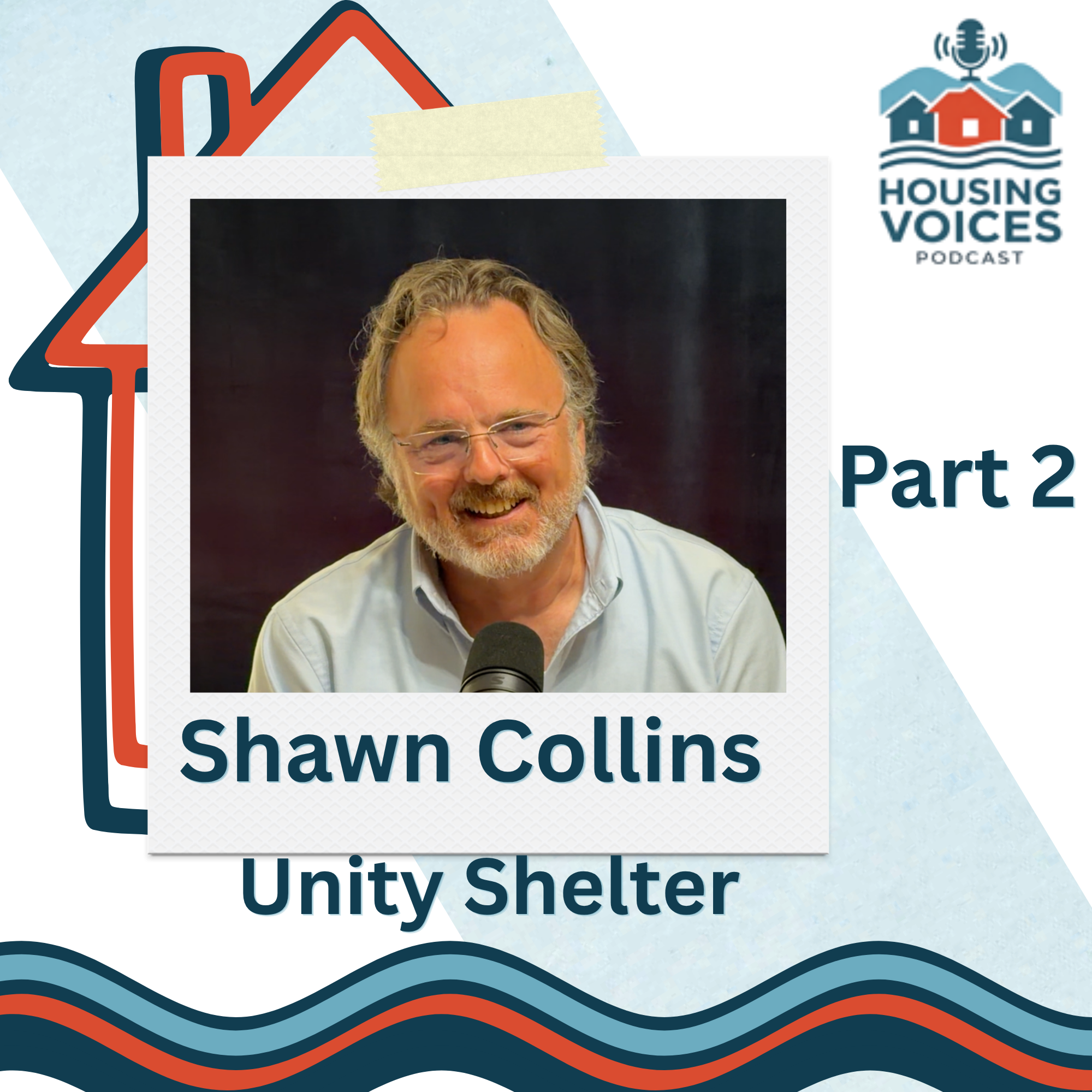
[00:00:05] Speaker B: Welcome back to Housing Voices. We've been having a great conversation with Shawn Collins from Unity Shelter about a lot of things, honestly.
[00:00:15] Speaker A: Oh yeah. It's not just about the houselessness.
[00:00:17] Speaker B: Yeah. I get on my soapbox a couple times.
[00:00:20] Speaker A: Well, you're good at that. You're passionate, you're driven, you're fantastic.
But we really wanted to expand our conversation. Yeah. Oh my gosh. And now you're big headed.
[00:00:31] Speaker B: Yeah.
[00:00:31] Speaker A: Uh huh. But I adore you. Yes, likewise.
[00:00:34] Speaker B: But we're getting back into this conversation with Sean, continuing about supporting the unhoused communities in our communities and how we can look forward to doing better and
[00:00:46] Speaker A: supporting our communities and supporting everybody and making a difference. Yeah, that part, that's really a big part. So welcome back to Housing Voices.
From the porches and shelters, streets and the room.
[00:01:03] Speaker B: If the house had voices, the truth could break through.
Welcome back to Housing Voices. We're in the midst of an incredible conversation with Shawn from. From Unity Shelter and I want to pick back up. We were talking a little about prevention being more cost effective than rehabilitating and coming in and trying to fix all of the wrongs. It's better to prevent the wrongs from ever happening.
And we also had in our discussion, talked about how it is really hard for a lot of folks who have become unhoused to jump back into, say, getting a job because they have physical disabilities or chronic health conditions that have been left untreated or they didn't have access to the healthcare. And how important it is to make sure that folks have access to those services before that medical event ever happens. Right. That stroke or the untreated diabetes. Right.
And how it actually helps us in the long run because then somebody may not become disabled and then we can get them on insulin.
[00:02:17] Speaker A: Right.
[00:02:17] Speaker B: Or a treatment plan for whatever their illness is and they can continue to work.
Right.
[00:02:23] Speaker C: Yeah. You know, prevention is, that's the holy grail. Right. Is let's prevent the homelessness from happening in the first place. And if it happens, it should be short, you know, brief and non reoccurring. Right. That's the goal. Right.
I think that the, there's a pipeline for adult homelessness that starts very young.
I think the, you know, I mentioned the ACEs score, the adverse Childhood Experiences study.
Somebody with a score of 5 or 6, they're 40% more likely to be homeless as an adult.
And those things could be, you know, a lot of that can be addressed early on by more intervention with kids to make sure that they're Getting the support that they need. If they've had a big traumatic event, make sure they get the care that they need to be able to recover from that in some way.
Make sure that their educational environment is safe and secure, all those kind of things.
It's never something that you can, by the time people come to our door, a lot has happened in their lives. If you can intervene early enough and stop some of that better the.
And it might not be they have to go all the way back to childhood. It might be more rent supports and making sure that it's, it's not so challenging for somebody when they, they do have that financial crisis and they have to make a choice between paying the rent or getting a needed medication or fixing the car so they can stay employed. Like getting that emergency funding to them quickly can make a huge difference. And there's lots of studies out there that show how those kind of short term financial interventions can really change the course for somebody and fix those problems and avoid them ending up homeless. And I think that that's the more we can move to that model and care for people at the point of need before they end up on the street. Because once they're out, it's incredibly difficult to get them back in. Right. It's. And more expensive. Oftentimes they're going to need more financial support to pay off past debts. They're going to. And those debts will haunt them if they try to get into housing. If they've had an eviction that will stay on their record for seven years and that's a long time to try and wait that out. And in a housing market like ours in Corvallis, where you've got a very low vacancy rate and very high rents and a very demanding college community, right. That eats up that housing quickly.
Like landlords don't have to, they don't have to go down the list very far. And if you've got an eviction or bad credit, debts to utilities or a previous landlord, you're probably coming right out of the stack and going in the trash can. So I think that it's, it's, it's definitely, you know, we talk about solving homelessness.
It's not just about getting people into housing once they're home homeless, it's about stopping the pipeline. Right.
People sometimes tell the story about, you know, the, the village that has the river going through it and they keep pulling people out of the river and like, let's go upstream and fix the bridge where people are falling in and, and that's kind of the story that needs to be told.
[00:06:02] Speaker A: And so what organizations do best with the prevention
[00:06:08] Speaker C: right now? It's tough.
I think we care does a lot in Corvallis to try and help. There are some others that have been able to step in. St. Vinny's the St. Vincent de Paul folks are able to do that kind of short term emergency help.
Vina Moses, you know, there's a.
There's both formal and informal networks of folks and I've run into them.
I ran into another one the other day. It's like, oh, you just call your friends. Okay, great, call your friends. Let's make this happen.
[00:06:42] Speaker A: The.
[00:06:44] Speaker C: It's amazing how much community support there is for that kind of emergency help, but it's not enough. And I think that a lot of the, the formal systems that used to be funded and administered by Community Services Consortium, a lot of the funding for that kind of emergency rent support or other utility help and things like that, a lot of that's gone away or it's been really reduced so that they'll run through their funds very quickly. And so it makes it tougher because that's, that's the spot. Right. That's the official spot that people are supposed to go to. And if they don't have funding, they might not know who to refer them to. And if they're not connected with services correctly, you know, a lot of times we will meet people who've been out on the street for a long time or they're living in their car, maybe they've got a family and they, they've never been homeless before and they just have no idea who to even ask.
[00:07:42] Speaker A: Yeah. Or where to go.
[00:07:44] Speaker C: Yeah.
[00:07:44] Speaker A: Where, where do I go? How does this work? Who can help me? Because some of them organizations, they'll help somebody once.
[00:07:51] Speaker C: Yeah.
[00:07:52] Speaker A: Right. And so that's a limiting factor. Right.
And sometimes there's not education that goes with that. Like, hey, all right, so maybe we have a chronic problem. Hey, how can we help and assist. Right. In order to prevent this from you from getting to this situation. Because they too are overloaded.
[00:08:11] Speaker C: Yep.
[00:08:12] Speaker A: Social and human services are really overloaded right now.
We're going to hop in from prevention to. Unfortunately, some people have fallen into the abyss and they're struggling and they're working really hard to try and get themselves out. But the cost of homelessness is far greater than just the cost to unity.
It's an increased cost in insurance, health insurance.
By health insurance. I mean, usually that doesn't happen. Right. So our hospitals and things are receiving A greater burden. It's a greater burden on law enforcement, on fire food. Right. It's. It's hard to eat more economically if you're living on the street. Right. Than if you have a freezer or fridge or, you know, or some way. Yeah.
[00:08:57] Speaker C: The ability to really cook and store food is.
[00:09:01] Speaker A: It's huge. Right. And how are you going to get yourself.
[00:09:04] Speaker C: Yeah.
[00:09:05] Speaker A: So when someone comes into Unity, how do you determine who gets the beds to start with and what's their process to having them successfully go into transitional housing?
[00:09:16] Speaker C: Sure. So emergency shelter particularly, we did this before we were required to do it.
But the current statewide shelter program guidelines are that emergency shelter is supposed to be low barrier.
And we've been low barrier from the start. And low barrier shelter means substance use is okay. Mental health issues, criminal background, all of those things don't matter. We don't screen for that at entry. It's really, you show up and you need a bed.
The screening process that we're going to go through is can you actually take care of yourself tonight in the sense that, like, are you capable of managing your toileting and things like that? Or if you're intoxicated, are you so intoxicated that you're not functional and can barely stagger into the building?
That's going to be a challenge.
[00:10:12] Speaker A: Right.
[00:10:14] Speaker C: Are you intoxicated and belligerent or having a mental health crisis and are yelling and being super disruptive and maybe aggressive with people? It's all behavior based for us. And it should be in a low barrier shelter environment.
It's really, for lack of a better phrase, it's can you play well with others? Right.
If you can function in the space and, and get along with the other people here and not get in, you know, not have some kind of conflict, you're in that. So low barrier shelter is intended to be like, let's get you in.
So getting a bed is really going to be a matter of capacity.
If we ever have to exit somebody, we try and do it for as brief a period of. Of time as possible. And what we're really looking for is behavior change. Right. Like having people understand, like, what you did is a problem. You know, you threatened. I watched an exit happen this morning, and it was because somebody had really threatened somebody else. Like, okay, you can't do that. You're going to take a night out.
[00:11:16] Speaker A: Right.
[00:11:17] Speaker C: But come back tomorrow. It's a new day.
You know, we'll. We'll restart that. Move from emergency shelter space to transitional housing space is a little bit different. Because we're going to be looking at, okay, can you live around other people on an ongoing basis? Are you, are you actually interested in getting into housing right now? Or is that like, not really your goal? Right. And, and no harm, no foul, Right. If somebody isn't ready for that, that's okay.
But, but it doesn't, but it means that you're probably not ready for transitional housing. Because if you're going to be in transitional housing, you're going to have to work with case managers. You're going to have to be motivated enough to actively work on the barriers that you might have. It might be getting your id, it might be getting your Social Security card. Again, it might be ultimately employment, if that's one of the barriers.
It might be getting on wait lists for rent assistance or a Section 8 voucher. Like, if you're not willing to go through those steps, you're not really ready for transitional housing.
And we, we are pretty, you know, the, the simple way that I would explain that is our micro shelter based transitional housing program is not an alternative to shelter.
And sometimes people think, well, I don't like shelter. I want a micro shelter. Right. I want my own place. I don't want, I don't want to share a bit, you know, share space with all these other people.
Like that's not enough. Right. This isn't just, you don't like it there. So we're going to move you into this. You really have to be kind of motivated.
It doesn't have to be immediate. When people come in, sometimes their first goal is I need to kind of come down off of living on the street for all this time and get out of fight or flight. And yeah, I need my ID and I need these other things, but I really, you know, we, we recognize that when people move in, particularly if they've been out for a long time, it can be three months before their brain settles down enough to really focus on a goal.
[00:13:24] Speaker A: Right. Because it takes a while to feel safe.
[00:13:26] Speaker C: Yeah. So the goals that we're going to work with people on initially are going to be pretty small. You know, let's, let's take some steps, get some easy wins. Right. Id. We know how to do that. Let's, let's get you down to the DMV with this form, get your id. So security card a little more complicated, but you know, because maybe you don't have your birth certificate. Let's work on that. Right. It's going to be baby steps. And then as that gets, we kind of clear some of the document stuff out or other minor goals. It's like, okay, let's. Let's talk about housing. You know, what would you need and what was a problem when you were last housed?
Conflict with my landlord. You know, they were. They were horrible, totally unfair. And I blew up at them and they kicked me out.
Okay.
[00:14:12] Speaker A: Yeah.
[00:14:12] Speaker C: Let's talk about how to navigate a landlord relationship. Right? Let's. Let's talk about what that looks like, what your obligations are as a renter. We might encourage somebody to get into rent, well, class, which will do a lot of that, like, kind of life skills training around how to be a good tenant.
We might do other things to work with them, but it's really.
Shelter's kind of the front door.
And really oftentimes our daytime service is the hygiene center that operates out of the men's shelter building is really the. Maybe it's the doorstep. Right. It's the.
It's the welcome.
[00:14:49] Speaker A: The threshold.
[00:14:50] Speaker C: Yeah. And then you're gonna come and we're
[00:14:52] Speaker A: thankful for the hygiene center.
[00:14:54] Speaker C: Absolutely. It's helpful.
[00:14:55] Speaker B: A good shower really is a vibe shift.
[00:14:59] Speaker A: It makes a huge difference for me. It's like, oh, you know, just feels like it's rinsing things off. What I appreciated that you brought up there was the fact that getting rent assistance and getting the other.
The vouchers. Right. That requires work for people to do. It's not a handout. And I think sometimes in the community, people think, oh, well, they're just taking. And you're just like, oh, no. These are long processes that are tedious and studious that require a lot of work for people to leverage or to utilize. And not many are coming out. If I remember, in like 2025, there was like, none.
[00:15:39] Speaker C: It's been really limited.
[00:15:41] Speaker B: The.
[00:15:42] Speaker C: This administration has really cut back on vouchers.
We have not seen the vouchers pulled that we've seen in the past.
And it's voucher value is. It's gone up a little bit, but not up with rents have gone up more. And so one of the concerns we have right now is that we might see people who got in with a Section 8 voucher and are housed, but the rent's gone up beyond the value of the voucher. And now they're at risk of losing housing again.
And losing housing once and getting back in is a big deal.
Losing housing multiple times, you start to think that you're not actually capable and that there's no hope, and that's a really bad spot to be in.
[00:16:37] Speaker A: It is and it's dehumanizing. Thank you. That was the word I was looking. I'm so glad you've got a lot of the words.
All right, so we get people in and we're in shelter and sometimes we're able to get them into micro shelters, if that's something that works for them. And then how do you transition? Keep transitioning? And what is the rate of transition of being able to find? Because it's hard to find rentals because it's expensive. Right. The vouchers are for a time period. So if you don't use your voucher within the time period, that's also really hard. Right. If you don't use it, you lose it. Right. So that's another limiting factor.
How are you being successful and what are other tools and steps for success that we can see in use?
[00:17:24] Speaker C: Persistence is part of it.
Partners are a lot of it. I mean, the, the case managers at Corvallis Housing first are dedicated to working that. Right. I mean, they, they've gotten some people into housing that I never thought we would see get into housing.
And I think that the.
I just want to kind of want to go back to this idea that, you know, people are just getting handout. It's. There is this mythology that people that are homeless are just lazy.
Like, the amount of work that it takes to survive without stable housing far exceeds what it takes to be housed, right?
[00:18:05] Speaker A: Oh, yeah.
[00:18:06] Speaker C: I mean, yeah, I work a lot of hours a week. I, you know, but I could work less. And it's work, right. I mean, you kind of get acculturated to going to work and having a job and you go home and if, if it's like, I don't want to do anything tonight, you're not going to be worried about your safety.
You might be putting off some task that you need to get done, but the task isn't, I need to find food and a place to put up my tent and then make sure I stay up all night because I'm scared of these other people that I'm around. Right, right.
[00:18:46] Speaker A: And you're vulnerable, especially women.
[00:18:48] Speaker C: And in the morning, I don't have to get up, pack up and move because the city's going to come make me move again. Right. Like, it's an enormous amount of work. And then to get into shelter and not be able to stay there all day means you're going to. At 9 o', clock, you're going to walk out of shelter and you're going to be outside until 5 o'.
[00:19:07] Speaker B: Clock.
[00:19:08] Speaker C: Now You've got to navigate that like it's an enormous amount of work.
And then once you get into transitional housing again, you're going to have work to do, as you said. Right. Like going through that process and trying to get your applications done and working with your case manager and keeping that relationship up and then navigating all the other people that might live in the area around you. And, you know, like, it's a. It's a lot. It's a lot. It's. There's a reason that people get overwhelmed and we try and accommodate that.
[00:19:39] Speaker A: And I'm really glad you went back to that and spoke on that, because it's something that we hear. Right. We're like, oh, my gosh. No. Right, yeah. Or people just see. Well, they're just out there begging for money and you're like, oh, my goodness. Right. Yeah, it is.
It's hard, right? That. It's heartbreaking.
So when they get into transitional housing, you're working along with Corvallis Housing first and providing the case management with the case management in order for them to stay in housing. Right. Because that's another change, another new thing or something that they haven't done in a while.
How much case management goes into that and how are you continuing down that path?
[00:20:21] Speaker C: It varies person to person about how much it takes the.
Sometimes we get. We've had people that have rolled through transitional housing in 30 days. We've had people that have been there three years before they get into housing. And so for the folks that come in and out in 30 days, they just needed a lily pad. Right. I need a safe spot for this much time to be able to figure out what's next. And a lot of times they already have a pretty good idea what to do. They just need a spot that's safe and stable for just a little bit of time. And they launch. And we don't often have to do much to help them except. Yep, we get it. We get it. You're okay.
Here's a safe space. Right. For the folks that are longer term, they're going to be working with case management maybe a lot to try and both get all those applications in and knock the barriers down and in that process develop some life skills at the same time that are going to help them stay in housing. Now, once they get into housing, it's a very vulnerable moment.
And after care, you know, following people after they move into housing, CHF does a lot of that. We do some, to the extent that we can. The CARE team involved a lot of folks after they get into housing. But that's a really tough space.
What we find for a lot of folks that move into housing that have been out for a long time, they might move into an apartment where they're surrounded by people that have never been homeless. And so you kind of.
If you're out for a long time, you tend to develop a little bit different identity and a sense that you are other because you're treated as other broader society. And now you're moved into an apartment complex where you're surrounded by working adults or college kids, and they have no idea what it is experience you've had in life.
And so you're. You're very isolated.
And isolation is part of the recipe of homelessness. Right. It's part of the formula that gets people homeless and keeps them there sometimes is they've been isolated from their network of support, maybe their family has rejected them because of substances or gender identity or any number of things.
And so that experience of moving into housing can be very isolating, too.
And so you really want to make sure that you're connecting with people after they move to housing.
Like, even if it's just like, hey, are you okay? You know, or hey, come back and visit, it's okay, you know, like, we don't. We don't mind. Come, come see us. You've got friends here. It's all right. We don't want you to move back in, but definitely come, because it's just that there we had a staff member that described it as going to Italy and not knowing the language and having to figure out everything.
Right. If you haven't been housed for a long time and suddenly you're housed and you're responsible for the rent, you know, and maybe it's just making sure the vouchers, you know, handled every time, or. And then utilities and you got to clean and all these things that you have to do to be a responsible renter can be overwhelming. And then on top of that, you're feeling isolated and alone and that nobody around you understands anything about what you're struggling with.
That's kind of a nightmare scenario. We see a lot of people that are excited to get housing again, and then at the moment that they get ready to move, they'll admit they're terrified.
[00:24:06] Speaker B: Of course.
[00:24:07] Speaker A: Right.
[00:24:07] Speaker C: It's so scary.
[00:24:08] Speaker A: It's very logical. Yeah, absolutely. Because that's a huge change. Right. Leaving what, you know, for the unknown. That's one of the things, you know, humans greatest fears is the unknown.
[00:24:18] Speaker C: Yeah. And I. I think Honestly, it's a weak spot in the network right now. Is that aftercare? Because I think it's poorly understood what that really means and how long it can take for some people, six months out, they're feeling good, stable, everything's great. Some people never get there. Like, really, they need somebody to be paying attention to them for the rest of their lives. Yeah. If they're, if they've got substance issues, sometimes it's a deadly recipe for them to get back into housing if they don't have more ongoing support because now they're alone.
[00:24:51] Speaker B: Right.
[00:24:51] Speaker C: And the brakes are off and.
[00:24:54] Speaker A: Yeah, that's something you mentioned earlier that I wanted to clarify for people. Right. While it is a low barrier shelter, it doesn't mean that people can use while in shelter.
[00:25:04] Speaker C: No, no.
[00:25:05] Speaker A: I just wanted to make sure that that was clear. Right. They may come in and have used before, but nobody uses in the shelters or any of that, right?
[00:25:13] Speaker C: No, we do bag ch and we will hold things.
You know, somebody comes in with, you know, bag of weed and pipe. Okay. Then it's contraband in shelter. We'll store it for the night and give it back the next day. They come in with an unopened bottle of booze. Like, okay, appreciate that. You got that. It's your property. You, you know, you spent money on that. We're not going to dump it out, which some shelters will.
We store it, give it back to them the next day.
Sometimes they forget it's there and we'll have it for months, you know, but, yeah, they can't use it in shelter.
[00:25:51] Speaker B: Okay.
[00:25:52] Speaker A: I just wanted to make sure that we made that point clear.
[00:25:54] Speaker B: Yeah.
[00:25:54] Speaker A: Mythbust, we might know it. Yeah. Myth bust. That was good.
[00:25:58] Speaker B: Nice.
[00:26:00] Speaker A: So what, after you can get somebody in shelter, what's the rate of people staying in? Right. What are some of the other barriers besides not having, you know, the rent assistance. Right. The vouchers available, you know, the cost of rentals here.
[00:26:18] Speaker C: So the transition from shelter directly into housing is fairly rare. It's usually shelter, transitional housing, and then housing.
And it does happen, but it's just not as. As common. And a lot of times it's somebody that's found housing on their own. Right. And case management often isn't. It's like they're in shelter and they.
They had something lined up. It just wasn't ready and then they. They disappear.
For the folks that come into our transitional housing program, most years it's been 50% of the people that come in end up going into permanent housing. That Year.
[00:26:57] Speaker A: That's fantastic.
[00:26:58] Speaker C: Yeah, so it's been in this last year was really a year where we saw it go down to about 30%, which is still not horrible, but it's just like what happened? Well, a lot of what happened is housing supply.
You know, two years ago there were a lot of apartments that opened up and a ton of people got housed. Last year there was not as much and there wasn't as much rent assistance available.
So the pipeline started to. To block up and we just haven't seen as many people transition in. This year is looking probably on par with last year. My guess is it's going to be about 30 again.
But we. We definitely have had people move into housing.
[00:27:39] Speaker A: So what is that 30%? Is that within standard deviations within the state, within the nation?
Do you have statistics on that for. We can see a rate success?
[00:27:51] Speaker C: That's a great question. I don't have a good answer there.
I should.
[00:27:57] Speaker A: Yeah, well, you can get back with us and we can. Yeah, it feels like a good number,
[00:28:01] Speaker C: but, yeah, 30% doesn't feel all that great. 50% felt pretty good. And when we've talked to other providers, they're like, yeah, 50%, you're doing pretty well if you're getting people out.
When we were at 50%, our average length of time in a micro shelter was six months.
Our average length now is more like nine or ten. So it's just. It's slowed down.
[00:28:26] Speaker A: Is there a need for more micro shelters, for more transitional housing?
[00:28:30] Speaker C: We have them built. We need places to put them.
So there definitely is a need for more transitional housing in the community.
The. The. Our wait list for transitional housing is very long. And.
And we've got 34 units in place. I've got another eight built and waiting.
So there's any business owners or churches in the city of Corvallis that are interested in talking with us? We would love to. To place more micro shelters.
It's taken a while to build to that 34, and it's a lot to keep up with those people and get them the case management that they need. But we've kind of worked that system out pretty well.
[00:29:13] Speaker A: How does that system work? So we know about SafeCamp. Right. And so how many micro shelters are there?
[00:29:18] Speaker C: There's 16 right now.
[00:29:20] Speaker A: Okay. And then you've still got a lot others.
[00:29:23] Speaker C: Yeah.
[00:29:24] Speaker A: Throughout town.
[00:29:24] Speaker C: So we've got.
[00:29:25] Speaker A: Are they in groups? How does that work?
[00:29:27] Speaker C: So this for most. So we've got six sites right now.
There's only two that are more than three or Four micro shelters. So most of them have been smaller installs as few as two, plus a kitchen unit or kind of support unit, and then as many as four. The permits recently changed with the city of Corvallis that let us go up as we could go up as high as 25 if we had a new site that could do that.
The last one that we expanded was at Compassion Church and we now have six living units there, a kitchen unit and an office. So we will staff at that site as well. So the case manager has a place
[00:30:12] Speaker A: to work and so that case manager working there five days a week. How does that work? Or is that more intermittent?
[00:30:18] Speaker C: The idea is to have staff or case management there, you know, five days a week at least.
The. It's a little bumpy right now because we just recently expanded, so we're still kind of getting scheduling nailed down. But the case managers there.
There are six people living there.
They're probably there two, three times a week, touching base with people having appointments.
And of course, the folks that live there can reach out anytime and. And ask for help. For help.
But yeah, it's. The case manager is there less than our regular staff, but. But they are there pretty, pretty frequently during the week. And we, as we kind of move forward with that site, we'll get into a groove where there's somebody there seven days a week.
[00:31:07] Speaker A: So just for clarity, there's no plumbing.
[00:31:10] Speaker C: No.
[00:31:11] Speaker A: So they get to go to the hygiene center in South Town.
And how often are people allowed to use the hygiene shower?
[00:31:19] Speaker C: They can come, I think every day.
It depends a little bit on capacity. So the. We've got seven showers, but.
And we're open 11 to 4.
The showers just part of. It's a practical reality.
You know, we have to do a deep clean of the showers kind of at the end of the shift. So shower time really ends by three.
So it's how many showers can we get in that time period? Right.
But if you show up and need a shower and spot on the schedule you're going to get in, the laundry is more restricted. And I can't remember how many times a week they can do laundry, but.
Because that's. That really is a bottleneck, you know, just in terms of capacity. It takes more.
[00:32:03] Speaker A: But.
And that's just across all homelessness and transitional housing.
Laundry is an issue.
[00:32:09] Speaker C: Yeah, laundry. I mean, the laundry and showers are big challenges. Food is actually a big challenge. Not in terms of getting food to people, because we've got actually pretty good food network between the food banks and St. Vincent.
There's a lot of food available for folks. It's. Where do you cook it? How do you store it?
A lot of people that have been homeless for very long, like, those skills are degraded and they're used to more packaged food. So, you know, they're not. They're not always cooking a lot. They might be reheating things in a microwave. So.
[00:32:47] Speaker A: And is that what. Look. What does the kitchen shelter look like?
[00:32:50] Speaker C: So we do have water in there. So we've got tanked water in the. In there. So there's a sink and got. Typically a microwave.
An inductive cooktop. Fire department's not excited about hot surfaces. So inductive cooktops work a lot better for us.
Coffee maker, it's pretty basic. And then a fridge might be.
Depending on the site and the needs of an individual, there might be a shared fridge that's in the kitchen unit. They might have a mini fridge in there, too. Particularly people with medications that they're concerned about will get a mini fridge. Fridge in there. So they've got that.
Sometimes we get a mini fridge for somebody because they're really paranoid about having food where somebody else could get.
So, yeah, they're more comfortable if they've got their own. Okay. You know, as long as we can. As long as we can do that safely. You know, we've got enough power and the units clean enough that it actually makes sense. Great.
[00:33:50] Speaker A: Can you share one of, I'm sure, many success stories or heartfelt stories?
[00:33:56] Speaker C: You know, I just heard one this morning that really made me happy. So we had somebody that came into safe camp probably two years ago, maybe three. They'd been camping for a long time, and they were.
They were addicted to opiates. They'd been out for a long time.
It was actually the first person I'd worked with that ever actually admitted to me that they used.
And by that time, I'd worked with a lot of people. But, like, most people are like, nope, nope, not at all.
This person was totally upfront about it.
[00:34:29] Speaker A: Nice.
[00:34:29] Speaker C: Was amazing.
And. But also was very clear, like, I need to get. I need to end that right? Because I want to. I want to be reconnected with my kids. I want to work again. I want to be housed. Like, this has to change.
They. They got housed.
They were mostly clean, but not completely.
Now they're working.
They've got a regular job. They're clean and sober. They've reconnected with their family.
They had lost a lot of their teeth when they were out because dental care Is really super tough.
[00:35:11] Speaker B: Well, even if you have insurance, it doesn't come with your health insurance.
[00:35:15] Speaker C: Right, right. So they've got dentures now. Yeah.
[00:35:18] Speaker B: Teeth are not part of your body, so.
[00:35:20] Speaker C: Right. So we don't have to worry about them. Yeah. That was a huge success story to hear. You know, one of my staff came and was like, oh, yeah. They were just walking by the street next to my house, and I talked to them and got a boyfriend who works in homeless services. Like, it's. It's just this complete flip.
They look good, they're happy.
[00:35:41] Speaker B: Yeah.
[00:35:42] Speaker C: Obviously figured some things out.
And we love those stories.
[00:35:48] Speaker B: That's amazing.
Which is why I think we really started this podcast is talking about the housing production and the housing supply. And you brought up the really stagnant growth in our housing supply that affects everybody. Right. It is not just the families that need a home or the college students that need an apartment or the seniors that need a space to age in place. Right. It is. It affects everybody. So if we're not building the housing, all of the different types of housing that we need, then there is not space for folks to enter in after they have left the housing continuum.
[00:36:29] Speaker C: Yeah. Yeah. There was a study done in Oregon a few years ago about the. The number of homes that we build in Oregon versus the number of new households that are being created. Right. Just natural growth of, you know, kids grow up, they get married, start families. They need. They need housing. We are under building by 50%.
I think the. The current governor is very focused on changing that. And I think there's a lot of work that's being done to get more housing production going, but it's. We're still way under. And it. It changes the equation for everybody. Right. I look at the value of my house and it's gone way up.
You know that. I mean, not because of anything I've done.
[00:37:14] Speaker B: Well, just because of the market. Yeah, exactly.
[00:37:17] Speaker C: So it makes it a lot more difficult to enter the housing market as a buyer. It raises rents. Like, everything goes up.
[00:37:25] Speaker B: Yeah.
[00:37:26] Speaker C: Except those rent supports that would actually get people in. So.
[00:37:30] Speaker A: So if you could wave a magic wand. You know, I love this question.
[00:37:34] Speaker B: We need to get an actual.
[00:37:37] Speaker A: I can do that.
Oh, my gosh. I really love that idea.
Okay. All right. That's a solvable problem. Yeah. But if you could wave a magic wand regarding houselessness, the whole. The whole enchilada. Right. What would be your ask easy questions?
[00:38:02] Speaker C: Yeah, that's a simple one.
[00:38:03] Speaker B: Yeah.
[00:38:04] Speaker C: How do I put myself out of business entirely?
[00:38:07] Speaker A: I Mean, ideally, yeah, you're working. Yeah, that is the goal, right?
[00:38:10] Speaker C: Yeah, it's a, It's a very odd business to be in that you're like, please, could we just like, not have to do this?
Wow. I, That's a really tough question for me, partly because I'm just not prone to magic wand thinking. But
[00:38:28] Speaker A: then you need to live in my world a little bit more because in Marty world, you know, things will always turn out with a silver lining because I'm always trying to find. Find it.
[00:38:38] Speaker C: You know, there's so many, there's so many things. I mean, there's structural changes that I think need to happen. I think, you know, housing supply is part of that.
I once made myself enormously popular in a public forum by suggesting that we cap equity growth in housing.
Yeah.
[00:38:57] Speaker A: How dare you.
[00:38:58] Speaker C: I'm a little surprised that I was ever invited back, but, but I do think that, you know, the. For incumbents in the housing market, you know, people that already own. It's a great market. Right. I mean, yeah, like my house is more than doubled in value, so why do I want house pricing prices to go down unless I think about the broader impact?
So housing supply is part of it. I, I think so much of what needs to change is, is the maybe tougher one of people understanding what's actually happening and understanding the policy choices that we're making in terms of housing development, in terms of taxation, in terms of a lot of other things, and how that has a huge ripple effect on the way that the poorest among us actually can live and whether or not they can.
And I don't think people understand the realities of homelessness. They also just don't understand the realities of what today's housing market actually is doing to the broader economy and particularly the people at the low end of that economy.
[00:40:11] Speaker B: We have a K shaped economy where if you have money, you get richer and if you don't, you get poorer. And there is no profit incentive for helping people who don't have money.
[00:40:23] Speaker C: Yeah,
[00:40:26] Speaker A: it, it. That comes back to humanity. Right. How do you think a great way is to educate people? All the thoughts were running through and the question was not very succinct. I'm no Bri.
Well, she's not succinct, by the way. Yeah, no, not succinct.
[00:40:43] Speaker B: That's what I was gonna say. I don't know who you were, but you're.
[00:40:46] Speaker A: But you're eloquent.
[00:40:47] Speaker C: That's good though. It gives me a chance to go drink here.
[00:40:49] Speaker A: Yeah, yeah. Take Take a sip of water. But it's like, how do you.
Because it's not simply the people that live in the community that need to be educated about the houseless crisis. Right. And the ramifications of policy changes and what that looks like. Right. That's also the legislators.
[00:41:06] Speaker C: Yeah.
Our electeds don't always understand. I think that one of the realities that I saw very quickly when I was at hp, my wife got involved with the South Corvallis Food bank and very quickly was like, you gotta volunteer, you know, like you gotta get in there and.
And I go in there and I see the level of poverty that's walking through the door every day and the level of food insecurity that people have in the midst of one of the richest agricultural areas, like this is obscene.
I do not understand.
And then I'd go back to work and virtually everybody I work with has a six figure income and are living their lives and feeling good about it. And they're in a bubble that does not connect with the reality.
[00:42:01] Speaker A: Oh yeah.
[00:42:02] Speaker C: And I don't know how to break that bubble. Right. I think that volunteerism helped. I think there were a lot of times that people would see things when they were out doing volunteers, volunteer gigs that would open them up to a broader reality of our community.
But in that environment.
And I don't think this is unusual, maybe even more so now that work from home, work remote, remotely has become more the norm.
Like when I was at hp, I had team members that were in Israel, London, Barcelona, India, California, Idaho.
Almost my entire team by the time I left was somewhere else. And so your ability to connect local realities to the rest of your life, I think breaks down. Right. You start to live in this all encompassing world where everybody's fine and everybody makes decent money and has a house and. And you don't really think about what else is happening.
And I think that's a problem and I don't know, I wish I knew how to fix it. I think we are trying to do more educational opportunities and get out in the community and talk more about what's going on.
I've talked with a lot of other providers about how do we get this amazingly complex story about homelessness and housing and poverty in this community across the nation. How do you tell that story in a way that doesn't put people to sleep or make them give up? Because it's so complicated that they think, well, there's no way out of this?
And I haven't figured out that recipe yet.
[00:43:51] Speaker B: I'm really glad that you brought that up, especially on the policy, because I can very much personally relate to it. My family went through housing insecurity, and we were unhoused when I was in high school, and I had. Eventually I got a job working in D.C. in the Senate, U.S. senate. And when I had started talking about the experiences in my life, which really did not even, I think, touch a lot of the stories that I know now and the trauma and the housing insecurities that folks have really, truly experienced. And I was really. I had a privileged kind of unhoused experience, if that's, you know, how we want to phrase that.
And I was talking about my lived experience, and I had a lot of colleagues working in the Senate saying, wow, that's incredible. You need to write a book. Your story is incredible, how you are so resilient. How did you make it? And I'm sitting thinking, I don't think it was that bad, like. Or I don't. I know a lot of people, my fellow Oregonians and my fellow Americans, that had much worse stories.
Right. And if you think that, that. That my story is bad, you don't realize the true conditions that people are living in right now. And then I think we see those policy ramifications every day. Because I don't think really that you can solve a problem from a policy perspective if you don't have any idea what it's like to live that when
[00:45:16] Speaker A: we hide it as well.
[00:45:17] Speaker C: Yeah, right.
[00:45:18] Speaker A: We're putting, you know, those who are homeless hidden. Right. So it's not out there. So people can see and feel and experience and educate themselves on it. Right.
[00:45:29] Speaker B: And I don't think these people even really knew what. Realized what they were saying. Right. I think they truly and genuinely were trying to be great and nice and gracious, but it just really showed and reflected to me that, wow, we've got a problem.
Cause I don't think you can have a government of the people, by the people and for the people if you don't have actual everyday Americans in. In that government.
[00:45:53] Speaker C: Yeah. Yeah, that's well said. I mean, again, back to hp. I had this experience one time.
The group that I was in got moved into global marketing. And so I'm out at dinner with all my fellow managers in that group, and they're talking about, you know, we got to. We got to develop a better understanding of how to, you know, sell PCs and whatever. Right. And they're.
They're thinking about their plan in terms of the experience that they have living in Palo Alto, California, where a 600 square foot house might cost you a million and a half dollars.
And you're, you know, the, the first hotel I stayed in there was next to the McLaren dealership. Right. Like, this is not real life. I'm like, you need to go to Nebraska. Like, you need to go to the Midwest and, you know, or the Rust Belt. Like, you don't need to think about how to market to the people that live in Palo Alto. And they looked at me like I was out of my mind.
Like this is reality. Like, not for most people.
Not even close. And I, I just think that's a, it's one of these kind of confirmation bias problems that we're in the midst of in so many society.
Like, it doesn't, it doesn't impact me. It's not my experience.
[00:47:16] Speaker A: Yeah.
[00:47:16] Speaker C: The only homeless people I know are, you know, drug, drug addicts that are flying aside. WinCo.
[00:47:21] Speaker B: Yeah.
[00:47:22] Speaker C: You know, surely there's no more complication than that. Yeah, actually, there's a lot more complications.
[00:47:28] Speaker B: And I'm, I'm hoping with conversations like this and, and with, I think, the politically, the moment that we are in where wages are not catching up with costs and people are really asking, so what, what is, what is the benefit? Right. I'm not seeing the benefits here.
And, and pivoting from the rugged individualism. Right. Replacing rugged individualism with the warmth of collectivism. Right. That we didn't get here after thousands and thousands of years on our own.
[00:48:00] Speaker A: Right.
[00:48:01] Speaker B: Right. Nobody did.
And I think we need to remember that.
[00:48:05] Speaker C: Yeah.
So my office is at the First Congregational Church, and the pastor there says, you know, we live in the shelter of.
And I think that's.
[00:48:15] Speaker B: Right.
[00:48:15] Speaker C: Like we. None of us could do this on our own.
None of us get here.
You know, like, how many of us built our own log cabin. Right. And were born in it, raised ourselves. None.
It's just not happening.
[00:48:31] Speaker B: And how do we get at the end and say, I won at capitalism, I made the most money and you are all alone.
[00:48:36] Speaker C: Yeah. Yeah.
[00:48:38] Speaker A: So what is an action item that you can leave people with? Right.
To really start making a difference in the housing situation? Right.
[00:48:48] Speaker C: Yeah.
You know, I go back. So when I was working with the Housing Opportunity Action Council, my job was actually hosted at United Way. And so I'm going to steal their tagline, which is give, advocate and volunteer.
I do think volunteering and giving is really important. I think what those do is do some of that educational piece. Right. If you show up and volunteer in the shelter, it's a great way to Break down all the myths. Right. Because you're going to meet people that have PhDs.
You're going to meet people that. With GEDs and everything in between and people that are working full time and trying to figure out how to do that and live in shelter. Right. So that advocate piece or the, the volunteer piece can be crucial to enable the advocacy. Right. Right. Now, I think advocacy for these services and articulating that from our.
You pick a religious or cultural tradition that has talked about how we're supposed to live. We are supposed to care for one another.
We are supposed to care for the sick and the elderly and the infirmities and visit the person in jail. And like, all of these things that are part of our best traditions.
Like, we have to actually start advocating to our elected leaders that that's the values we want to see.
Not exclusion, not let's take away all the supports that make your life possible because you're clearly a loser in this economy.
Like, all of those things are fly right in the face of the best human traditions.
We have to make that change.
I think we have to demand that people are of higher value than property. Yep. We need to protect the environment. We need to. You know, sometimes when I say that people are like, oh, you're just gonna doze the wetlands and build housing? Like, no, there's a balance that has to be struck.
But the balance should be in favor of trying to make human life possible,
[00:51:02] Speaker B: because what else is this for?
[00:51:04] Speaker C: Yeah.
[00:51:05] Speaker B: Truly. And I'm really glad you brought up the elected officials. I think also, in addition to making them understand and helping them understand the situation, I also think that we should have electeds that come from that situation.
[00:51:21] Speaker C: That would be nice.
[00:51:22] Speaker A: Yeah, would for people. Right.
Working with and volunteering with people who are houseless has been a struggle for me. Right. Because so many people are afraid.
[00:51:34] Speaker C: Sure.
[00:51:35] Speaker A: Right. Or they're like, oh, well, that might smell, or that might be this or that might be that. What are some rules and opportunities for someone who's curious and interested and wants to volunteer but isn't ready to jump into the deep end of the pool?
[00:51:49] Speaker C: Sure.
[00:51:49] Speaker A: What would some of those opportunities look like?
[00:51:52] Speaker C: I think that the. I get this question a lot, actually, and I think the roles that we've got right now that are the easiest to step into and kind of kind of dip your toe in the water are the food service roles. So at both shelters, we serve an evening meal, we serve a morning meal.
It's more self serve there. But. But there's work around that.
We Serve four days a week at the men's shelter Stone soup meals. And every day we've got sack lunches and things like those. Those kind of opportunities, you're going to be interacting with people a lot less than some of the other volunteer roles where you're really going to be in the mix. Right.
[00:52:35] Speaker A: Okay. And if I wanted to get more in the mix, what would I do?
[00:52:38] Speaker C: If you wanted to be more in the mix, you'd do. You'd pick up roles that are, we call staff support.
So you're going to be more, you know, basically helping another staff person and interacting with the people in shelter a lot more.
The food service ones, you can kind of limit your interaction and kind of observe a lot more.
The staff support roles, you're. You're a lot more hands on. And I mean, one of the things that we used to have, if I go back pre pandemic when we had all those volunteers, some nights we would have more volunteers than we needed, which is a great problem to have because then they could actually just talk with people.
And so we saw relationships build in that space between volunteers and the people that we serve that were so very different than just a transactional.
Here's your meal. Right.
[00:53:33] Speaker A: And those meal nights were always my favorite nights to come in and volunteer because we would sit down and we'd connect and we'd talk and there'd be even times when, you know, when a Gamers 2 would be played or a puzzle would be done. And that is where I think the real human connection is needed. Right.
Because then people feel a value.
[00:53:53] Speaker C: Yeah.
[00:53:54] Speaker A: When you don't feel value, Right.
You're not gonna not perform, but you're not gonna help yourself as much. Right. When somebody values you, you're gonna elevate not only them, but yourself.
[00:54:09] Speaker B: And I've gotta do a plug for my favorite, which is street outrage, which is probably, I think, more on the jumping into the deeper end for folks, but incredibly rewarding. Incredible experience. Meeting people where they are, as I think probably the lowest of the low barriers and the incredible encounters that I have had, the relationships with people where it is just changed me and my life for the better.
And I encourage everybody to do a street outreach shift if they are, if they are able to, where you meet them, where you are, you make a cup of coffee and you make them some oatmeal, bring them some food and you sit and talk. Right. And we've had opportunities where folks say, yeah, I am ready to get into treatment. Can you help me start that? Like yes, absolutely. Let's go right now.
[00:55:03] Speaker C: Yeah.
[00:55:04] Speaker B: And that's amazing.
[00:55:05] Speaker C: Yeah, I think.
[00:55:06] Speaker A: But people need people to help.
[00:55:08] Speaker B: Yes.
[00:55:08] Speaker C: Yeah.
[00:55:09] Speaker A: Right. And. And that's the power in the street outreach.
[00:55:12] Speaker C: Right. And I think there are so many great organizations in Corvallis that have opportunities like that.
Both the deeper, like let's go into the deep end and the Lighter Touch. I mean, Vinyl Moses uses a lot of volunteers and honestly is just a fantastic organization. I'm a big fan.
CHF uses volunteers. Corvallis Housing First. The Drop in center has a lot of volunteers and like that experience can be life changing for people. The South Corvallis Food bank, that it's really. I blame my wife for getting me into this work. Really.
[00:55:49] Speaker A: Margaret's lovely.
[00:55:50] Speaker C: Yeah, she's lovely. And very tricky.
Very tricky getting me in there. It's like, I think I'll set that up here.
[00:55:56] Speaker A: She's a chess player.
[00:55:57] Speaker C: She doesn't play checkers. No. But that, that really did like, crack open a big bubble for me to, to see. Like, oh, this is not just a super wealthy community full of highly educated people. It's a much broader community and the. We're in many ways a barbell community. You've got a lot of people at the wealthy end and a lot of people at the low end and not a lot in the middle. And anytime that you can kind of open up that reality, I think it's, it's a good, good thing.
[00:56:32] Speaker B: Both fortunately and unfortunately, there is a lot to do.
[00:56:35] Speaker C: Yeah, yeah, yeah.
[00:56:37] Speaker A: We want to thank you for coming and being our guest and taking so much extra time so we could get more learning from you.
[00:56:44] Speaker B: Yeah, well, and if folks wanted to reach out if they heard anything that they think, yeah, I have some land that I could. You could put some of your shelter space on. How do they get in touch with you?
[00:56:58] Speaker C: You can send me
[email protected] you can call our number. A baby actually stole my badge, so. Which has my number.
[00:57:09] Speaker B: The baby stole your badge.
[00:57:11] Speaker A: That's another story.
[00:57:13] Speaker C: We would have a whole other podcast to talk about that.
They're holding it ransom, apparently. But.
But yeah, that's the easiest way is to just shoot me an email. You can also. My work number is 541-313-8776.
Unfortunately, it's always on.
[00:57:30] Speaker A: So thank you and thank the case managers because you've got a fantastic team that you work with and I'm just in awe of all of them because that's hard work.
[00:57:40] Speaker C: It's hard work day in day out. And, you know, we're so fortunate. And the staff that we get are generally people that really care.
We see a lot of people on our staff that have lived experience, but we also see a lot of college students and other folks that are just like, yeah, you know, I know there's a need and I want to do something about it. So how can I get in here? So it's, it's really, it's, it's been one of the most fulfilling experiences I've had is working in this space. So.
[00:58:13] Speaker A: Awesome.
[00:58:13] Speaker C: Yeah.
Thanks for the time today. Yeah.
[00:58:16] Speaker A: Thank you.
[00:58:18] Speaker B: So I'm Bri.
[00:58:19] Speaker A: And I am Marty, and this is Housing Voices.
[00:58:21] Speaker B: Practical Solutions Meet.
A special thanks to our partners Marty Bulford.com and Cynet.net for supporting thoughtful dialogue around housing in our communities.
Music for Housing Voices is Provided by Karen DeWolf and Adrian Criz. Thank you for helping us set the tone.
You can find
[email protected] and connect with us under Housing Voices on Instagram, Facebook, LinkedIn, Bluesky, TikTok, and our YouTube channel.
If you found value in today's conversation, share this episode, follow the show, and help us expand the dialogue.
Until next time, this is bre. Let's keep listening, keep learning, and keep building practical housing solutions together.