[00:00:00] Speaker A: The truth can breakthrough.
[00:00:04] Speaker B: Hi, I am Marty.
[00:00:06] Speaker A: I'm Bri.
[00:00:07] Speaker B: And welcome to Housing Voices.
Today we're going to switch it up a little bit and change our format a little. So we're going to tell you a little bit about why we chose this person to come in and a little bit about our backstory with the topic.
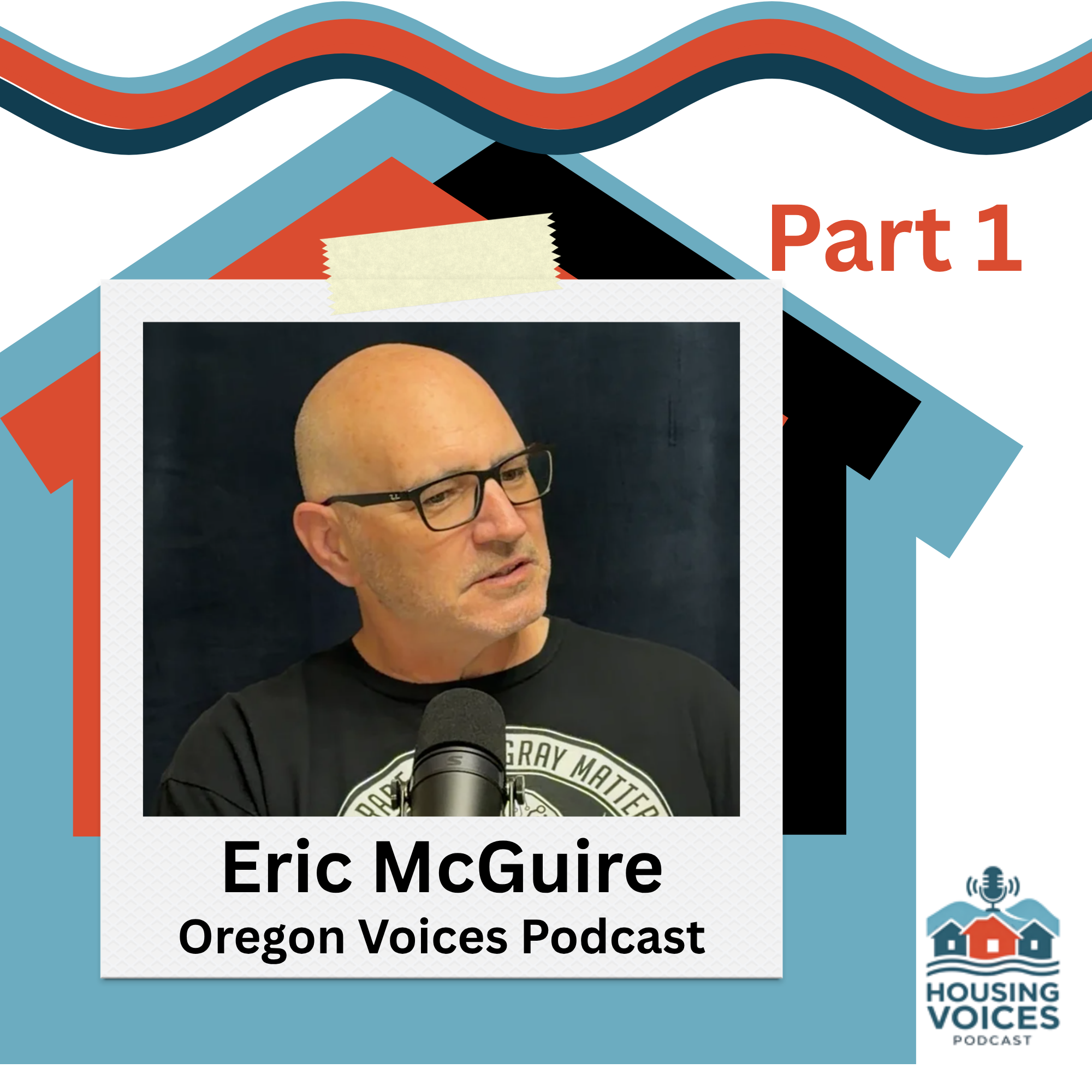
[00:00:24] Speaker A: Yeah. So today We've got Eric McGuire. He is a really strong advocate for education. He is a teacher himself.
He is hugely active in the OEA Union, which is the Oregon Education association, which is the union that represents teachers. And on this podcast we've talked a lot about the effects of lack of housing and property taxes and what that means. And I'm really hoping to drill down on the effects of lack of housing, which means lack of property taxes being collected, which then means that our education and our students are affected.
[00:01:05] Speaker B: You know, as a former teacher, I am really looking forward to hearing what's actually happening now because, you know, it's been 15 years for me since I've been in that game. And I view teachers as like angels on the side of heaven. Right.
The work is so hard and so challenging and it's the commitment that our teachers take. Right. It's not the nine months.
[00:01:30] Speaker A: No.
[00:01:30] Speaker B: Right. It's 40 plus hours because it's all the planning and then the follow up and then the grading and it's so instrumental and it's undervalued. Yeah.
[00:01:44] Speaker A: And not to mention that teachers have to pay for their own supplies. Right. That aren't covered by their districts. And that's a problem too. My background is working for the US Senate and I did education policy.
That was kind of my bailiwick. And I think we really are facing a reckoning when it comes to how we fund our education and how it is a very braided kind of funding model from the federal government, from the state government, from counties, all of that. And I think we are now seeing a lot of the problems in real time right now that that model isn't necessarily serving our students or our teachers or our families or our communities the way that we could be, and we know that we should be.
[00:02:32] Speaker B: Because education is foundational.
[00:02:34] Speaker A: Yeah, absolutely.
[00:02:35] Speaker B: It's just like housing. Right. If you don't have an educated workforce. Right. An educated public. Right.
We're open to much bigger problems in the world. Yeah. Right.
It's not just about the global warming. Right. It's about the policies that we support.
Or not. Right.
[00:02:57] Speaker A: And educators are also people and consumers in our communities as well. So if the teachers can't find a place to live in our community to teach the kids. We've got a problem there as well. There have been localities across the country that have had to step in to provide housing for their teachers because they don't pay their teachers enough to catch up with market rate housing in their communities.
And then you have a bunch of students that don't have teachers and then what?
[00:03:27] Speaker B: Right.
[00:03:28] Speaker A: It's a huge problem.
[00:03:29] Speaker B: It's a huge problem. And it's all around housing as well. They're interdependent. And sometimes I think that people will talk about housing and people talk about education and forget how interdependent. Intertwined. Yeah, yeah. Intertwined. That they are.
[00:03:45] Speaker A: Absolutely.
[00:03:46] Speaker B: Well, let's get on with it. And we're going to now Next meet Eric McGuire
[00:03:52] Speaker A: from the Porches and shelters, streets and the room.
If the house had voices, the truth could break through.
Welcome back to Housing Voices. My name is Bri.
[00:04:10] Speaker B: And I am Marty. And today we are joined by Eric McGuire.
[00:04:15] Speaker A: Hi, Eric.
[00:04:15] Speaker C: Hi.
[00:04:16] Speaker A: Thanks for joining us.
[00:04:17] Speaker C: I'm privileged to be here and excited to be on the other side of the conversation.
[00:04:21] Speaker A: Yeah. You have your own podcast here in Oregon, Oregon Voices. It is a really great podcast. Really cool conversations with a lot of amazing organizers, activists, candidates. Most importantly, I think is one of the really cool things that you guys do.
[00:04:39] Speaker B: Tell us about it and what made you decide to do that.
[00:04:42] Speaker C: Oh, boy.
Well, over the last five or six years, since about 2019, I went through my own process of a second divorce and, but also an exploration of my own identity, both professionally and personally. And so I went through a process that's, you may know, or it's called dbt, which is dialectical behavioral therapy or.
And that was eye opening for me about my own identity and how I dealt with issues and how I processed information.
But it also kind of threw me into a whole other aspect of like, exploring my identity as a teacher.
And so as a social studies teacher, I had been under the impression that I'd been doing my social justice duty just by being a social studies teacher in Oregon.
And that was not the case. And so one of my last years of Mountainside, I had a student who said, you know, I, I really think you should start a podcast out of the blue, nowhere.
[00:05:45] Speaker B: Wow.
[00:05:46] Speaker C: She said, I really like your voice. I think you would be a great podcaster. And so I kind of tucked that away for a while.
But then as, as I ran for school board last year, a year and a half ago, and kind of got behind the scenes of what was Happening.
[00:06:02] Speaker A: Eye opening.
[00:06:02] Speaker C: Eye opening. It was eye opening. It was infuriating, frustrating. And so I decided this seems like an avenue to take. And so a colleague of mine that I had come across just briefly in my career, Katherine Watkins, she's amazing.
Her and I connected via my wife, who was her unicerve person during that whole experience that she went through.
And we immediately connected. And so the model that I had in my head was the scene on radio podcast is where the guy who starts the podcast is a white documentary filmmaker or white documentary maker. And he brings in a guy, his name's Chenjerai Komanika, and that's his check. So African American dude. White dude. And he brings in a guy to make sure that he's not overstepping his bounds as a white male.
And so I kind of brought Catherine along for that same purpose. And she's been way more than that. I mean, she's just been incredible. But the purpose behind it was people like me that look like me, that are at the top of the privilege chain, need to be pushing back against the people that have not realized their role in that process.
And so the. The original intent of the podcast was to discuss Oregon as an exclusionary state, what that means now, connecting those two histories.
And so that's how we started out. But then we got involved in politics because all of these candidates were getting left behind and not getting airtime because they weren't part of the dominant, you know, group. They weren't part of the status quo, they weren't accepting PAC money, whatever the case might be. They were being shut out.
And so especially by the Washington County Democrats that I had experienced during my run as a school board candidate, I'm like, these people need a voice. And so we kind of did a sidetrack and we brought in probably 12 candidates more than that and gave them a space.
[00:08:14] Speaker A: So, which is great.
[00:08:15] Speaker B: Where are you in the state? Right. Just so that people who are listening know and tell us about your journey of running for school board and why I'm assuming that you probably did that from the enlightenment that you went through.
[00:08:29] Speaker C: Oh, yeah, yeah. Because I had to run against a really well known Latina.
And so I grew up in Cottage Grove, which is just an hour and a half away from here, maybe less.
And from there I just, you know, I had a journey through 30 years in Beaverton school district and decided to retire in 2024 with my fortunate pers1 benefits.
[00:08:56] Speaker A: Nice.
[00:08:57] Speaker C: But also have kids in college. And so like, my college savings plan was to work and since Oregon had passed the bill that said you can work full time as a retired educator. I did.
And.
But what that did is it opened me up to run for school board, because you can't run for school board if you work in the district.
And so my kids were still in the district. I decided that there was a lot going on in Beaverton that I had experienced that needed to be called out, and so I did that.
I randomly met somebody at Centennial Middle School that was from Beaverton that knew people, and that's how I met Leslie, was to endorse me as a candidate against the Latina that she knew and was not in favor of. And so, like the run for school board.
Yeah, that. That was really like one of the biggest growth things I'd ever done in terms of putting yourself out there for a community.
[00:09:57] Speaker B: That's huge. Yeah. Running for an election.
[00:09:58] Speaker C: Yeah. Slice and dice.
[00:09:59] Speaker A: Running for office is not easy, especially if you're challenging the status Qu.
Which is kind of what this podcast was really born out of, that a deep frustration with the system as it is not working for too many people. It was only the system as it was, was supporting a lot of folks that were very privileged and, you know, folks that already had money.
And I firmly view housing as a human right. And we have to do something to change the system or at least at the bare minimum, let's talk about it in a real.
Because I don't think it does us any favors to not call out, you know, bad behaviors or bad, you know, as, as one example. Or bad, you know, tax breaks for, you know, some company or some developer or something, you know, whatever it is that those are maybe some bad examples there or not. But it doesn't do us any favors if we don't know exactly what we're walking into to. To have any opportunity to fix the problem.
[00:11:06] Speaker C: Exactly. Yeah. And so I'm lucky enough now to be in this very, very unique position as a person who's run for school board, as a person who's gone through a process of understanding who they are more.
And then I'm on the inside of probably what could be considered the most political family in the state right now, which is the Munoz's.
[00:11:29] Speaker A: Yes.
[00:11:29] Speaker C: And so I'm operating from this very unique and privileged spot in which I get to see a lot of policy stuff that's being made. So I have seen the discussions around housing and the unique kind of angles that. And creative angles that are being taken right now.
[00:11:45] Speaker A: Yeah, well, that's what we need. We really Need.
Because this is a make or break issue for our communities, for our future.
If we don't have enough places for people to live.
[00:11:57] Speaker C: Right.
[00:11:57] Speaker A: How are we collecting property taxes? Right. And then the funding environment as it stands right now is really predicated on money coming from counties, you know, property taxes from the state and from the federal level. And we know there's a lot going on on the federal level right now as it is. And how.
How. How are we talking about this issue? And is this.
This system and this model of funding for our schools the best one that we have? Right.
[00:12:26] Speaker C: No.
[00:12:27] Speaker A: Yes.
[00:12:27] Speaker B: So why don't we take a step back? Because, well, the three of us know how schools are funded.
[00:12:32] Speaker C: Yeah.
[00:12:32] Speaker B: Maybe everybody else does it. Right. So it doesn't. Oh, my gosh. Maybe I really need to go back to school.
Will you teach me?
All right, so go over how our schools are funded. Do you want to?
[00:12:47] Speaker C: Sure, yeah. I can talk a little bit. I've experienced the whole. The whole genre of funding since I was a little kid. So I remember being in fourth grade and my school district went on strike in fourth grade because all our school districts were individual entities raising the money that they could from their property taxes. And so Cottage Grove is not a bastion of exceedingly wealthy people.
[00:13:11] Speaker A: No, it's a working class town.
[00:13:12] Speaker C: They always did not pass the bond.
And we, of course, were up against schools like Churchill and Sat Eugene and all these other wealthy areas.
And then skip ahead a few years to 1991. I was in this town graduating from Oregon State.
[00:13:29] Speaker A: Go Beeves.
[00:13:30] Speaker C: I got my undergrad degree here after spending four quarters here because I had been kind of a journeyman into colleges and I had way too many credits to not have a degree.
But that was the. In 1991 was the year that Measure 5 was underway.
And I think his name was Don McIntyre, remember? Right.
So the tax. The tax pushback was underway here. And I remember that because Oregon State canceled their social studies master's program.
And so that. Then I left the state again.
[00:14:06] Speaker A: Can I jump in measure five for folks who aren't aware, if you could.
[00:14:10] Speaker C: I was just gonna. Okay, I was gonna try to get my best definition of it, but basically constrained the amount of tax you paid per thousand dollars on a property. So I can't remember if the amount was up to $5 per thousand or there was like a limit that you could have.
And so that also put.
I think the same act put the funding of schools on the state, not on the local area.
[00:14:40] Speaker A: So there's measure five, and then measure 50, as well as brought up in property tax conversations, that the end result, both of those measures was essentially that localities, like counties, were tied, basically set in concrete, that if they wanted to change their property taxes, it was much more difficult and basically impossible, essentially.
And it was just really tied the hands of a lot of localities. Budgets. They couldn't reassess the property taxes the way that they could before measures five and 50, which was very devastating for budgets for schools, for.
[00:15:20] Speaker C: And for higher ed as well.
[00:15:21] Speaker A: Yeah. And services and all of that. It was. It was not good.
[00:15:25] Speaker C: So the funding system is locked in Amber in 1991 and here we are in 2026.
So that's part of the problem that you're seeing right now is that we're stuck in the past and so the funding system is miserably broken.
[00:15:46] Speaker A: Yes.
[00:15:47] Speaker C: I don't know if that answered your question, but.
[00:15:48] Speaker A: No, it does.
[00:15:49] Speaker C: I was just speaking about, like, my history with this has been then as a teacher, I. I've.
This is my 33rd year, and I've spent what amounts to like 16 bienniums.
[00:16:03] Speaker B: Yeah.
[00:16:03] Speaker C: Going through the process of the budget. And sometimes the budget would have enough money to cover for inflation to. To kind of keep it level, I guess. But even with this fund of, you know, the Student Success Act, I think it was, that amount of money actually only brought it back to level, basically because of inflation.
[00:16:24] Speaker A: Yeah.
[00:16:25] Speaker C: So we had. I'm sure. I don't know if we're going to talk about this group, but. Oregon center for Progressive Policy or I can't. Politics.
[00:16:32] Speaker A: Oregon Center Public Policy. Yes.
[00:16:35] Speaker C: We interviewed Juan Carlos a while ago, but I read their stuff all the time.
[00:16:39] Speaker A: They are really good.
[00:16:40] Speaker C: It's fascinating. Their podcast is fascinating because they just say it like it is, and it's not like it is in the mainstream media, which is why podcasts like yours are so important.
[00:16:55] Speaker A: And yours is.
[00:16:56] Speaker C: This is how people get information now.
And the narrative there is really a detriment to the people of Oregon.
[00:17:05] Speaker A: Yeah. We are really in a tough spot with our education funding here in Oregon as well. We have the quality education model, which is also from 1991, I think is 91 or 99, something like that. But it's from the 90s where we are the only state in the nation that uses census data to calculate our fund, our education funding model, which is really not good for funding because the census is not exact, it's not perfect. And when there's only X amount of kids accounted for in this area in the census, you didn't get everybody. And so those kids still show up to school and then who foots the bill?
[00:17:47] Speaker C: And there's another better source of information to use.
[00:17:50] Speaker A: Yes, there is also, by the way,
[00:17:51] Speaker C: legislators choose to use the one that's old, simplistic.
[00:17:56] Speaker A: Yeah.
[00:17:57] Speaker C: And less money.
[00:17:58] Speaker A: Yeah. And I think that's really representative of. I think a lot of, A lot of our problems across the state is we're looking for new, fresh ideas. We're looking for something better. You cannot tell me that in the year 2026, that this is the best that we can do for our people, our kids, our housing. Right, It's.
[00:18:16] Speaker B: We need to get back onto the housing.
[00:18:17] Speaker A: Yes.
[00:18:19] Speaker B: So let's do it.
[00:18:20] Speaker C: Sorry if I.
[00:18:20] Speaker B: No, no, it's so good. And then I was like, oh, that's right. We're housing voices.
So tell us from your experience, both as a child and as an educator and now as an activist, how you have seen the impacts of housing on the education system. And what changes have you seen along the journey?
[00:18:41] Speaker C: Yeah, I think the starkest, like the, the moment that I really realized it was when I started teaching at Centennial Middle School. So I taught in Beaverton for 30 years, and there is without a doubt a. A population of kids that are. That have no place to live, their families are on the. On the move, whatever the case might be.
But if you compare that to Centennial, and Centennial is even better off than Reynolds, which is kind of one of those school districts that's at the very bottom and literally hanging by a thread to keep their doors open.
And what I realized is that as a teacher, I could walk into my classroom in Beaverton every day and teach.
Like, I could do what I needed to do. Pedagogically, I can't do that incident. I cannot do what I need to do on a daily basis in terms of teaching instruction because of, I mean, I'm going to say behavior, but it's not because of the behavior of kids, it's just because of the situations they're coming from. So Centennial has, I want to say it's in the 40 percentile of kids experiencing poverty, high 40s.
And that number about three or four years ago changed from free and reduced lunch, they changed it to this other number that it's. It's a more solid number, a more accurate number, because free and reduced lunch during COVID and everything, like, everybody was on free.
So that was my introduction into, like, what actual poverty meant.
And then, you know, when you do your, your role and you have your kids up on the screen they all have a little icon for McKinney Vento.
So you know, the kids that are at least enrolled in a program that is supporting them in some way with the situation of being houseless and having a place to live.
But many kids don't have that even.
And so you don't really know that until you get deeper into like talking to counselors, talking to their parents.
And so I think that was my eye opening moment of how much privilege I taught in, in Beaverton versus, you know, trying to figure out how to navigate that situation.
[00:21:01] Speaker B: Can you give some specific examples of how the housing impacts kids when they come to school?
[00:21:09] Speaker C: Sleep deprivation is probably the number one thing. I mean, I teach 11 and 12 year olds and so a lot of heads down on desks. So that's like my first signal to start checking in with parents and with counselors and with administrators to figure out. And a team, I have a team of five other teachers that we all work together with the same kids.
So definitely sleep deprivation.
A lot of kids will, you know, they'll wear the same clothes every day and for a week. And so that's another, like I will refer them to their counselor because we have a closed closet and I don't want to have that conversation with them because I think they don't.
I'm just not the, the tall white guy coming across.
[00:21:54] Speaker A: Well, you can, it's a lot of shame associated with that.
[00:21:57] Speaker C: Yeah, yeah, yeah. And so I want them to come to class so I don't want them to feel like I'm judging them, which I think people, just any human being feels judged when someone starts talking to them about where do you live?
[00:22:08] Speaker B: Yeah.
[00:22:08] Speaker A: As a kid who faced housing insecurity in high school, I didn't want to talk about it.
[00:22:13] Speaker C: Yeah, yeah. So those are probably the two biggest things. And then, I don't know, I'm not too in tune with the way 11 and 12 year olds eat.
But I think that that's another thing that, you know, a lot of kids are hungry.
[00:22:30] Speaker B: Yeah.
[00:22:31] Speaker C: And so I don't, I try to make food accessible in my classroom.
That's a slippery slope.
[00:22:39] Speaker B: Yeah.
[00:22:40] Speaker C: With six graders. Yeah. But.
And then just ability to focus and learn, like just to stay focused on what we're trying to accomplish in the classroom can be almost impossible, especially if they're asleep.
[00:22:56] Speaker B: Well, and that's what it goes back to housing. Right, right.
Being a human. Right.
[00:23:01] Speaker C: Yeah.
[00:23:02] Speaker B: Right. Because if people aren't getting the sleep that they need in a safe and secure place, they're not going to be able to learn. You know, it's going to affect food, it's going to affect all the aspects. And sometimes I think we forget about that when we come into our cozy little houses at night and go to sleep. That, you know, there's so many children out there that are now, not only are they homeless, but now they're not getting the education that they rightly deserve.
[00:23:29] Speaker C: And I would say that a lot of people were just kind of trained to not look.
[00:23:34] Speaker A: Oh, absolutely.
[00:23:35] Speaker B: Yeah.
[00:23:35] Speaker C: Dominant culture trains us not to have that, to gaze upon that and then to judge it also as something that is like, it's a, it's a mark against you to be without a place to live.
So our opinion of people who don't have homes is not good.
[00:23:53] Speaker B: Yeah.
[00:23:54] Speaker C: But you know, I think that we socialize. It's a socialization process that we just put people into, into categories. And that's kind of what capitalism wants us to do.
[00:24:07] Speaker B: Yep.
[00:24:07] Speaker C: Is to make sure people are separate and one group is not.
One group believes that they'll never have to slip down into that other category. They'll always have their position as compared to someone else.
[00:24:20] Speaker B: Yeah.
[00:24:20] Speaker A: Well, if there are winners, then there are losers. Right.
[00:24:24] Speaker C: That is the way it's set up.
[00:24:25] Speaker A: That's how it is. And I think what I really want to talk about as well, as well about this is the, the effects of how we run our housing that feeds into everything that you just mentioned. The housing insecurity, poverty, food insecurity, and then the reverberations through education as well, that if we aren't building enough houses, then there aren't as many houses to buy. Right. And then those people that bought the house are not paying into property taxes, which then you follow that downstream to the school.
And that directly affects, you know, our food. Right. The access to food for kids. Right. The education that means there's less money for enough teachers. And then you've got 35 kids in a classroom and that makes it really hard to learn.
And then as, as we've talked about on, on this podcast before, there are a lot of cities that are doing, you know, a mupti, which is a multi unit property tax exemption. So if you come to this city and you build an apartment building, you don't have to pay taxes for 10 years, let's say property taxes.
And then we're like, oh, crap.
Okay, so I understand maybe why you did that to attract a developer to make it more financially advantageous for this developer to come into this community to build housing. But Then somebody's got to foot the bill because we've got kids in schools, we've got teachers to pay.
We have buildings, infrastructure to take care of that. Somebody's got to pay for that. Right. Not to mention, you know, police, fire, all of the other infrastructure, our water or our sewer as well.
That this is not just.
This is not housing is not just about. And building enough housing is not just about finding places for people to live as well. Our entire system is predicated on you being able to buy a house.
[00:26:23] Speaker C: Yeah.
[00:26:24] Speaker A: And that's a huge problem.
[00:26:25] Speaker C: Yeah, it's a huge problem.
[00:26:27] Speaker B: That was a really big soapbox.
[00:26:29] Speaker A: You. Yeah, I do that.
[00:26:30] Speaker B: You do? Yeah. It's part of that passion heart that
[00:26:33] Speaker C: you have, your podcast.
[00:26:34] Speaker A: Yeah, yeah, I have the mic. She.
[00:26:38] Speaker B: So I'm going to get out of that. That maybe you're not fond of the Muktis.
I mean, maybe. Maybe you might have said that they're not really helpful to the whole community in its entirety.
[00:26:52] Speaker A: Yeah. I understand why they came about, and I understand why people thought that. Thought they were a good idea. However, I think. Are we through the mupties, prioritizing developer profits?
[00:27:04] Speaker C: Are they a good idea?
[00:27:07] Speaker A: I'm trying to be diplomatic.
[00:27:09] Speaker C: We had enough of them getting Everybody getting tax breaks.
[00:27:12] Speaker A: Yes. I am done with, you know, very rich already. Rich people getting more tax breaks. I am absolutely done with.
[00:27:18] Speaker C: Are you familiar with the Overton window?
[00:27:20] Speaker A: Yes.
[00:27:20] Speaker C: I'm obsessed with the Overton window, so
[00:27:22] Speaker B: talk to me about that.
[00:27:23] Speaker C: So the Overton window is a. I'm gonna do my best to explain it, but there's a. There's a criteria of, like, acceptable.
I don't remember all the criteria, but there's five different labels you can put on a topic.
And so, like, I used the data center argument as an example because six months ago, if you would have talked to the Oregon legislative leadership about data centers, they would have shooed you away. They would say, I don't want to talk to you about data centers.
This is the third rail, or whatever the hell that means.
Do not mess with data centers. Now, you cannot pick up your social media without seeing one of those people on there saying, we are going to tax the hell out of data centers and they are going to pay their fair share and blah, blah, blah. And so the Overton window, then what's acceptable to talk about has shifted.
[00:28:19] Speaker B: Okay.
[00:28:19] Speaker A: Yeah.
[00:28:20] Speaker C: And so what used to be unacceptable now is in the acceptable window of it. And so I always think about that in. With what you're talking about in terms of art. When, when politicians get the urgency to not give a damn about the people that are the builders and the. And the. And the developers and just start making laws that force them to do the things that all these other democracies do.
No other democracy has the problem that we have unless it was colonized.
[00:28:50] Speaker A: Yeah. Small detail.
[00:28:52] Speaker C: So I think what I'm trying to get at is like, when will we hit the political will for people that look like the people that are leaders right now in our state?
Have you noticed that there's never been a person of color as a leader statewide in this state?
[00:29:08] Speaker A: Mm, yeah, absolutely.
[00:29:11] Speaker C: Because there's a very different perspective most of the time. And a lived experience.
[00:29:16] Speaker A: Yeah. As someone who used to do policy as well, I think, especially when it comes to housing, if you ha. I firmly believe that if you haven't really experienced a problem, I don't think that you can adequately address that problem. And especially with housing that is such a multifaceted issue. There's so many different things contributing to our housing problems that I think we have to have people who have. Have lived experience with housing insecurity or homelessness to truly address the problem or
[00:29:46] Speaker C: at least avail themselves of people telling them and being accepted, acceptable for them, to tell them their stories and to learn about. Oh, I did not know that. You know, here's what I can do in my position as a legislator to help start alleviating this problem.
So I don't know if that took you away from what you want to talk about, but like that was what was on my mind is like our political will in housing is just non. Existent.
[00:30:11] Speaker A: No, that's. I mean, that's what I think I started out on this podcast talking about was that as a 30 year old I would like at some point to be able to buy a house. And I'm getting very tired of hearing all of these politicians and elected leaders talking about the problem, the housing problem, the housing shortage that we have and, and then not doing anything to address
[00:30:34] Speaker C: it except wringing their hands.
[00:30:36] Speaker A: Yes.
[00:30:36] Speaker C: Don't have the money.
[00:30:37] Speaker A: Yeah. Or you know, passing, you know, setting goals for housing production, which is great.
[00:30:43] Speaker B: But the housing that they're building isn't necessarily what's being needed out there.
[00:30:48] Speaker C: Right.
[00:30:48] Speaker B: Or the infrastructure.
[00:30:49] Speaker C: Right. Also over half a million dollars each to buy a home.
[00:30:53] Speaker B: Yeah.
[00:30:54] Speaker C: Single family home most of the time. I mean, depending on where you are.
[00:30:56] Speaker A: Yeah.
[00:30:56] Speaker C: I live in Woodburn now. I moved from Beaverton to Woodburn and we were discussing purchasing a new home in Woodburn. I'm like I'm not. I'm not gonna pay 6, $700,000 to move into a house right now. That just seems crazy to me.
[00:31:11] Speaker A: Well, who has. Who has that kind of money? I think, yeah. Increasingly less people have that kind of money.
[00:31:18] Speaker C: Right, right. And in Woodburn, luckily, there's a certain legislator that has been able.
[00:31:24] Speaker A: What is her name?
[00:31:25] Speaker C: She was able to actually get some housing in the last session.
[00:31:29] Speaker A: It's incredible for Woodburn.
[00:31:31] Speaker C: And now, just by virtue of chatting with people in Woodburn, one of the developers or builders is, like, trying to change the requirements of what they have to pay for versus what the city has. They're trying to get out of the original agreement.
[00:31:48] Speaker A: That's not cool.
[00:31:49] Speaker B: Lovely.
[00:31:50] Speaker C: Yeah.
[00:31:50] Speaker A: Color me shocked.
[00:31:52] Speaker C: Yeah.
[00:31:52] Speaker A: Anyway, I think it's. I really think it's very interesting our. Our housing conversation, how we're talking about how much more money can the state legislature allocate for this. How much more money, which is our. Our tax dollars. Right. And so if we're pouring in all of this money to make it a better deal for developers to build the house so that then they can sell it at market rate after it's. It's built, and then I'm getting in, and I'm buying this house, and then I'm paying property taxes on the house that my taxes built, and I'm paying all of these taxes and on everything else. Right. At what point do we stop subsidizing our developers to make it more profitable for them and just have the state build it themselves? Right. Or however that looks. Right. Instead of. Instead of just continuing the same model where we're supporting these big businesses and these big developers so that they can continue making millions on these.
On these homes that they're building with our money to kickstart it, why don't we just keep that money and build it ourselves? As a great question, the people.
Yeah, that's getting kind of fringe there.
[00:33:07] Speaker C: Getting outside of my expertise.
[00:33:08] Speaker B: Yeah.
She. She's a passionate little wildfire.
She just lets it go. And I just sit there and. Yeah.
[00:33:17] Speaker A: What are you talking about? I am a delicate flower.
[00:33:20] Speaker B: You are not a delicate flower.
And whoever told you that lied straight to your face. Straight to your face. Okay.
What would you like to see differently for housing, for children?
[00:33:33] Speaker C: I think in my mind, just from my own edification over the last seven, eight years, is that lots of countries that are very wealthy do this really well.
They don't have people walking around that don't have homes. They have multifamily homes. They have complexes that are beautiful and well supplied and like no one else has this type of problem.
And so that's what I always kind of look to is, you know, again, talking about the podcast I was telling you about. There's a season on capitalism. In one of those episodes, they go to the Basque region where they have a different type of capitalism than we have. And CEOs are only allowed to make 30 times more than their workers. And all of the money from a city goes back into a fund where everyone gets the returns on the. On the money that the town. You know, like there's just ways to do it that are so much more humane.
And I kind of feel like we're on the edge of that starting to have resonance.
[00:34:40] Speaker B: I would. Yeah, I would agree with hoping so
[00:34:42] Speaker C: in particular, but in states like Oregon, maybe New York, others, there's. There's places where I think people are starting to recognize that there's way too much money being made for us to be in the situation we're in.
[00:34:53] Speaker A: Yeah. Well, when you talk about economic development. Right. Economic development for who?
When we talk about economic development is providing tax breaks for businesses and corporations and stuff. When, you know, the corporate activity tax funds our student success Act. Right. And is it not economic development in kind of the most cynical of forms, that we should invest in our schools so that we have more educated and better prepared workers exiting our schools so that they can hit the ground running and get a good job and be a good worker?
[00:35:29] Speaker C: Yeah.
I mean, if you ask me what I want for kids, I would love to see homes built that are communal, that are around a circle of services from the time they're born until they leave for college and after. But also like where parents can feel like both parents can work if they want to work, that kids are going to be taken care of, they're going to. I don't know. I mean, I just feel like the idea of the single family dwelling is so individualistic and it's such a part of who we are.
But there are models of that around the country where families choose to live in a more communal setting and help one another.
I would argue probably more families of color than white folks, but that's what I'd love to see is kids in a setting where they're being taken care of by the people that are around them, not just their parents. It's a community.
[00:36:29] Speaker A: I think Oregon has some of that. I know some polycules.
[00:36:32] Speaker C: Yeah, I. I don't. I mean, I live in that. I live in that world of. Of whiteness most of my. Most of the time. So I don't see a lot. I see a lot more now than I have in the past, but yeah.
[00:36:46] Speaker A: Sorry, that was so rude.
Polycule. Are we all familiar with the poly.
[00:36:51] Speaker C: I'm not.
[00:36:53] Speaker A: It's a polyamorous dynamic where they're, you know, multiple adults.
I know I, in some of the volunteer because I do straight outreach twice a week and there's a person that I volunteer alongside and they have multiple adults in their relationship and they help, you know, balance the childcare duties, child rearing, all of that stuff. And they're also going in on houses together and to buy, to buy houses because they need the multiple streams of income to qualify for a mortgage for a home. So.
[00:37:25] Speaker B: Yeah, but that's several clients.
[00:37:27] Speaker A: Yeah, that's I think out of necessity in some ways. I mean, obviously I'm generalizing here because I don't know all of those people, but it's, it is a nature.
It is a result of our housing system. We have been having an amazing conversation with Eric McGuire on teaching education and the housing landscape as well. It's been an amazing conversation and for
[00:37:53] Speaker B: this part of our conversation, because we're going to have you back to talk about a couple things here in about a minute. But first you're going to wave your magic wand and you're going to say what you want to see changed regarding the impacts of housing on education for children.
[00:38:10] Speaker A: Easy question.
[00:38:12] Speaker C: The impacts of housing.
[00:38:13] Speaker B: Yeah. What would you like people to do? What would be a great action item that you can ask people to do anything like that?
[00:38:24] Speaker C: You know, I think, and this isn't as much in some communities, but there are, there are actually a growing number of community entities.
I mean, just the example that I have is close to us as Latino network. And so like they're connected to a lot of people in our, in our community that are not exactly excited to come out of their homes right now.
So like, and our school has almost no volunteers, like literally no parent volunteers.
[00:38:54] Speaker A: Really.
[00:38:55] Speaker B: Wow.
[00:38:55] Speaker C: Which is foreign to me coming from Beaverton. So I would like to see more communities having a group that can, can congeal and bring together, bring together the community not in the school, but at their site. Because a lot of people are not comfortable in schools.
Yeah, they don't have good experience. Whether you might be a Latino, white or Somalian, like, it's ner. It's a nerve wracking experience to enter into an institution like that. So that's what I would say is a. Is to really bolster. Community organizations.
[00:39:30] Speaker B: I hear that you like bolstering the community organizations and community living.
[00:39:35] Speaker C: Yeah.
[00:39:36] Speaker B: So you're the guy about the community. That's what I'm seeing.
[00:39:39] Speaker C: I am. And it's counterintuitive to my entire life, except for the last, like, seven or eight years. And I think that has changed my view of the world. I mean, that's. It's like a, you know, once you. Once you exit out of that kind of dominant culture, whiteness, male world, you can't unsee things anymore.
And so everything I see, I'm processing on that, on that level to think about how, how can we make this better for people. And so that's.
I get pretty frustrated with my school district, which we can talk about that later, but, you know, just the kids in our schools are not being served because we don't talk about poverty.
[00:40:22] Speaker A: Well, it's scary. We're all too close.
[00:40:26] Speaker B: It's fear. People don't talk about things that they're afraid of. They think it's a sign of weakness versus the strength of asking for help. Right.
Yeah. Well, thank you for coming and being in part one.
[00:40:37] Speaker C: You bet.
[00:40:38] Speaker B: And I'm Marty.
[00:40:41] Speaker C: Great conversation. We'll see you on the other side.
[00:40:43] Speaker A: And I'm Brie.
[00:40:45] Speaker B: And this is Housing Voices Solutions.
[00:40:48] Speaker A: Meet.
A special thanks to our partners Marty Bulford.com and Cynet.net for supporting thoughtful dialogue around housing in our communities.
Music for Housing Voices is provided by Karen DeWolf and Adrienne Kriz. Thank you for helping us set the tone.
You can find
[email protected] and connect with us under Housing Voices on Instagram, Facebook, LinkedIn, Bluesky, TikTok, and our YouTube channel.
If you found value in today's conversation, share this episode, follow the show and help us expand the dialogue.
Until next time, this is Bri. Let's keep listening, keep learning, and keep building practical housing solutions together.