[00:00:00] Speaker A: The truth can break through.
[00:00:04] Speaker B: Welcome back to Housing Voices. I'm Bre.
[00:00:07] Speaker A: And I'm Marty.
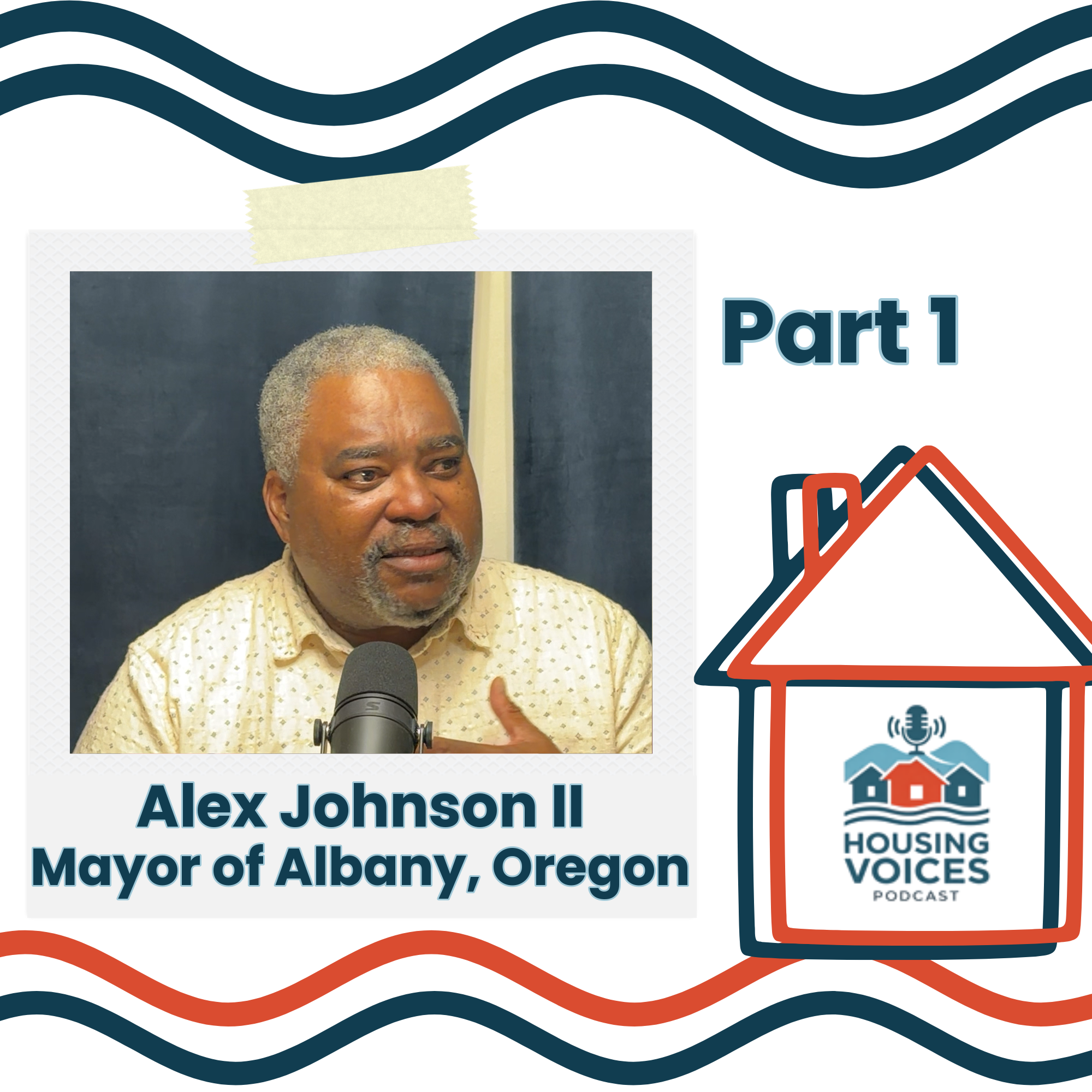
[00:00:08] Speaker B: And today we have another great guest, Mayor Alex Johnson ii. He is mayor of Albany. And if folks have listened to our previous episodes, we had Alexandra Ring from League of Oregon Cities talking about housing and cities doing amazing work on housing. And she brought up Albany.
[00:00:29] Speaker A: Albany has been doing great work.
Alex has a history, or Mayor Johnson has a history of serving in the military, of doing project management, of truly caring for the community, both as a volunteer and as a referee. And so his commitment is really broad and expansive. And what they've done in Albany, the continuum of care and of building has been really profound.
[00:00:57] Speaker B: And I'm also interested to hear from him about the actual implementation of a lot of this, the housing work.
We've talked to a lot of people throughout the entire continuum, but in a lot of ways, our housing is created on the ground, on a city level. And how does that pan out and
[00:01:18] Speaker A: how does that relate to our last guess?
[00:01:20] Speaker B: Exactly right.
[00:01:23] Speaker A: Thank you for joining us.
[00:01:26] Speaker C: From the porches and shelters, streets and the room.
[00:01:33] Speaker B: If the house had voices, the truth could break through.
Welcome to Housing Voices. This is Bri.
[00:01:44] Speaker A: And I am Marty. And today we have the honor and privilege of having our friend and Albany mayor here with us today.
[00:01:51] Speaker D: Today.
[00:01:51] Speaker A: Mr. Alex Johnson, thank you for being here on the podcast with us.
[00:01:55] Speaker C: I'm happy to be here, and I was really honored to be invited. I've seen some of your other podcasts. I'm like, that's really interesting. Why haven't they called me yet?
[00:02:05] Speaker B: We're waiting.
[00:02:06] Speaker A: We're holding on. We had.
Who was our last.
[00:02:09] Speaker B: Alexandra Ring from the League of Oregon Cities. We had an amazing conversation with her about housing, obviously, and she picked Albany as kind of one of her highlighted cities that's doing really good work, work on housing. And so we. That's. As soon as we picked up the phone and said, okay, well, let's talk about kind of the nitty gritty of what you're doing there.
[00:02:30] Speaker C: And I know Alexandra, she actually, I testified before them on rulemaking, that there's some changes that the governor, though the staff wants to make before allowing us to finish the other stuff they implemented that last long session. So it's like they keep stacking changes on us. So I'm pushing back. The city building is pushing back. Wait, stop making changes till we figure out the changes you made before.
You know. So Alexander Re asked me to testify. I've testified. Then we'll be testifying again. So I guess they heard me. I was very clear on that. We need to.
There's no one size fits all, because the same thing that works for us does not work for Reid support.
[00:03:05] Speaker A: Right.
[00:03:06] Speaker C: So we have to make sure that they understand that different size cities have different size needs.
[00:03:09] Speaker A: Yeah. And I do think that the League of Oregon Cities is really open to feedback and listening, or at least that was what I understood from them.
[00:03:16] Speaker C: They really are.
[00:03:16] Speaker B: Yeah.
[00:03:17] Speaker A: Could we take one step back and just talk about your background, who you are, what you do, how you chose to run for mayor, what led to all of that?
[00:03:28] Speaker C: So actually.
[00:03:29] Speaker A: And be sure to talk into the mic.
[00:03:31] Speaker C: Okay. So actually, I was a member of a group called Act Album Community Together.
It was a organization that was created to pick candidates and groom them to run for office in Albany because a lot of folks weren't stepping into the. Into the foray.
And a good friend of mine, Liz Irish, she.
[00:03:49] Speaker B: We know her.
[00:03:50] Speaker C: Yeah. She kind of. She basically called me into her office. I mentioned I was thinking about running for city council, and she called me into her office and said, alex, you need to shit or get off the butt.
Basically, what it boils down to.
And so I decided, okay, I'm gonna do this. And so talked to my boss, Norma, my wife, 41 years, and she said, I know how you are. You know, you do everything. You go in on both feet. He says, I'll do the little stuff. I'll do the big stuff, but not the little stuff. Little stuff meaning home shows. Cause I tried to go to everything.
And I ran for office and see Jeffrey Evans beat him 70.25% by 75%.
And then when I walked home from the bowling alley campaign night, I walked home from the bowling alley because I knew there was gonna be alcohol involved. So I didn't want to get a DUI my first night.
[00:04:38] Speaker B: Yeah, that's not a good look.
[00:04:39] Speaker C: So I turned on them. I cul de sac. All my neighbors were in my front yard, my.
On my driveway.
[00:04:45] Speaker B: That's awesome.
[00:04:46] Speaker C: I'm like. So I got this feeling of, what did I just do?
[00:04:48] Speaker A: Give me chills.
[00:04:49] Speaker C: What did I just do?
[00:04:50] Speaker B: There you go.
[00:04:51] Speaker C: And so. And so it began, and people reached out to me.
You're Liz Irish, Your friend, your mother. My friend.
Our friend.
She just said, okay, let's figure this out. And so we started planning. So one of the things is on my list, the very first thing was fixing our meetings.
We had to fix our meetings. They started 7:15. Last bus runs at 7:30. So we're automatically alienating people that had no transportation.
And the second thing was there was no time limit.
My predecessor let people speak as long as they wanted to. Well, you got seniors waiting to get a word of the city council. And these other folks would come, in one example, eight people read an eight page letter.
[00:05:37] Speaker B: Well, I got, I'm sitting there thinking about, I got work in the morning, right.
[00:05:41] Speaker C: So fixing to me is really important to me. So the first thing on my list of 15 was fixing the meetings. So I.
[00:05:45] Speaker A: So let's take a step back because we know this because we talked a little bit before the podcast. But you started off as city councilor, right? And as soon as you went on a city councilor, you were like, I'm gonna go for mayor.
[00:05:57] Speaker C: Yes. I decided that I'm gonna make a list of things I would fix if I were mayor.
And it was 85 things total.
And I started synthesizing those down to bite sized chunks, which ended up being 15 things.
[00:06:08] Speaker A: And so who were the people who really helped you with that synthesizing? Right. Because sometimes you're, you're a big, like, I want to do it all.
[00:06:16] Speaker B: You have vision, right?
[00:06:18] Speaker A: Yes.
[00:06:18] Speaker C: So. So Liz Irish, like I mentioned before, Liz Irish, my BNI group, I met with people about my BNI group, which I don't know if you know what that is. Business Network International.
And these are people that are professionals. They're business owners, they work in housing, they work in law, they work in flowers.
So all these industry folks, plus housing folks, developers, engineers that I talked with about before my campaign and I just put it all together, right? And so the third thing on that list was housing Housing Affordability Task Force. And the Housing Affordability Task force, we brought 47 people together from all different walks of life, industries.
And we, we put together this task. We went out to the community and found out what are the things that we can do to build housing and affordable housing and housing just period in Albany. And that list came back and we've started implementing it. One was tearing the SDCs. Our SDCs were like flat rate, you know, 1,000 square foot house, like 25 grand to connect to the city.
Well, nobody's going to build small homes.
[00:07:17] Speaker B: And SDC is service system, Development charges.
[00:07:20] Speaker C: Yeah. So a good friend of mine, Liz, her being in the industry of mortgages and residential housing, she basically educated me on the process of connecting to the city and those kinds of things, plus my development director.
And so what I did was I proposed to the people that were interested in me running for mayor this is what I plan to do.
And they said if you do that, we're all gonna build.
Well, and they're all building now.
[00:07:44] Speaker B: I think it's really incredible as well because this area, Albany, Corvallis area has really grown and there hasn't a lot of housing development in the Corvallis Benton county area, you know, writ large, let's say.
And so there have been a lot of people, especially the Oregon State students have gone over to the Albany area and I welcome them because it's there you're building housing and it's a bit more affordable than Corvallis. I was, I was looking the other day, one bedroom starts at 1800 in the area that I live in, in Corvallis, which is, that's a lot.
[00:08:24] Speaker C: So what things that I found is that cities will build affordable and high end nothing in the middle. And so middle housing is really important to me. Like Hayden Homes, they had a development design called Meadowlark and once we passed the SCCs that are tiered, they redid everything they're building 650 square foot, two bedroom, two car garage homes. A young couple called me and said, Mr. Mayor, we'd like you to come out and meet us at our property.
27 year old, 28 year old, they bought their first home, 1158 square foot, three bedroom, two bath, two car garage for $320,000.
[00:09:02] Speaker B: Yeah, 320 is unheard of.
[00:09:04] Speaker C: They're building equity, right? They're building equity that hasn't happened in years here. And so, and then with the, with the affordable piece Farm Workers Housing Development Corporation, Maria Aguera came to me at my office and said, we would like to build this.
I said, okay, so get started.
[00:09:21] Speaker A: Okay.
[00:09:22] Speaker C: So they had to do some fundraising, but their first 54 units are going to be done. They've paved it last week and they're going to build four more. 50 sets of 54.
[00:09:31] Speaker A: Where are they building them?
[00:09:32] Speaker C: So you know where Walmart is? I'll go Fish Farm Road at the end of that. And these places are beautiful. I mean ad accessible.
I mean I walked through there with the governor's wife and she was like, how are you doing this? That's next. I laid it out for it. When you get your paperwork done, if your prints are right, everything is right. You get your permits in two weeks In Albany.
[00:09:52] Speaker B: That's something that has been highlighted as a barrier to creating housing as well.
[00:09:58] Speaker C: When I got elected to mayor, it was 18 weeks.
So Matthew Rutgers and the community development team have really modified and cleaned up how they do business. And it makes it easier for me to go out to people and say, I'd like you to build my community.
Well, it takes forever. No, no, no, not anymore. Come, come talk to my people. And so when somebody comes to me want to build housing, I take them what I call the marriage tour. I drive them all around town, take about half a day. I take them to the shelters. I take them to the Simpson Timber area where the homeless camp was, was, and still is some parts of it. I take them out to the housing units, affordable, middle and high income. And we talk about Albany and what I'd like to see them do.
And then I take them. I turn them over to Sophie Adams, our economic development manager. Matthew Rutgers county tax assessor, my city manager. And I walk away.
And they make it happen.
[00:10:50] Speaker A: So what made housing be so vital to you and really be something that you put so much focus on because you went from shortening up the meetings and making them accessible to housing boom.
Usually that means that there's some emotional tie or some story behind.
[00:11:11] Speaker C: I'm glad you said that. So I refereed football for 25 years.
[00:11:14] Speaker A: I know you. You taught my kids how to rap.
[00:11:17] Speaker C: I owned part softball for 15. And a lot of times I would see these people later on, like Nikki, for example. I won't tell you her last name, but Nikki walked up to me in Safeway saying, my husband and I are going to move because we can't find a place here. And I was. When I met Nikki, she was three.
[00:11:33] Speaker A: Wow.
[00:11:33] Speaker C: So now she's a grown woman with children. She says, I can't afford to live here.
Right. And so housing became an issue for me because all those young ladies and young men that I umpired and refereed their games over the years, they didn't live here. They couldn't find a place to live. I'm like, no, we have to retain them. So this is an epiphany for me first. April 18th was our very first Saturday market, Burma's Market.
And I went there and I was so happy to be there. And I'm looking around, I counted 18 strollers.
[00:12:01] Speaker B: That's nice.
[00:12:02] Speaker C: Think about that for a moment.
18. So housing is big because we don't have children. Albany has no future.
[00:12:08] Speaker A: Yeah.
[00:12:09] Speaker B: Well, especially in an economy where so much is predicated on generational wealth and building wealth and your home being, for many people, the biggest purchase that they ever make in their life.
That is something that really kneecaps growth of a city.
There are several places across our state that are closing Schools because there's not enough children.
[00:12:31] Speaker C: And I'm on the Long Range Facility Advisory Commission for the school system, and they're talking about building two elementary schools.
Think about that. I mean, this is astonishing to me, that babies are the future. So when I look at the baby strollers, yesterday or Saturday, yesterday at the farmer's Market, my wife and I counted 22 strollers.
[00:12:50] Speaker A: So your stroller count's now going up.
[00:12:52] Speaker C: It's going up.
[00:12:53] Speaker A: Okay. So now we know that Mayor Johnson is not really counting the people. He's counting the strollers.
[00:13:00] Speaker B: He's watching the strollers.
[00:13:01] Speaker C: The strollers.
[00:13:02] Speaker A: Tell me it is a little creepy.
Think about it, though.
[00:13:06] Speaker C: So. So. So this is it. This is the. So I. When I became mayor, I looked at 25 years. What is Omni going to be like, 25 years? That's why I leaned into the if I Were Mayor contest.
And the Oregon Mayor's association has this contest called if I Were Mayor. And fourth and fifth years have to draw a poster of what they want for their city, and they're gonna have to tell me why they want it and how they're gonna pay for it.
Right. And so it brings the parents into it.
Now the parents are going, I didn't know that. So the really cool thing about that is teachers invite me to their classroom to talk to these children about this program. So I have, like, three classes of third graders and fourth graders and fifth graders, and I go over the city's website, the strategic plan. I show them how to find information, and they go home and tell their parents. I learned this from the mayor today.
[00:13:50] Speaker A: How much fun is that?
[00:13:51] Speaker C: It's wonderful.
[00:13:52] Speaker A: I'm like, that must be, like, the highlight of your year.
[00:13:55] Speaker C: It's first three months of the year. I'm like, cloud nine.
[00:14:00] Speaker A: That's so fun.
[00:14:01] Speaker C: So. So. And then for me, finish this one. So the marriage contest. Middle schools have to write an essay. They're closer to being high school graduates than elementary kids are. These kids, I have them to focus on. You're the mayor the day you graduate from high school. What things would you like to see happen for your city if you're the mayor?
[00:14:18] Speaker A: Nice, right?
[00:14:19] Speaker C: And then high schoolers have to do a video presentation, use their voice, their image and PowerPoint, or, you know, a video of the city, them walking around or whatever. We run state. We've won state five years in a row at one of those levels.
[00:14:31] Speaker B: That's awesome, right?
[00:14:33] Speaker C: So other mayors are going, how are you getting that many kids to participate? Because I go to the schools and the teachers give me two class periods, right. The first one, I go show them the technical stuff, they write down their questions. Second one, I come back and they answer the questions.
[00:14:46] Speaker A: Nice, right? What are some of the biggest things that you've learned or you've changed based on what you've heard from those kids as they progress through number one for
[00:14:56] Speaker C: elementary kids, we don't have a splash pad. We have to go to Carvas for splash pad.
[00:15:01] Speaker B: Yeah, they're asking the important questions.
[00:15:03] Speaker A: Yeah.
[00:15:03] Speaker C: Our plans change. We have a splash pad now.
[00:15:06] Speaker A: But that is important to a child.
[00:15:07] Speaker D: Yes.
[00:15:08] Speaker A: Right. I mean, that's fun, that's community.
[00:15:10] Speaker C: Right.
[00:15:10] Speaker A: It's relationship.
[00:15:11] Speaker B: Kids deserve a community that they enjoy too.
[00:15:14] Speaker C: Right?
[00:15:14] Speaker A: Yeah, I love that.
[00:15:15] Speaker C: And the third, third thing on that list was the Waterfront 2001. The city council at that time promised the city, if you do the urban renewal district, we will have this capstone project will be the waterfront redevelopment.
I got elected mayor in 2021. 2020, excuse me. And it hadn't been done. So that was on my list as well. I'm sure you've seen it since then, right now.
[00:15:38] Speaker A: It's beautiful. Yes. So the difference in downtown Albany from when I moved here to now is astronomical, I think.
[00:15:47] Speaker B: I think it highlights also, also a larger theme when it comes to housing and livability, that it's not just about building housing. It is obviously very important.
[00:15:58] Speaker C: The amenities are important.
[00:16:00] Speaker B: But the communities that people want to live in and grow in as well matter just as much as the houses that we build.
[00:16:06] Speaker C: And people told me that is never going to happen.
Seriously.
And I said, well, I can respectfully disagree. I said, exactly. It's on my list. I get my list done. And so when it started, we had to cut down 80 some odd trees. And people were really upset on social media. I was getting lambasted on social media. But you know, I have clients that I love them dearly. They went out 87 year old, 80 year old. 70 year old, 60 year old went out and stood on the stumps that were rotted out. Course, took pictures and sent them off, put them on Facebook.
It all calmed down.
[00:16:39] Speaker A: So that's what you learned? The splash pad is what we got out of the young kids. What did you get out of the middle schoolers?
[00:16:46] Speaker C: The middle schoolers I got. Well, middle schools are really into environment now.
So we compost 25% of our biosolids. And so when I go and define a biosolid, your waste, your solid waste from your body and good thing about that is I get their attention. I say, every time you flush the toilet after you poop, go Cha ching. Right. Because it creates Hub City soil compost. And the kids laugh. But they start digging into it.
The kids look into what it means. So they go to the website and look at all the composting stuff. Dad, mom, check this out. They show their parents that we're composting 24% of our stuff, our bio poop. And it brings attention to that. So going to 100% in the next two years is really big because now we're going to start selling that soil to other school systems, other counties, other cities, you know, and so they've. Counties and cities have reached out to us, to me, about our process.
And we also have called shrubhub. We're growing our own plants.
[00:17:40] Speaker B: Nice.
[00:17:41] Speaker A: So with the waste,
[00:17:47] Speaker C: I forgot processing.
[00:17:48] Speaker A: Thank you.
What is it being used for?
[00:17:51] Speaker C: Gardens.
Gardens, flower beds. It's being used for our bioswales, for cleaning up water before it goes back into the system where it's being used for golf courses, it's being used for planter boxes. It's being used all over town.
[00:18:06] Speaker A: Is that also something that will elongate the use of the sewer system?
[00:18:11] Speaker C: Yes. And also generate revenue for the city.
[00:18:14] Speaker D: Nice.
[00:18:14] Speaker A: And how does it do both it us both?
[00:18:17] Speaker C: Because you buy it from us by the yard and then that money goes back into the system. So it prevents rate. Rate increases for those kinds of things. And so for us. And it sends 87, $798,000 per year of savings of taking stuff to the dump.
[00:18:32] Speaker B: That's awesome.
[00:18:33] Speaker C: Less wear and tear on our roads. Right. There's a whole lot of things in the works right now that I can't disclose. That's going to even reduce that even further.
[00:18:41] Speaker A: That's really wonderful.
[00:18:42] Speaker C: Yeah.
[00:18:42] Speaker A: And. And that was something that came from the kids.
[00:18:45] Speaker B: That's amazing. You mentioned Hub City and I want to talk a little bit about the different types of housing that you have worked on in Albany and supported in Albany. Because something that we talk about on this podcast a lot is that and the guests that we've had have brought up that there are so many different kinds of housing that are needed. It's not just single family homes. There is an entire continuum that we
[00:19:09] Speaker C: need to invest from smaller low income housing, like tiny home villages. We have Hub city village. And I was involved in that from the beginning with lobbying for money. For that Senator Wyden gave Merkley. Excuse me, Senator Wyden and Merkley gave us $600,000 for Not Me, but the organization. But I wrote letters, I lobbied for them. And the grand opening, Senator Merkley was there and it was amazing to have those 27 tiny homes be built. And people cried when they got their keys. I mean, it was. It was emotional for me as the mayor, but there were people that did not want it, did not want that. They thought it was going to be just a homeless camp. We had the fundraiser. One of the ladies that was most against it gave him a check for $50,000.
[00:19:53] Speaker B: Wow.
[00:19:54] Speaker C: Yeah, that's powerful. And I went to the community, like the. There's a sister living community there. And I went and talked to them directly because they were, they were concerned. And I shared with them, this is what it's going to look like. I showed them some examples and they calmed down. It was like, oh, okay, it's not going to be a homeless camp. It's going to be bringing people from shelters or being homeless into a safe, lockable place.
And that.
About a month after we broke ground, I was. No, about a year after we broke ground, I was. They broke ground, I was at the home show. And my second day, typically I'm the mayor the first day, husband. The second day, third day, I'm saying goodbye, I'm the mayor again. When the second day, people don't approach us because normally my wife and I are together with a bag and I'm carrying and she's doing her shopping.
This lady approached me and she said, mayor, I think we need. I'm going to talk to you for a second. And so mommy said, go ahead. She went and kept going. The lady says, I think we need a tiny home village here. I said, you don't know because what do you mean there's one being built right now. And she started crying because her son was on the street and he finally got into a shelter in Ben or Johnny Hillman. Ben. And I asked my Norm, can I take her over to.
So she got in the car with me, just met the lady, we drove over there and like the first two or three were up, she was bawling. Her friend group got together and they make quotes for all 27 units.
[00:21:09] Speaker A: Wow.
[00:21:10] Speaker C: Right?
[00:21:11] Speaker B: You know, that's the stuff that matters.
[00:21:13] Speaker C: That's the stuff that matters. And the community cares. I mean, we do care about. Even though they may be lower income or homeless, they're family.
And if we can help them in any way by putting them in a smaller place to live, to transition them back to more permanent housing, stable housing with what's on site, peer Support that enriches the whole community.
[00:21:34] Speaker A: I'd like for you to talk for a moment about the online peer support and are there case management that goes along with that?
[00:21:40] Speaker C: There's a person that lives there that has one of the tiny homes that trans. She was actually on the streets in North Carolina. No, she on the streets here in Albany and she went to North Carolina, went through some training, got clean and she came back to be the on site peer support person. So that person is the person I reach out to when I want to come to a community conversation.
And it's working. They have their own board, they're responsible for cleaning it, they have their own garden where they grow their own vegetables. And so it's a whole tight knit community. And people, they start, they get a job. If their income goes up, they may have to find another place, but they set aside part of their rent so they can have a deposit and first and last for their next place.
[00:22:19] Speaker B: Well, creating those steps for people is I think extremely important in our housing continuum. Because if you are trying to get a starter home or your first rental that's expensive, you've gotta get a first, last deposit. If you've got an animal, utilities, it's a big thing. It piles up, right. And so as costs continue to rise just across the board, when it comes to pretty much everything, everything, it's very.
That debt gets stacked higher and higher who do want to get back into the housing ecosystem. And then if we have this backlog of folks and we don't have enough middle income housing, and I think that's what you're building a lot of.
[00:23:04] Speaker C: My goal is every economic level strata across that whole range will have an opportunity to buy a home or rent a home in the city of Albany. You know, when I, Dave Montagna, built 275 apartments off Knox Butte on the, on the roundabout and I met people there that were from Baltimore and Dallas and Los Angeles. And I said it doesn't bother you have a 30 minute commute to Corvallis. 30 minutes, that's nothing.
[00:23:30] Speaker A: Nothing. Yeah.
[00:23:31] Speaker C: So a lot of those apartments are filled with graduate students, doctors that have come from other places where a 30 minute commute is like a walk in the park. And so those are full the banks. One of the first developments that was approved for Albany, I had an interesting start. Anyway, they were denied four times by the planning commission.
Wow, four times.
Right. So when I took office, when I got back from Arizona, my mother and I had Covid. She was on ventilator 97 years old. So we went down there and my wife could spend time with mom and her sister.
And so they came and scheduled an appointment with me. They came to my office and they had a whole on PowerPoint presentation about their angst of going through. But when I was down in Arizona before I took office, I listened to all the minutes, I read all the minutes and listened to all the audio and video of every board and commission that I had appointees to.
And so I started making a list of changes I was going to make.
So I didn't want to spend my first two years battling my predecessors appointees. So I replaced them all.
Didn't go over well.
[00:24:34] Speaker A: I'm sure I remember that.
I do remember that.
[00:24:38] Speaker C: But the thing about it is when the Morleys came back to me, I said, when is their next time coming to the planning commission?
And they said February 4th. I said, it'll be approved because the other group, the other folks that were doing it literally the fourth time, oh, we've heard this before.
Wow, it was terrible. They got treated horribly.
Now you follow the rules, keep your personal stuff out of it or you'll be replaced.
[00:25:06] Speaker A: What was the prior planning commission's reasoning on. On not approving?
[00:25:12] Speaker C: They don't want growth.
[00:25:15] Speaker B: Interesting to be on a planning commission, planning for the future. And you don't want to the anti growth.
[00:25:22] Speaker C: And. And it was funny because Mayor Kyle Palmer from, from he's a mayor of Silverton at the time we had to form a Western Oregon. Western Oregon Realtors Association. Yes. War.
We were on the dais and I open, I say thank you for coming. Whatever, whatever. Do my speech, short five minute talk. And then I turn it over to my counterparts from other cities. I let them speak last.
And he got up and he basically said during his time, he was saying that these boards and commissions, they seem like it's a lifetime appointment. And everybody lives in Albany started laughing.
[00:25:55] Speaker B: Yeah.
[00:25:56] Speaker C: And he goes, what's everybody laughing about? Because Mayor Johnson will tell you. So I told him that's what I just told you. I said I did not want to spend my first term or any term fighting my predecessors, people, her agenda, you know. And so I replaced him.
Of the 36 spots that I removed over 400 applications, interviewed 100 people. Over 100 people. I picked the best 36 of that set. Only lost 2 cents then because they either retired or moved out of the city.
But mayors, mayors, a lot of mayors, I found they want the title but not the work that goes with it or they're afraid of the work that goes with it because they don't get backlash. I get murdered on social media all the time, but things get through. We just changed the ordinance for SDCs. You can now start paying your SDCs at occupancy.
[00:26:48] Speaker A: Okay, interesting.
[00:26:49] Speaker C: So they have the capital to build instead of having to take out a huge loan to build. Well, they have their capital and they can start paying when people start occupying those places.
So it gives them a better window. They can finance, they can plan better to build their developments. And people love that. People love the fact they're permits in two weeks. People love the fact that we replaced the building official just left us. And so that's been a positive note for builders and developers. And Albany is an attractive place to build your business, build your home, build your apartment complex. So probably there's another six or seven they're going to come to Albany. That's been brought to my attention by the developer themselves about before they go down to city Hall.
But we're talking about three or 400 apartments.
[00:27:35] Speaker B: That's awesome.
[00:27:36] Speaker C: And so even, even apartments are based on the square footage. So your SECs are tied to the square footage and we're revenue neutral. We don't make any money, we don't lose any money.
[00:27:45] Speaker A: So I had a question and it's going to come back to me really quick.
[00:27:53] Speaker B: Some of these ideas. Can you talk a little bit about how you came to them when it comes to the deferred SDCs? Was that from conversations with developers with housing people?
[00:28:04] Speaker C: It was actually the housing affordability test. There were several things that were on there. It was with my campaign team, Liz Iris being one of them that shared their ideas. They shared and we kind of prioritize the list and we're going down that list. I'm a list person. So we got the SECs deferred. We have the CET tax, the construction excise tax, but we've made it really small because it's going to take forever to build it up. We didn't want to drain people on the front end. We just want to steady build it up. So you'll pay for helping to pay for SDCs for low income affordable housing. And then we did the occupancy. Deferring the SDCs to occupancy. That was a huge shift. And I got a lot of emails and text messages. Great job, great job, great job. So the League of Oregon Cities asked me to come and speak about housing. So. And the good thing about the Housing Affordability Task Force is that the governor paid for it. The Housing implementation plan. Yeah, she actually came to Albany. We had a big meeting and Matthew Rutgers and the developers are on this side. Her staff was on this side. And the governor, I sat side by side and we talked about this, the work that we went through to get to that point.
And I thanked her for paying, for paying for it. And she goes, what do you mean? I said, well, the grant you approved was for us to pay for our implementation plan. And so Governor Kotak and I, we talked about housing, we talked about affordability, we talked about a lot of things. But she was really impressed with what's going on in Albany. And a lot of mayors, a lot of governors are impressed with Alba. When I went back to Nashville, legal cities, I lobbied for infrastructure funds for small cities because we were getting hours from our congressional delegation, but a lot of small cities weren't getting any recognition from them. And so they started getting money. So when I go to national D.C. i talk about not just Albany, but I talk about other cities as well.
[00:29:49] Speaker A: So I remembered my question.
[00:29:51] Speaker C: Okay.
[00:29:52] Speaker A: All right. So how are you balancing the utilities? Right. So we've heard from a lot of our guests about the problems with water, sewer, power, and building out that infrastructure in order to build. Right. Because what you're doing is you're doing a continuum of care, a continuum of build.
But how are you balancing that out with the utility issues that we're having?
[00:30:15] Speaker C: So our utility rates are based on usage.
We have a low income program we believe pay 50% versus and we always put monies. Each rate payer puts money towards that like 25, 30 cents towards that low income subsidy.
We have a city services fee, which I proposed when I was a city councilor. Yeah, when I was a city councilor. And I ended up breaking the tie when I was the mayor.
But it was based on your waterline size. So it'd be 750 for a 3 quarter inch water line, $9 for a 1 inch water line. And it graduated up for the organizations because what happens, non profits don't pay anything. They don't pay any property taxes. You know, they pay their monthly bill, but they don't contribute to the fire truck showing up.
[00:30:59] Speaker A: Yeah, right.
[00:31:00] Speaker C: So what we did was they, they also pay the city services fee as well. So that brings them. So that's one of the reasons we don't have a budget shortfall. We're able to capture those funds. Right. And so it doesn't fall to just the ratepayers, the. Excuse me, the individuals, the businesses pay, the nonprofits pay their city services fee and it may be fifteen hundred dollars a month. LBCC has a nine inch water line. They probably, I'm sure they pay way more than I pay my $14 a month.
[00:31:27] Speaker B: Some of the conversation that we had, especially with Representative Gomberg from his position on the state legislature have talked about in this next, next session, the long session that we're going into January.
[00:31:38] Speaker C: Right?
[00:31:39] Speaker D: Yes.
[00:31:40] Speaker B: To have a package or some type of legislation to further support housing through infrastructure and, and helping cities build these infrastructures. You know, water, sewer, all of those important things. Because a lot of, a lot of cities, from our conversations and from Alexandra as well when we talked, when she was talking about League of Oregon cities, that a lot of these communities don't even have the capacity in their infrastructure, the wastewater drinking water to build any more housing. Has that come up in your conversations with other mayors? And how does, where does Albany sit in their capacity for the infrastructure?
[00:32:19] Speaker C: Obviously I think we're in pretty good shape.
[00:32:21] Speaker B: Okay, great.
[00:32:22] Speaker C: I think the planning, the city director Matthew Rutgers and his team have done a really good job of ensuring that we have the infrastructure that we need to have for the growth that we have planned or at least looking forward to.
I haven't heard any complaints as far as our folks. Now other cities have issues because some folks just don't have the staff.
They don't have the staff to do the research that our team does. We have a pretty good sized staff. And so our water department, our public works department, our community development department, they work really well together. And we do have a new public works director, Paul Trombino iii.
He has, he's coming to with a bunch of brand new ideas on transportation on the airport because you all know how I feel about the airport. That's a whole nother thing.
[00:33:06] Speaker A: We're not going to talk about that today, Alex.
[00:33:09] Speaker C: I can go all day about that one. But the thing is that we encourage our staff to bring their ideas forward. If it makes sense for us to do them, we execute them.
So I don't have any issues currently with. I have nothing from staff that says that we have a problem with raising for infrastructure. Now we do lobby because like the Cox Creek Interceptor, there's a couple phases we have to take the waterline underneath i5, you know, and under the airport and under Timberland Park. So there's a lot of work going in there. I think we have two more phases of that, but last year I think we had $3.6 million to kind of extend that. And I'm going to Be writing letters and lobbying to get another 5 million or whatever to continue that. Because once all those houses going on out east, they'll have a robust system, Sewage, water and stormwater, they'll be able to support the growth out there.
[00:33:54] Speaker A: So in supporting growth, right, are you needing to expand the urban growth boundaries?
[00:34:00] Speaker C: No.
[00:34:01] Speaker A: So you've got a lot of room.
And with the land, is any of it inhibited with.
[00:34:09] Speaker C: Wetlands are always gonna be wetlands. I mean, that's the thing. Always be wetlands. But also some of those lands have. Some of that land has hills on it. So, you know, like what's up street out there, Scrabble Hill? There's some of that you just can't build on. Right. Because this has trees and rocks and stuff. It's not buildable. But there's a lot of land. If you look at our map, it's hanging on my wall in my office, there's a red line around every city. As far as what your urban growth boundary is, North Albany's up against theirs, but East Albany and South Albany, we have land. I mean, we have land. We have 400, like the PepsiCo property.
We just amended our agreement with PepsiCo.
They still owe us 5 million from the original settlement. But the problem with that settlement was, I hope not going too far anyway, that we just was public. So we had to be hearing on it. We amended our agreement because before it was anything above 16 million, we got all the proceeds above 16 million. Well, so we changed this to 50% and they signed off on it. So we have a couple buyers interested in that property.
You know, hopefully we'll get us a factory that's going to create some jobs. But if you look at our urban growth boundary, we have land. I mean, we have 30 years of land.
[00:35:17] Speaker A: Okay. Because I was under the impression or understanding just looking at some of the mapping, is that some of that wasn't buildable. That was within.
[00:35:25] Speaker C: Every urban growth boundary has that. But we have enough land that we can build another 30 years.
[00:35:30] Speaker A: That's fantastic. That's really incredible to hear as a Navy veteran.
What kind of housing have you been working on to create for our vets?
[00:35:40] Speaker C: Oh, my gosh. Okay, so this is near and dear to me because I am a Navy veteran. There are some veterans that have fallen on hard times or illnesses or they're disabled that don't have stable housing either couch surfing or in a shelter.
So Lynn Benton, Housing Authority, they built a place called Valor Place. Donna Holt and her team built valor place. 30 units, elevator served. And the grand opening Was what a few months ago. And I was really supportive of that project.
But I'm on the Y Veterans board for housing and we built, we're building, currently building a 38 unit elevator served, all one bedrooms for veterans of Price Road, 1000 Price Road. And I literally cried the other day. I was standing, I threw my hard hat on and I was by myself. Everybody else had left and I'm thinking to myself, we're going to get 38 veterans off the street or other shelters into stable housing. And then Mark Aaron, I think his name is Aaron, he's putting together the care package. So we're changing it to rally point. So the care pack Rally point so people know they can come there. And the great thing about it, it's right in the same parking lot as Serenity lanes.
[00:36:54] Speaker B: Oh, nice.
[00:36:55] Speaker A: Okay, nice.
[00:36:56] Speaker C: So right in front of Serenity lanes is. We're right in front of Serenity Lanes and it's a beautiful building and we've saved so much money, we're actually putting things back, adding amenities to the property. So better furniture or better fixtures. Yeah. And it's, it's going to be done. It's 57 done now. I'd love to show you, show it to you. Because when I take people on development tour, they don't realize that we're building every level of housing.
We got 500,000 and 400,000 and 300,000, 200,000. We have low income, we have middle income apartments because some people don't want to buy a house. Some we want those options available in Albany and we do have them available now. And that young couple called and told me they bought their first home at 27, 28 years old. And they were happy, you know, as they should be. Yeah, she's expecting. So they have, you know, three bedroom place and they like ecstatic, you know. So it made me happy driving away from there thinking, perfect.
[00:37:50] Speaker B: From your, from the mayor's point of view, when you go on these tours, the city tour, to talk about all of the housing and with the potential developers and builders, do you say I want more of that specifically? And do they listen? How does that go?
[00:38:07] Speaker C: They'll change their plans and come back.
[00:38:09] Speaker A: Okay. Really?
[00:38:10] Speaker C: Yeah. That's what Hayden did.
[00:38:12] Speaker A: Good.
[00:38:14] Speaker C: And they actually come with, I mean, the smallest place you can get in Albany, 650, some odd square footage. But if you're a senior, you lost your spouse or you're just two seniors that are on a fixed income. You could buy a two bedroom place.
You pick your furniture, you pick your Your cabinets, you pick your flooring brand new,
[00:38:33] Speaker A: which means less maintenance costs, right? The things that are going to really be harmful and hurtful to seniors long term that they might not be able to do right by having a new place is really solving.
[00:38:46] Speaker C: Don't have to worry about maintenance for 10, 15 years depending on, on if you have, you know, constant upkeep or periodic maintenance and they're in a community with other people with kids and it's multi generational. I mean it's. And then first story, I don't know if you heard about first story. I've given away, given away four homes. And first story, people apply and they go through this interview process and they of course have to show their income. They have to show, you know, their credit and stuff like that. But first you actually pays the down payment and your closing costs and I get to hand them a set of keys.
[00:39:16] Speaker A: It's the best part, giving people keys, man.
[00:39:20] Speaker C: I mean that, you know, because you're a real estate professional, right?
[00:39:22] Speaker A: That is the pinnacle, right? That is like, oh yeah.
[00:39:26] Speaker C: There's a ceremony and I talk and the Hayden talks and first story talks and then we, we get to it and they pop the balloon, I take it and we give them the keys and they walk in, they show us their place and we haven't, I haven't even been in the place yet. They, they show us their place and, and the look on their face and the wife's crying, he's crying, they're hugging and they're, they're ecstatic.
You know, I was lucky. I bought my first house at 19 years old.
My grandfather's contractor. And in San Diego there's always somebody getting divorced. The last two pages back in the 80s was divorce decrees with the address oh gosh.
But, but you know, 10 years ago, a young couple couldn't even think about buying a house in Albany. Now they can.
A senior by themselves could buy a house in Albany. I had two, two clients, a couple sitting in front of me. They had this big house. It was like 2200 square foot. Paid off. They paid off over 40 some odd years, 30 some odd years. And they said, we can't sustain this anymore. Big backyard sheds and stuff. And so I said, you know what? I said, there's some smaller homes being built right now.
Like, no, they're not. So I said, let's, let's get my. So I got in my car, we drove over to there and they were like, oh my God. They took a tour of the model and everything and they bought one. And then. Then they gave. They bought one for their granddaughter as well.
[00:40:46] Speaker B: Oh, that's awesome.
[00:40:47] Speaker C: Right?
[00:40:47] Speaker A: Yeah.
[00:40:48] Speaker B: So Grandma, Grandpa, if you're watching.
[00:40:50] Speaker C: Right. I mean, things like that don't happen in a lot of cities. I like it happening at Albany because it's instant gratification for me and that I'm doing the right thing on behalf of my city.
[00:41:01] Speaker A: But you're also expanding. Right. You're taking those people who are in homes that are too big, putting them right. That they are. It's just too much. Right. They've grown past that point in their life and they want to downsize. So you're opening that up as well.
[00:41:15] Speaker C: Yeah. And opening up that house for somebody is ready to grow into a bigger home.
[00:41:19] Speaker A: Do you have some more time so we can continue this conversation?
[00:41:22] Speaker C: We're all family here. We're having a good time.
[00:41:24] Speaker B: Cool.
[00:41:24] Speaker A: Awesome. So thank you. We're going to come back here and just. And we'll see you at next episode with Mayor Alex Johnson.
[00:41:34] Speaker D: A special thanks to our partners MartyBulford.com and Cyanet.net for supporting thoughtful dialogue around housing in our communities.
Music for Housing Voices is provided by Karen DeWolfe and Adrienne Kriz. Thank you for helping us set the tone.
You can find
[email protected] and connect with us under Housing Voices on Instagram, Facebook, Facebook, LinkedIn, Blue Sky, TikTok and our YouTube channel.
If you found value in today's conversation, share this episode, follow the show and help us expand the dialogue.
Until next time, this is Bri. Let's keep listening, keep learning, and keep building practical housing solutions together.